'Part of Bogota's soul': how Colombia fired up the car-free movement / Photo: © AFP

Fifty years ago, a 28-year-old Colombian with a bushy beard, flares and vintage Raleigh bicycle led a revolution on the streets of Bogota.
Architect Jaime Ortiz Marino got permission to shut down a section of roads and -- with 5,000 other two-wheeler radicals -- pedaled down the middle of the street on December 15, 1974 in protest over car culture.
The world's first Open Streets event quickly grew into a weekly fixture named "Ciclovia" that has spawned dozens of imitations in cities worldwide.
"This is the biggest outdoor civics classroom in the world!" Ortiz Marino, now 78, told AFP, surveying his creation with satisfaction on a recent Sunday.
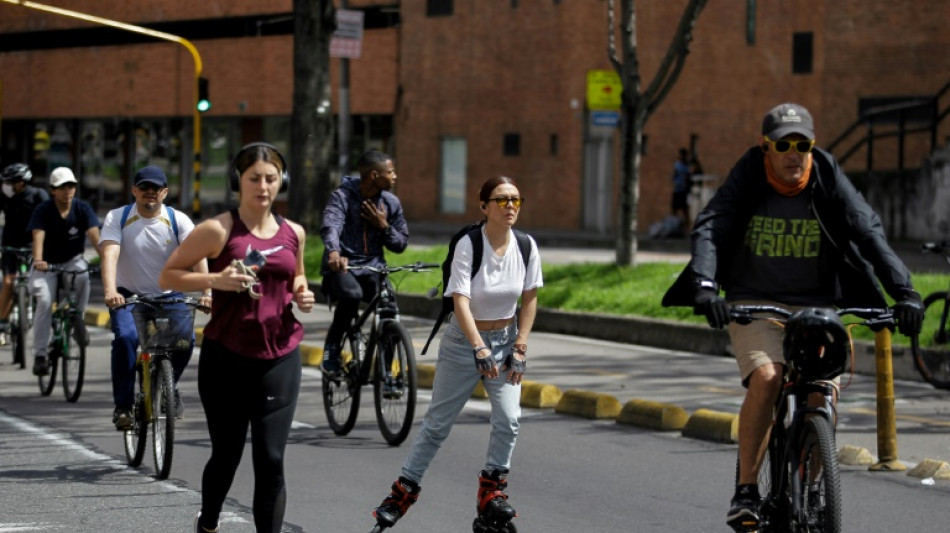
An estimated 1.7 million Bogotanos walk, cycle, jog, rollerblade, scoot, ride unicycles, push buggies through 128 kilometers (79 miles) of car-free streets each Sunday.
The program's global renown is a huge source of pride in Bogota, helping transform a city blighted by guerrilla and paramilitary violence in the 1980s and 1990s into a Latin American capital of cool.
"Ciclovia is part of Bogota's soul," Camilo Ramirez, a migration specialist, told AFP as he and his wife Anny Garcia jogged down the street behind their bike-riding children, aged 5 and 12.
"This is what keeps me alive!" said Jhon Lozano, a spry 89-year-old cycling fanatic, who leaves home at 4:30 am each Sunday to meet up with friends along the route.
- 'Escape valve' -
Ortiz Marino describes Ciclovia as an "escape valve" for residents of Latin America's fourth-biggest city, which has seen its population explode to eight million in the past half-century.
Public transport, which consists almost exclusively of buses -- a long-awaited first metro line is still under construction -- has failed to keep pace with the growth, resulting in some of the worst traffic jams in the world.
Sundays offer a welcome respite from the gridlock and smog, as a tsunami of fitness enthusiasts pour through the city, from the wealthy north to the poorer south.
The mood is festive, with stalls dotted along the route offering juices, arepas (corn cakes) and other snacks.
For Ramirez and Garcia, who grew up cycling and skating on Ciclovia, having the freedom of the city once a week has become a Bogota birthright.
"If we don't go out for some reason, for instance because it's raining, the children miss it," Garcia said.
- Crazy about bikes -
At an elevation of 2,600 meters (8,500 feet), the world's third-highest city might seen an unlikely place to start a biking revolution.
But Colombians' passion for cycling dates back generations, fueled by the exploits of legends such as 1987 Vuelta a Espana winner Luis "Lucho" Herrera and 2019 Tour de France winner Egan Bernal.
In 1974, Ortiz Marino recalled, Bogota was "a city designed for cars, but in which people do not have cars."
The bicycle became a symbol of emancipation, "allowing everyone to move about in ways that are accessible to all," psychologist and urbanist Carlos Efe Pardo said.
The city now has nearly 600 kilometers of dedicated cycle lines.
Ciclovia has also helped create employment for thousands of people, including the bicycle mechanics stationed at regular intervals along the route to pump tires and fix punctures.
"Here I have earned what I need to pay for my daughter's education, my own well-being and my home," 56-year-old bike mechanic Eladio Gustavo Atis Bernal said.
- Costs brake US rollout -
Ciclovia's biggest legacy however has been its ability to transcend Colombia's deep political and social divisions.
Throughout decades of violence, it never came under attack, with the defunct FARC guerrilla group vowing never to target it, according to Ortiz Marino.
The program, which is poised for further expansion into Bogota's poorer southern districts, has become one of the city's biggest exports, spawning spinoffs in Chile, Mexico City and Sao Paulo, among others.
But no major US city or European capital has managed to shut out cars each week.
"It's really about costs," Aaron Paley, co-founder of Los Angeles' monthly CicLAvia told AFP.
He cited eye-popping costs for insurance and special water-filled barriers required to be set up.
Colombian-born sustainable mobility consultant Marcela Guerrero Casas also faced challenges in trying to import Ciclovia into the South African city of Cape Town.
Citing that city's low density -- a legacy of the racist apartheid regime which kept communities apart -- and the absence of a legal framework for closing streets, she said: "Ultimately, each city must develop a model that suits its unique conditions."
J.P.Estrada--TFWP