The Fort Worth Press - Fueling the Los Angeles fires: the Santa Ana winds

USD -
AED 3.672499
AFN 66.073567
ALL 82.870557
AMD 381.4977
ANG 1.790055
AOA 916.999821
ARS 1441.4753
AUD 1.505741
AWG 1.80125
AZN 1.733153
BAM 1.678705
BBD 2.013364
BDT 122.282772
BGN 1.67875
BHD 0.376983
BIF 2953.569114
BMD 1
BND 1.294944
BOB 6.907739
BRL 5.342698
BSD 0.999601
BTN 89.876145
BWP 13.280747
BYN 2.873917
BYR 19600
BZD 2.010437
CAD 1.38815
CDF 2229.999833
CHF 0.803965
CLF 0.023435
CLP 919.350363
CNY 7.07165
CNH 7.06997
COP 3805.96
CRC 488.298936
CUC 1
CUP 26.5
CVE 94.627762
CZK 20.788021
DJF 178.006472
DKK 6.413095
DOP 63.979263
DZD 129.960902
EGP 47.561498
ERN 15
ETB 155.051714
EUR 0.858701
FJD 2.26196
FKP 0.748861
GBP 0.749545
GEL 2.707732
GGP 0.748861
GHS 11.370991
GIP 0.748861
GMD 73.000349
GNF 8684.831581
GTQ 7.657084
GYD 209.137648
HKD 7.785415
HNL 26.328145
HRK 6.4661
HTG 130.859652
HUF 327.985502
IDR 16684.25
ILS 3.22337
IMP 0.748861
INR 89.94655
IQD 1309.540669
IRR 42124.999963
ISK 127.770338
JEP 0.748861
JMD 159.999657
JOD 0.708958
JPY 155.330495
KES 129.303563
KGS 87.450404
KHR 4002.334624
KMF 421.999991
KPW 899.993191
KRW 1472.349808
KWD 0.30692
KYD 0.833083
KZT 505.531856
LAK 21676.809119
LBP 89516.767233
LKR 308.334728
LRD 175.938682
LSL 16.941802
LTL 2.95274
LVL 0.60489
LYD 5.434032
MAD 9.231238
MDL 17.00842
MGA 4458.959547
MKD 52.906919
MMK 2099.939583
MNT 3546.502114
MOP 8.016033
MRU 39.863012
MUR 46.070177
MVR 15.409874
MWK 1733.372244
MXN 18.18685
MYR 4.110984
MZN 63.900796
NAD 16.941802
NGN 1450.629832
NIO 36.787647
NOK 10.098385
NPR 143.802277
NZD 1.730535
OMR 0.384493
PAB 0.999682
PEN 3.360156
PGK 4.24115
PHP 58.974994
PKR 280.247111
PLN 3.633165
PYG 6875.152888
QAR 3.643659
RON 4.373102
RSD 100.813002
RUB 77.272376
RWF 1454.419048
SAR 3.753229
SBD 8.223823
SCR 13.511902
SDG 601.503673
SEK 9.407755
SGD 1.29544
SHP 0.750259
SLE 23.000032
SLL 20969.498139
SOS 570.266164
SRD 38.629019
STD 20697.981008
STN 21.02887
SVC 8.745763
SYP 11058.244165
SZL 16.928669
THB 31.8565
TJS 9.171638
TMT 3.5
TND 2.932369
TOP 2.40776
TRY 42.508699
TTD 6.776446
TWD 31.272004
TZS 2434.999856
UAH 41.959408
UGX 3536.283383
UYU 39.096531
UZS 11958.989413
VES 248.585897
VND 26360
VUV 122.070109
WST 2.790151
XAF 563.019389
XAG 0.017073
XAU 0.000236
XCD 2.70255
XCG 1.801608
XDR 0.70002
XOF 562.932418
XPF 102.347136
YER 238.398782
ZAR 16.93566
ZMK 9001.203093
ZMW 23.111058
ZWL 321.999592
  • RBGPF

    0.0000

    78.35

    0%

  • CMSC

    -0.0090

    23.471

    -0.04%

  • NGG

    -0.4590

    75.451

    -0.61%

  • SCS

    -0.0900

    16.14

    -0.56%

  • GSK

    -0.4500

    48.12

    -0.94%

  • RIO

    -0.1800

    73.55

    -0.24%

  • AZN

    0.1050

    90.135

    +0.12%

  • BTI

    -0.9050

    57.135

    -1.58%

  • BP

    -0.9600

    36.27

    -2.65%

  • RYCEF

    0.0500

    14.7

    +0.34%

  • CMSD

    -0.0580

    23.262

    -0.25%

  • RELX

    -0.2200

    40.32

    -0.55%

  • BCC

    -0.8550

    73.405

    -1.16%

  • BCE

    0.2590

    23.479

    +1.1%

  • JRI

    0.0150

    13.765

    +0.11%

  • VOD

    -0.1890

    12.444

    -1.52%

Fueling the Los Angeles fires: the Santa Ana winds
Fueling the Los Angeles fires: the Santa Ana winds / Photo: © AFP

Fueling the Los Angeles fires: the Santa Ana winds

Helping drive the wildfires in the US city of Los Angeles are the so-called Santa Ana winds, a weather phenomenon known to dry out "the hills and the nerves to flash point."

Text size:

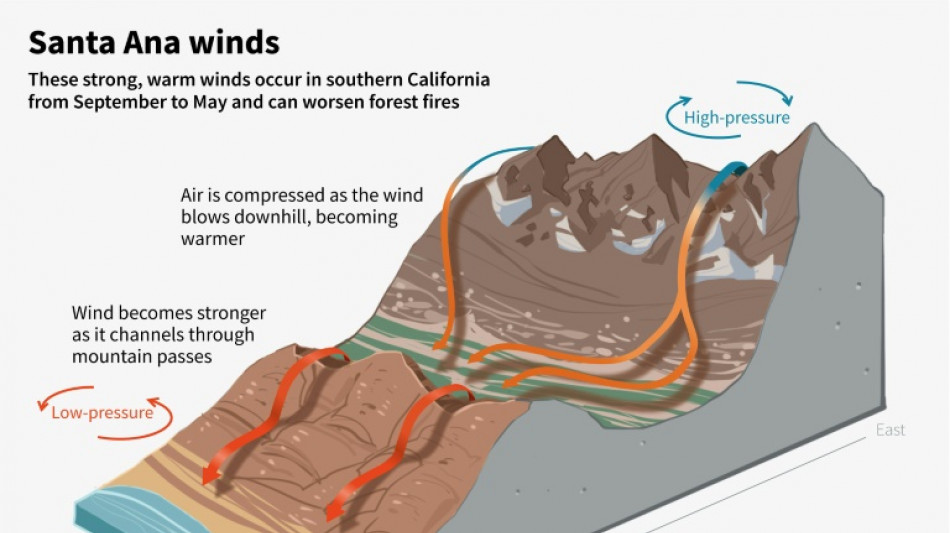
The windstorms occur when cold air gathers in the neighboring states of Nevada and Utah. As it moves west and then rushes down California's mountains, it heats up -- and dries out.

- Creating fuel, spreading fires -

The Santa Anas can both create the conditions for deadly wildfires and fuel them once they are underway -- drying out vegetation when they blow through, and then fanning blazes once they spark.

As the 23,700-acre (9,500-hectare) Palisades Fire and 14,000-acre Eaton Fire have raged around Los Angeles, fast-moving winds have exacerbated the situation, throwing hot embers into new patches of dried brush.

While firefighters sought to take advantage of a brief lull on Friday and Saturday, heavy winds were back with gusts up to 70 miles per hour (110 kilometers per hour) by Sunday, with harsh conditions forecast to continue this week.

- Cold air, hot winds -

Santa Ana winds usually occur between September and May, typically for a few days at a time.

When a high-pressure system forms over the deserts to California's east, it pushes air toward the Pacific coast.

As they move down the Santa Ana and Sierra Nevada mountains and shoot through valleys, the winds compress -- creating a rise in their temperature and a drop in their relative humidity.

With hot, dry gusts that can knock down trees or kick up dust and particulate matter, the winds have long caused problems in southern California.

The 2017 Thomas Fire, which destroyed more than 1,000 structures, was fueled in part by back-to-back Santa Ana winds.

- Frayed nerves -

The Washington Post likened the weather pattern to "a giant hair dryer," and writers have long noted the effect the winds seem to have on residents psychologically.

American author Raymond Chandler once described them as so hot they "curl your hair and make your nerves jump and your skin itch."

For Joan Didion, they blew "sandstorms out along Route 66, drying the hills and nerves to flash point."

A.Maldonado--TFWP