The Fort Worth Press - Near miss: Indonesia probes crash of suspected Chinese rocket fragment

USD -
AED 3.672497
AFN 64.499262
ALL 81.070066
AMD 361.549984
ANG 1.789785
AOA 917.999711
ARS 1524.2543
AUD 1.431496
AWG 1.8
AZN 1.701035
BAM 1.743829
BBD 2.014417
BDT 123.721084
BGN 1.747831
BHD 0.377781
BIF 3002.474199
BMD 1
BND 1.279451
BOB 11.686453
BRL 5.0403
BSD 1.000134
BTN 94.889261
BWP 13.713165
BYN 2.983818
BYR 19600
BZD 2.011502
CAD 1.407405
CDF 2315.000055
CHF 0.825305
CLF 0.024929
CLP 981.129534
CNY 6.67915
CNH 6.67879
COP 3160.57
CRC 454.28202
CUC 1
CUP 24.00428
CVE 98.600451
CZK 21.665901
DJF 178.099352
DKK 6.656515
DOP 61.513085
DZD 134.611017
EGP 53.948904
ERN 15
ETB 160.898607
EUR 0.89054
FJD 2.258101
FKP 0.751528
GBP 0.749245
GEL 2.595043
GGP 0.751528
GHS 11.687293
GIP 0.751528
GMD 73.495892
GNF 8797.502876
GTQ 7.646492
GYD 209.208602
HKD 7.84807
HNL 26.939936
HRK 6.709901
HTG 130.833872
HUF 323.453013
IDR 18005
ILS 3.106575
IMP 0.751528
INR 94.89735
IQD 1516.294414
IRR 1795727.495433
ISK 121.28025
JEP 0.751528
JMD 158.942169
JOD 0.709034
JPY 158.157002
KES 129.860504
KGS 87.450057
KHR 4069.000026
KMF 438.999746
KPW 899.999961
KRW 1327.620108
KWD 0.31071
KYD 0.833489
KZT 452.159957
LAK 22492.498389
LBP 89549.999703
LKR 331.452008
LRD 171.097242
LSL 16.409783
LTL 2.95274
LVL 0.60489
LYD 6.419778
MAD 9.781598
MDL 17.833435
MGA 4549.999778
MKD 54.963867
MMK 2099.540776
MNT 3598.083246
MOP 8.085328
MRU 40.201353
MUR 47.259761
MVR 15.449721
MWK 1742.00016
MXN 18.419165
MYR 4.083502
MZN 63.909703
NAD 16.410287
NGN 1326.497435
NIO 36.845037
NOK 9.39476
NPR 151.823815
NZD 1.760115
OMR 0.384503
PAB 1.000129
PEN 3.448497
PGK 4.50225
PHP 63.1005
PKR 276.825016
PLN 3.892445
PYG 5768.724951
QAR 3.642013
RON 4.744799
RSD 104.559014
RUB 82.752979
RWF 1475
SAR 3.763651
SBD 8.058149
SCR 13.892637
SDG 601.503112
SEK 9.9015
SGD 1.278555
SHP 0.750188
SLE 24.679996
SLL 20969.504398
SOS 571.498196
SRD 37.695129
STD 20697.981008
STN 21.95
SVC 8.751165
SYP 13001.999685
SZL 16.410307
THB 33.604502
TJS 9.211455
TMT 3.5
TND 3.00401
TOP 2.40776
TRY 49.578201
TTD 6.785253
TWD 32.623903
TZS 2645.334979
UAH 45.096251
UGX 4160.276757
UYU 40.158351
UZS 12045.00023
VES 879.788897
VND 25882
VUV 119.358066
WST 2.773115
XAF 584.156242
XAG 0.017477
XAU 0.000242495668
XCD 2.70255
XCG 1.802595
XDR 0.707052
XOF 584.156242
XPF 106.498957
YER 236.149942
ZAR 16.41496
ZMK 9001.197866
ZMW 19.978334
ZWL 321.999592
SSP 5816.545442
MXV 2.079212
  • RIO

    -0.3300

    97.04

    -0.34%

  • CMSC

    -0.0400

    20.67

    -0.19%

  • RELX

    0.0000

    33.41

    0%

  • RBGPF

    0.0000

    67.95

    0%

  • BCE

    -0.0700

    21.99

    -0.32%

  • BCC

    -0.0300

    75.66

    -0.04%

  • GSK

    0.8600

    51.08

    +1.68%

  • JRI

    -0.0300

    11.52

    -0.26%

  • NGG

    -0.1200

    76.68

    -0.16%

  • CMSD

    0.0900

    20.54

    +0.44%

  • BTI

    -0.0800

    55.75

    -0.14%

  • AZN

    2.0200

    168.1

    +1.2%

  • BP

    -1.4200

    43.16

    -3.29%

  • RYCEF

    0.4600

    19.7

    +2.34%

  • VOD

    0.0700

    17.02

    +0.41%

Near miss: Indonesia probes crash of suspected Chinese rocket fragment
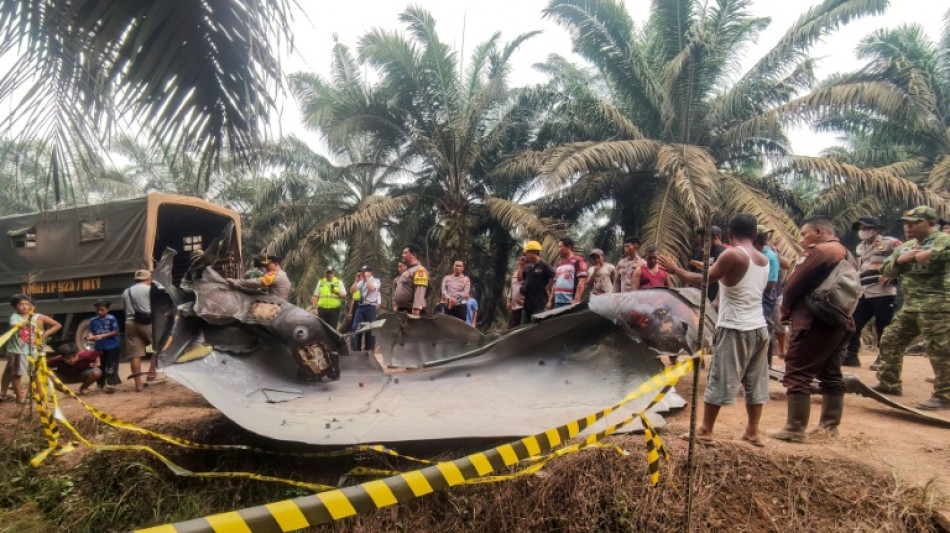
Near miss: Indonesia probes crash of suspected Chinese rocket fragment / Photo: © AFP

Near miss: Indonesia probes crash of suspected Chinese rocket fragment

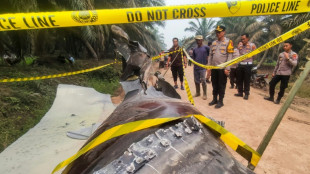
Indonesian authorities were investigating Tuesday after a car-sized piece of debris, possibly from a Chinese rocket according to a government agency, crashed into a palm oil plantation near homes and work sites.

Text size:

The debris was found on Monday morning by a plantation worker in Indonesian Borneo, after residents reported hearing a loud bang the previous evening over a remote area of Central Kalimantan province.

"It was just there. At first, I thought it might have been aircraft debris," Wardi Tamroni told AFP of his discovery near the town of Sampit.

Wardi, 51, said the object had crashed about three kilometres (1.9 miles) from the housing complex of the PT Agro Bukit palm oil company he works for.

"We usually carry out our activities in the area where the object fell," he added.

"Fortunately, all the workers had already gone home, so no one was left in the plantation."

Local police chief I Kadek Dwi Yoga Sidhimantra described the object as "a fairly large aluminium plate measuring up to nine metres (30 feet) with an irregular shape and visible burn marks".

The incident did not cause loss of life or property damage, according to civil aviation spokesman Zachrudien, who like many Indonesians has one name.

The debris also posed no radiation or toxicity risks, he added.

Indonesia's National Research and Innovation Agency (BRIN) said the debris appeared to come from a Chinese Zhuque-2E rocket.

The Chinese government said last week that a Zhuque-2E had launched 10 satellites into space from a commercial launch site in the country's northwest.

The China National Space Administration could not be immediately reached for comment.

BRIN researcher Thomas Djamaluddin said not all parts of a spacecraft necessarily burn up on re-entry into Earth's atmosphere, and more heat-resistant parts may reach the surface.

"This phenomenon is one possible explanation for the discovery of a large metal fragment in a palm oil plantation in Sampit," he said in a statement.

Debris usually crashes into the oceans which cover about 70 percent of Earth's surface.

- 'Leave it to fate' -

On Tuesday morning, a second piece of debris thought to be from the same rocket was found about one kilometre from the first, according to Zachrudien.

"We plan to inspect it. From the photographs, the object appears to be round and related to the first object," he told AFP.

"Its material also appears to be an aluminium alloy, but we will need to verify this."

The pieces were being examined at a nearby military airbase.

According to the European Space Agency (ESA), the casualty risk to individuals on Earth due to uncontrolled re-entry was lower than that for rare accidents such as lightning strikes or shark attacks -- though it is rising.

"Although the re-entry risks are still relatively small, they have grown considerably from 2019 to 2024, mainly due to increased space activities," the ESA Space Debris Office said in a report last year.

"If we had to anticipate something like this happening every day, we wouldn't be able to do our jobs," Wardi, the plantation worker, said of the freak event.

"We have to leave it to fate. What else can we do?"

H.Carroll--TFWP