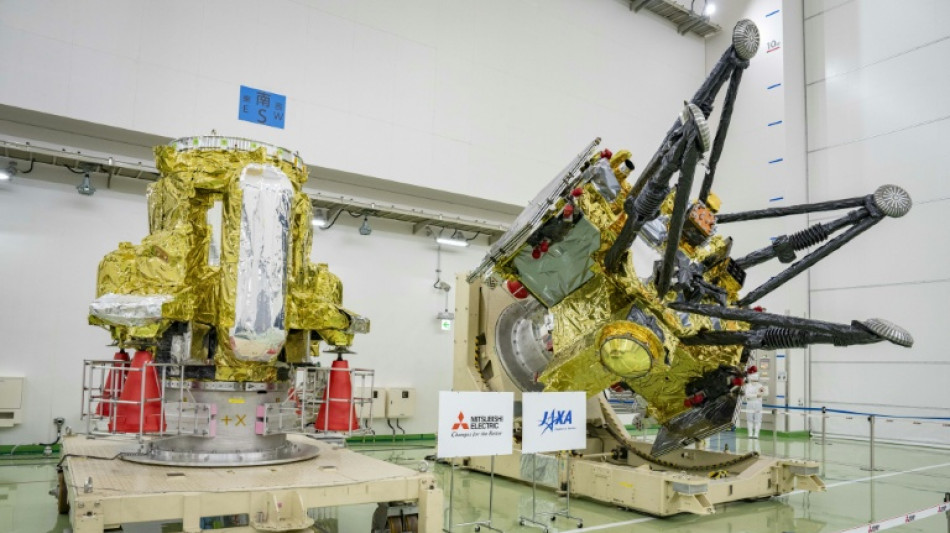
Japan probe on its way to Mars moon / Photo: © AFP/File

A Japanese spacecraft was on its way to one of Mars's moons on Tuesday on a world-first mission to retrieve samples, potentially helping unlock the origins of the Solar System and life on Earth.
The flagship H3 rocket carrying the unmanned Martian Moons eXploration (MMX) probe blasted off into a pitch black sky from the Tanegashima Space Center at 4:41 am (1941 GMT Monday), according to a live stream broadcast by the Japan Aerospace Exploration Agency.
Over an hour later, JAXA announced via the live broadcast that the probe had successfully separated from the H3 and was "beginning its journey toward the Martian system".
"I'd dreamt of this day, so I'm incredibly happy," said JAXA scientist Mari Aida. "Right now I feel really relieved."
Following the separation, JAXA said it received signals from the spacecraft as expected, confirming it was operating normally.
Despite the early hour in Japan, thousands of people tuned into the live stream, posting messages of encouragement.
The spacecraft is due to arrive near Mars around August next year, where it will orbit one of its moons, Phobos.
A French-German rover dubbed IDEFIX -- the French name for the comic hero Asterix's dog -- will be the first vehicle to travel across Phobos, conducting surface observations aimed at ensuring a safe landing.
Once MMX arrives on Phobos, it will collect at least 10 grams (0.35 ounces) of material from the surface during its planned three years in the Red Planet's vicinity.
The mission -- which aims to be the first round trip to the Martian region -- is a collaboration with US and European space agencies, as well as numerous universities and tech companies.
- 'Paradigm-shifting science'-
Scientists hope it will help lay the groundwork for eventual human exploration.
"The samples from MMX will bring forth paradigm-shifting science on the Mars system for generations to come, especially as NASA prepares to send the first humans to Mars," Nicky Fox, administrator of NASA's Science Mission Directorate, said in a message broadcast on the JAXA live stream.
JAXA hopes the mission will reveal how Mars and its two moons formed, a key piece of knowledge in working out how the Solar System was born.
One theory for the origin of the moons -- the "giant impact" hypothesis -- is that they formed after a celestial body collided with Mars.
The "capture" hypothesis, meanwhile, postulates that the moons are asteroids pulled in by Mars's gravity.
Determining which theory is correct will help reveal "how a habitable environment for life might have arisen on the terrestrial planets", JAXA said, referring to the four rocky worlds closest to the Sun -- Mercury, Venus, Earth and Mars.
JAXA said the mission will also explore the possibility of using Phobos as a "natural space station" by establishing the requirements for a round trip -- something "essential for crewed Mars exploration".
It will also observe the planet's other moon, Deimos, although it will not land on it.
US and Chinese space agencies have also been vying to be the first to return rock samples from the surface of Mars back to Earth.
NASA's Perseverance rover, which has been roaming across Mars since 2021, has already collected samples.
The return mission, however, was effectively cancelled by the administration of President Donald Trump following a vote by Congress in January.
China's Tianwen-3 spacecraft is scheduled for launch around 2028 and hopes to return Mars samples to Earth as early as 2031 -- potentially before the Japanese mission's return.
X.Silva--TFWP