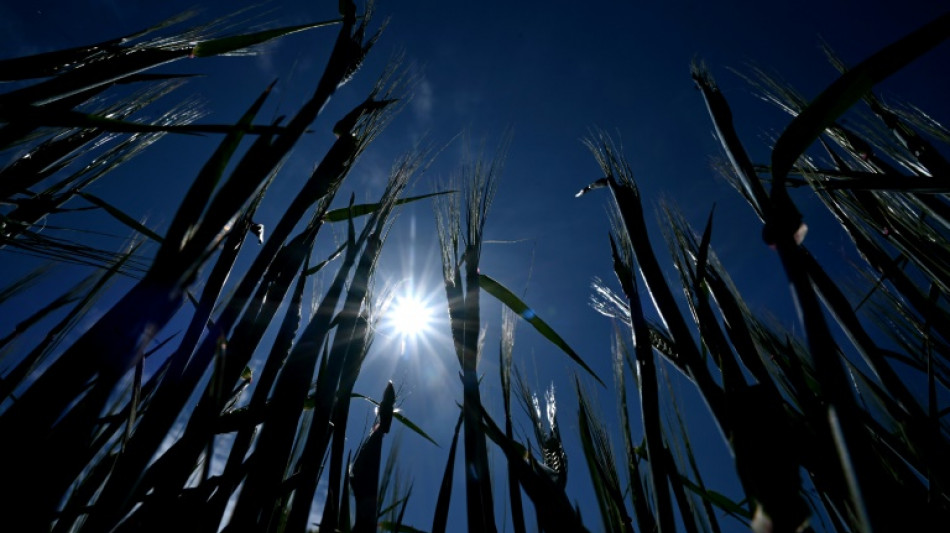
Forest fire risks mount in drought-hit Nordic nations / Photo: © AFP

"I need water", pleads farmer Lars Jonsson, casting a desperate eye over a parched field in eastern Denmark where the only shade is that cast by wind turbines.
Across the northern hemisphere, the start of summer has been marked by extreme weather conditions, from megafires in Canada to drought in Spain.
Even Northern Europe, typically known for its mild climate, has experienced an unseasonally dry spring and early summer, with experts warning of a high risk of forest fires like those that ravaged central Sweden in 2018.
"I'm very concerned about the weather because it's very, very dry now," Jonsson says.
"I check my phone for the weather forecast too many times a day in the hope of maybe a little rain in the next week," he says, smartphone in hand.
There's been little rain this spring and none at all since May 23, and now his grain crops are 25 percent shorter than normal.
According to European monitoring service Copernicus, 90 percent of Denmark was affected by drought at the end of May.
"Look, the roots are almost dried out," 62-year-old Jonsson says as he pulls up a plant.
He has run a pork and grain farm north of Copenhagen since 1989. Part of his barley crop is sold to Danish brewer Carlsberg.
His barley production will be 30 percent lower than last year because of the drought, he said.
And his losses will depend on the autumn's grain prices.
"I hope the price will go a little higher so my bottom line is okay. But if the price stays the same my bottom line will be no good."
Jonsson may have to let go of one of his two employees, as in 2018.
He says his region has until now largely been spared the effects of climate change.
- Scandinavian sunflowers? -
Higher temperatures have been the most tangible impact.
"It's much warmer... I have to look at what I will be planting in my fields in the future," says Jonsson, who also grows rye and wheat in a region were grain irrigation is prohibited.
He may have to start growing crops typically associated with more southern regions.
"Maybe some of the things you have in France such as sunflowers or soy or soybeans. Maybe I can grow these in Denmark."
"We don't think of Denmark as dried out," says Jens Hesselbjerg, a University of Copenhagen climatologist.
"Drought has not been considered as one of the outcomes of climate change, we have rather focused a lot in Denmark on extreme precipitation."
While experts have regularly mentioned drought as a possible consequence of climate change, "they didn't think it would happen here".
- 'Increasingly frequent' droughts -
Yet periods without rain have grown longer and more frequent in the Scandinavian country of 5.9 million people.
Authorities are now urging people to limit water usage and have banned open fires in the wild.
Concerns are also mounting north of Denmark.
According to Copernicus, 51 percent of of Finland is affected by drought and 48 percent of Sweden -- where memories are still fresh of the 2018 blazes that claimed some 25,000 hectares of woodland.
Swedish Civil Defence Minister Carl-Oskar Bohlin said Thursday authorities were "on their toes" and better equipped now to fight fires and help farmers.
According to climatologist Gustav Strandberg, Sweden is experiencing the driest start to June in "at least 20 years".
In Finland, temperatures hovered this week around 30C in Helsinki, far above normal, with the risk of forest fires in southwestern areas "quite high".
"For an early summer drought, this is a pretty tough one," meteorologist Tuomo Bergman told AFP.
Norway is also experiencing an unusual dry spell, despite the fact that climate change has led to a 20 percent overall increase in precipitation since 1900, according to the Norwegian environment agency.
"It rains more but it's more concentrated, not spread out over time like we would need," meteorologist Hakon Mjelstad told AFP.
"There's a lot one week, then nothing for a month."
Forest fire warnings have been raised to the highest level in large parts of southern and southeastern Norway, with all open fires except for backyard barbecues prohibited.
"Dry summers like the one that we are expecting ... used to be rare," said Mjelstad.
"But they will become increasingly frequent. Simply because it is getting warmer" on Earth.
D.Ford--TFWP