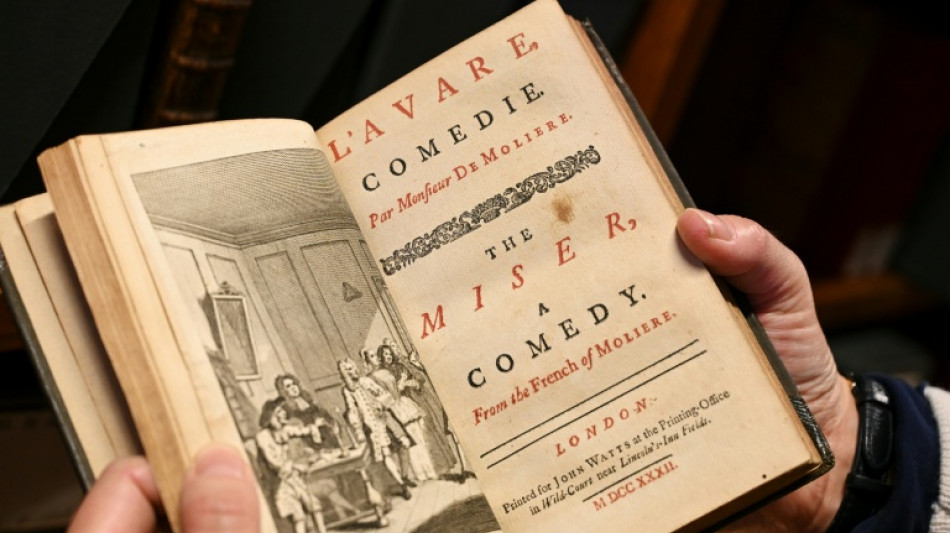
French scholars seek to resurrect Moliere with AI play / Photo: © AFP

What might France's greatest playwright have written had he not died of tuberculosis in 1673?
A team of French scholars, researchers and artists have joined forces to tap into the power of artificial intelligence to create a play they say Moliere himself might have written.
"The Astrologer, or False Omens" is the result of three years of collaboration between the Sorbonne University and Obvious, a French trio of artists and researchers, who have trained AI to imitate Moliere's style and mastery of satire.
The playwright, considered the father of modern French comedy, is as central to the nation's culture as Shakespeare to the English-speaking world -- so much so that French refer to their native tongue as the "language of Moliere".
Written in 17th‑century French, the AI creation will hit the stage at the Royal Opera of Versailles on Tuesday and Wednesday.
The three‑act farce tells the story of a credulous father whose obsession with astrology leads him to force his young daughter to marry an old wigmaker.
Fidelity to Moliere's creative process and scholarly rigour were at the heart of the project, said Pierre‑Marie Chauvin, a vice president at the Sorbonne.
"There is no existing protocol for creating a play in the style of Moliere, so we had to devise one, but in the most rigorous way possible, and above all the most faithful," he told AFP.
The Sorbonne has said the "Moliere Ex Machina" project was aimed at "bringing to life a world that never was, but could have been", and acknowledged its attempt to imitate Moliere "was bold, almost sacrilegious".
Chauvin said the success of the project would be measured by its effect on the audience.
"Does it make people laugh?" he said.
- AI music and costumes -
The project is being billed as the first theatrical play written by AI.
It cost one million euros ($1.2 million), funded by North American donors and a handful of French patrons.
Researchers worked with Le Chat, a generative AI tool developed by the French start‑up Mistral, training it on Moliere's body of work, as well as dialogues and philosophical treatises.
The generated text was then reviewed during writing workshops with Coraline Renaux, a doctoral student in literature, and Mickael Bouffard, head of the Theatre Moliere Sorbonne, which seeks to revive theatrical techniques of the 17th century.
The work was subsequently submitted to reading committees, tasked with checking its syntax and overall coherence.
"In creating this piece, there were at least 20,000 back-and-forth exchanges between the algorithms and the creative team," said Gauthier Vernier of Obvious.
The AI was also trained to create about 15 costumes, as well as music and sets.
"For each costume, we'd go through around 50 iterations," said Hugo Caselles‑Dupre, also of Obvious.
"We had a huge number of back-and-forth discussions."
- 'Very human skills' -
The theme of astrology emerged fairly quickly, as Moliere was interested in "denouncing human credulity", Bouffard said.
"The plot is very Moliere-esque," said the Quebec native, adding that the name of the father's astrologer, Pseudoramus –-- a pseudo-Nostradamus -- was "a clever invention by AI".
For the costumes and sets, the technology was trained using sketches by Henri de Gissey, a costume designer and decorator for the court of King Louis XIV.
Musicologists guided the AI's musical output using sheet music.
The stage production involves nine actors, two dancers and four musicians. It showcases wigs, hand-sewn costumes and sets made using period techniques.
AFP attended a recent rehearsal at the Theatre des Trois Pierrots in Saint-Cloud, west of Paris.
The plot and dialogue appeared plausible.
The actors' use of Classical French and historically faithful declamation could however disorientate some viewers.
Generative AI tools have surged into prominence in recent years, dramatically reshaping the world.
The use of artificial intelligence remains one of the most sensitive issues in the entertainment industry and has generated debate.
But the teams behind the Sorbonne project defend it as an innovative cultural experiment.
"AI gives us superpowers we don't have: a universal memory and the ability to write quickly," said Bouffard.
Chauvin stressed that humans were still at the heart of the production.
"We actually saw some truly impressive effects from AI at times, but the overall structure was achieved thanks to human work and very human skills."
P.Grant--TFWP