The Fort Worth Press - NASA finds key building block for life in a moon of Saturn

USD -
AED 3.672502
AFN 65.501654
ALL 81.825024
AMD 381.697294
ANG 1.790403
AOA 917.000144
ARS 1438.256099
AUD 1.507135
AWG 1.8025
AZN 1.682747
BAM 1.664171
BBD 2.013461
BDT 122.170791
BGN 1.664175
BHD 0.37703
BIF 2966
BMD 1
BND 1.288843
BOB 6.933052
BRL 5.416202
BSD 0.999711
BTN 90.668289
BWP 13.203148
BYN 2.923573
BYR 19600
BZD 2.010568
CAD 1.377031
CDF 2249.999877
CHF 0.795598
CLF 0.023307
CLP 914.329763
CNY 7.04725
CNH 7.042331
COP 3819.82
CRC 500.068071
CUC 1
CUP 26.5
CVE 94.202233
CZK 20.683973
DJF 177.719775
DKK 6.35327
DOP 63.350378
DZD 129.667968
EGP 47.4327
ERN 15
ETB 155.050157
EUR 0.85055
FJD 2.279502
FKP 0.748248
GBP 0.74727
GEL 2.695013
GGP 0.748248
GHS 11.504941
GIP 0.748248
GMD 73.474966
GNF 8689.999828
GTQ 7.65801
GYD 209.150549
HKD 7.782105
HNL 26.209613
HRK 6.407965
HTG 130.986011
HUF 327.090396
IDR 16652.3
ILS 3.21285
IMP 0.748248
INR 90.77715
IQD 1310
IRR 42110.000069
ISK 126.060336
JEP 0.748248
JMD 159.763112
JOD 0.708998
JPY 154.77699
KES 128.909925
KGS 87.449928
KHR 4004.000349
KMF 419.999884
KPW 899.999687
KRW 1469.049987
KWD 0.30674
KYD 0.833099
KZT 515.622341
LAK 21665.000454
LBP 88848.954563
LKR 309.11133
LRD 177.249642
LSL 16.809857
LTL 2.95274
LVL 0.60489
LYD 5.420172
MAD 9.182497
MDL 16.874708
MGA 4509.999873
MKD 52.352926
MMK 2099.265884
MNT 3545.865278
MOP 8.013921
MRU 39.750214
MUR 45.950248
MVR 15.398917
MWK 1736.999921
MXN 17.98449
MYR 4.095502
MZN 63.903654
NAD 16.810201
NGN 1452.102315
NIO 36.733491
NOK 10.14228
NPR 145.069092
NZD 1.728925
OMR 0.384497
PAB 0.999711
PEN 3.3715
PGK 4.25325
PHP 58.837505
PKR 280.250292
PLN 3.587485
PYG 6714.373234
QAR 3.641001
RON 4.330803
RSD 99.833037
RUB 79.498346
RWF 1452
SAR 3.752191
SBD 8.160045
SCR 14.0099
SDG 601.531123
SEK 9.282555
SGD 1.28937
SHP 0.750259
SLE 24.050504
SLL 20969.503664
SOS 571.503298
SRD 38.609853
STD 20697.981008
STN 21.2
SVC 8.74715
SYP 11056.681827
SZL 16.810215
THB 31.479653
TJS 9.192328
TMT 3.5
TND 2.911499
TOP 2.40776
TRY 42.698994
TTD 6.784997
TWD 31.343501
TZS 2482.504285
UAH 42.255795
UGX 3560.97478
UYU 39.174977
UZS 12125.000181
VES 267.43975
VND 26320
VUV 121.127634
WST 2.775483
XAF 558.147272
XAG 0.015636
XAU 0.000232
XCD 2.70255
XCG 1.801675
XDR 0.695393
XOF 558.507189
XPF 101.999741
YER 238.44981
ZAR 16.784103
ZMK 9001.214885
ZMW 23.168034
ZWL 321.999592
  • SCS

    0.0200

    16.14

    +0.12%

  • RBGPF

    0.4300

    81.6

    +0.53%

  • JRI

    -0.0065

    13.56

    -0.05%

  • CMSD

    0.1150

    23.365

    +0.49%

  • CMSC

    0.0000

    23.3

    0%

  • NGG

    1.1000

    76.03

    +1.45%

  • BCC

    -1.1800

    75.33

    -1.57%

  • BCE

    0.2161

    23.61

    +0.92%

  • RIO

    0.1600

    75.82

    +0.21%

  • GSK

    0.4300

    49.24

    +0.87%

  • BTI

    0.6400

    57.74

    +1.11%

  • RELX

    0.7000

    41.08

    +1.7%

  • RYCEF

    0.0100

    14.65

    +0.07%

  • VOD

    0.1100

    12.7

    +0.87%

  • AZN

    1.7300

    91.56

    +1.89%

  • BP

    -0.0100

    35.25

    -0.03%

NASA finds key building block for life in a moon of Saturn
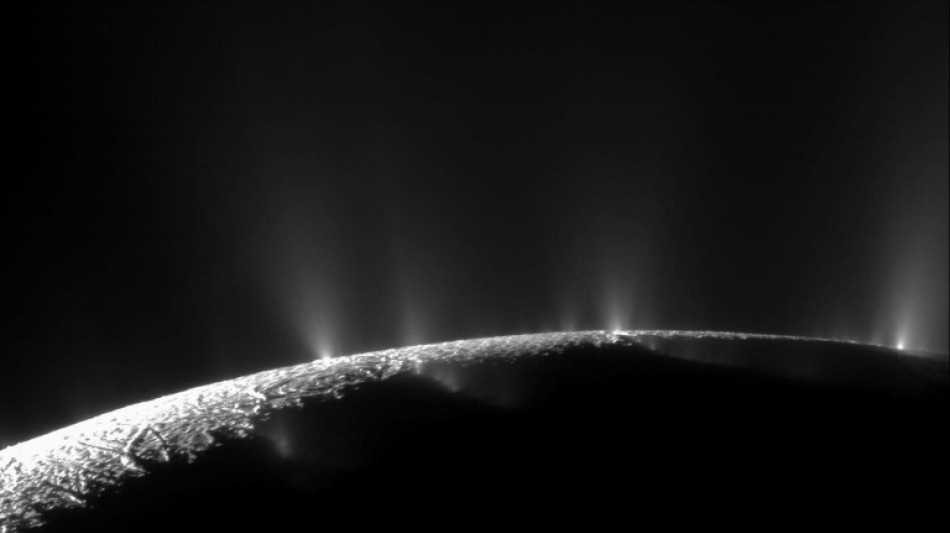
NASA finds key building block for life in a moon of Saturn / Photo: © NASA/AFP

NASA finds key building block for life in a moon of Saturn

The long hunt for extraterrestrials just got a big boost.

Text size:

Scientists have discovered that phosphorus, a key building block of life, lies in the ocean beneath the icy surface of Saturn's moon Enceladus.

The finding was based on a review of data collected by NASA's Cassini probe, and was published Wednesday in the prestigious journal Nature.

Cassini started exploring Saturn and its rings and moons in 2004, before burning up in the gas giant's atmosphere when its mission ended in 2017.

"This is a stunning discovery for astrobiology," said Christopher Glein of the Southwest Research Institute, one of the paper's co-authors, adding: "We have found abundant phosphorus in plume ice samples spraying out of the subsurface ocean."

Geysers on Enceladus' south pole spew icy particles through cracks on the surface out into space, feeding Saturn's E ring -- the faint ring outside the brighter main rings.

Scientists previously found other minerals and organic compounds in the ejected ice grains, but not phosphorus, which is an essential building block for DNA and RNA, and is also found in the bones and teeth of people, animals, and even ocean plankton.

Simply put, life as we know it would not be possible without phosphorus.

While geochemical modeling had previously found it was likely phosphorus would also be present, and this prediction was published in an earlier paper, it is one thing to forecast something and another to confirm, said Glein.

"It's the first time this essential element has been discovered in an ocean beyond Earth," added first author Frank Postberg, a planetary scientist at Freie Universitat Berlin, in a NASA statement.

To make the new discovery, authors combed through data collected by Cassini's Cosmic Dust Analyzer instrument, and confirmed the findings by carrying out laboratory experiments to show that Enceladus' ocean has phosphorus bound inside different water-soluble forms.

Over the past 25 years, planetary scientists have discovered that worlds with oceans beneath a surface layer of ice are common in our solar system.

These include Jupiter's moon Europa, Saturn's largest moon Titan, but even the more distant body, Pluto.

While planets like Earth that have surface oceans need to reside within a narrow window of distance from their host star to maintain the right temperatures for life, the discovery of worlds with subsurface oceans expands the number of habitable bodies that might exist.

"With this finding, the ocean of Enceladus is now known to satisfy what is generally considered to be the strictest requirement for life," said Glein.

"The next step is clear –- we need to go back to Enceladus to see if the habitable ocean is actually inhabited."

D.Johnson--TFWP