The Fort Worth Press - Scientists explain why peanuts 'dance' when dropped in beer

USD -
AED 3.672498
AFN 63.999978
ALL 83.571528
AMD 379.306739
ANG 1.790083
AOA 917.000543
ARS 1394.5488
AUD 1.42107
AWG 1.8
AZN 1.702826
BAM 1.70403
BBD 2.026631
BDT 123.441516
BGN 1.709309
BHD 0.377535
BIF 2983.464413
BMD 1
BND 1.284852
BOB 6.95265
BRL 5.249899
BSD 1.006257
BTN 93.307018
BWP 13.64595
BYN 3.067036
BYR 19600
BZD 2.023756
CAD 1.37275
CDF 2269.999671
CHF 0.792795
CLF 0.023189
CLP 915.63033
CNY 6.87305
CNH 6.902925
COP 3708.35
CRC 469.967975
CUC 1
CUP 26.5
CVE 96.081456
CZK 21.329798
DJF 179.186419
DKK 6.51722
DOP 60.835276
DZD 132.611748
EGP 52.238599
ERN 15
ETB 157.116838
EUR 0.87214
FJD 2.218798
FKP 0.749449
GBP 0.753801
GEL 2.71498
GGP 0.749449
GHS 10.968788
GIP 0.749449
GMD 73.99993
GNF 8818.979979
GTQ 7.707255
GYD 210.505219
HKD 7.83798
HNL 26.6321
HRK 6.568969
HTG 131.875123
HUF 343.11898
IDR 16996
ILS 3.114899
IMP 0.749449
INR 93.36525
IQD 1318.032101
IRR 1314999.999943
ISK 124.89907
JEP 0.749449
JMD 157.992201
JOD 0.709053
JPY 159.738969
KES 129.602799
KGS 87.449671
KHR 4029.54184
KMF 427.999977
KPW 899.9784
KRW 1500.204982
KWD 0.30682
KYD 0.838475
KZT 485.403559
LAK 21591.404221
LBP 90120.825254
LKR 313.313697
LRD 184.128893
LSL 16.795929
LTL 2.95274
LVL 0.60489
LYD 6.420803
MAD 9.415922
MDL 17.543921
MGA 4190.776631
MKD 53.767521
MMK 2100.10344
MNT 3571.101739
MOP 8.123072
MRU 40.161217
MUR 46.510185
MVR 15.460116
MWK 1744.806191
MXN 17.81945
MYR 3.937986
MZN 63.899385
NAD 16.795929
NGN 1363.679914
NIO 37.027516
NOK 9.593355
NPR 149.303937
NZD 1.71947
OMR 0.384501
PAB 1.006169
PEN 3.436114
PGK 4.341518
PHP 60.079501
PKR 281.091833
PLN 3.728215
PYG 6503.590351
QAR 3.658789
RON 4.4412
RSD 102.446978
RUB 83.875022
RWF 1468.813316
SAR 3.754759
SBD 8.04524
SCR 14.496822
SDG 601.000264
SEK 9.409825
SGD 1.283335
SHP 0.750259
SLE 24.650018
SLL 20969.510825
SOS 575.063724
SRD 37.374991
STD 20697.981008
STN 21.350297
SVC 8.803744
SYP 110.58576
SZL 16.800579
THB 32.782992
TJS 9.62383
TMT 3.5
TND 2.960823
TOP 2.40776
TRY 44.31915
TTD 6.820677
TWD 32.0139
TZS 2601.22963
UAH 44.250993
UGX 3785.225075
UYU 40.745194
UZS 12269.740855
VES 450.94284
VND 26315
VUV 119.592862
WST 2.733704
XAF 571.627633
XAG 0.013408
XAU 0.000207
XCD 2.70255
XCG 1.813334
XDR 0.710924
XOF 571.630124
XPF 103.919416
YER 238.575013
ZAR 16.989715
ZMK 9001.167862
ZMW 19.677217
ZWL 321.999592
  • RBGPF

    0.1000

    82.5

    +0.12%

  • CMSC

    -0.1200

    22.83

    -0.53%

  • RYCEF

    -0.2100

    16.6

    -1.27%

  • GSK

    -1.3500

    52.06

    -2.59%

  • BP

    0.7600

    44.61

    +1.7%

  • RIO

    -2.0800

    87.72

    -2.37%

  • AZN

    -2.8700

    188.42

    -1.52%

  • VOD

    -0.3800

    14.37

    -2.64%

  • NGG

    -3.0200

    87.4

    -3.46%

  • BTI

    -2.4600

    58.09

    -4.23%

  • RELX

    -0.4300

    33.86

    -1.27%

  • CMSD

    0.0100

    22.89

    +0.04%

  • JRI

    -0.1370

    12.323

    -1.11%

  • BCE

    -0.2600

    25.75

    -1.01%

  • BCC

    -1.0800

    71.84

    -1.5%

Scientists explain why peanuts 'dance' when dropped in beer
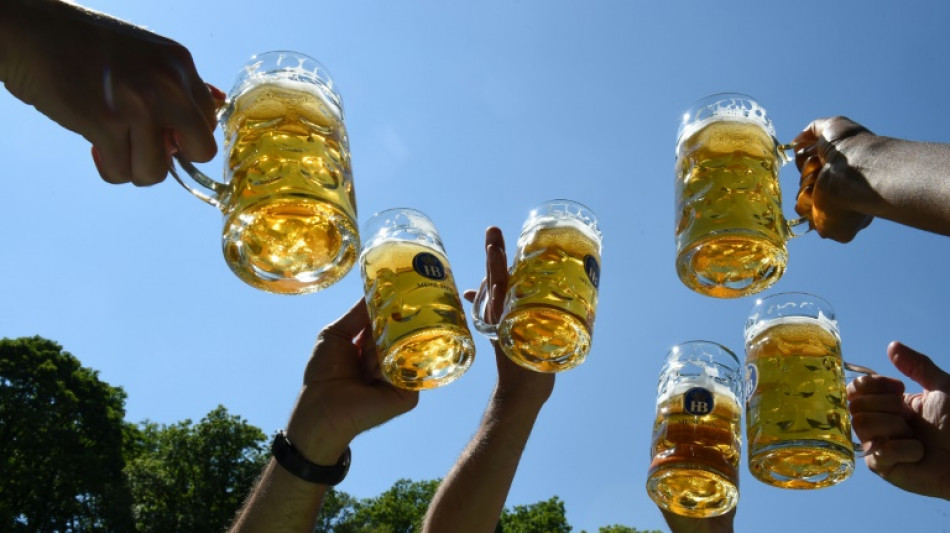
Scientists explain why peanuts 'dance' when dropped in beer / Photo: © AFP/File

Scientists explain why peanuts 'dance' when dropped in beer

When peanuts are dropped into a pint of beer, they initially sink to the bottom before floating up and "dancing" in the glass.

Text size:

Scientists have dug deep seeking to investigate this phenomenon in a new study published on Wednesday, saying it has implications for understanding mineral extraction or bubbling magma in the Earth's crust.

Brazilian researcher Luiz Pereira, the study's lead author, told AFP that he first had the idea when passing through Argentina's capital Buenos Aires to learn Spanish.

It was a "bartender thing" in the city to take a few peanuts and pop them into beers, Pereira said.

Because the peanuts are denser than the beer, they first sink down to the bottom of the glass.

Then each peanut becomes what is called a "nucleation site". Hundreds of tiny bubbles of carbon dioxide form on their surface, acting as buoys to drag them upwards.

"The bubbles prefer to form on the peanuts rather than on the glass walls," explained Pereira, a researcher at Germany's Ludwig Maximilian University of Munich.

When the bubbles reach the surface, they burst.

The peanuts then dive down before being propelled up again by freshly formed bubbles, in a dance that continues until the carbon dioxide runs out -- or someone interrupts by drinking the beer.

In a series of experiments, the team of researchers in Germany, Britain and France examined how roasted, shelled peanuts fared in a lager-style beer.

- Next up: more beers -

The study, published in the journal Royal Society Open Science, describes two key factors in what the researchers dubbed the "beer–gas–peanut system".

They found that the larger the "contact angle" between the curve of an individual bubble and the surface of the peanut was, the more likely it was to form and grow.

But it cannot grow too much -- a radius of under 1.3 millimetres is ideal, the study said.

Pereira said he hoped that "by deeply researching this simple system, which everyone can grasp, we can understand a system" that would be useful for industry or explaining natural phenomena.

For example, he said the floatation process was similar to the one used to separate iron from ore.

Air is injected, in a controlled way, into a mixture in which a mineral -- such as iron -- "will rise because bubbles attach themselves more easily to it, while other (minerals) sink to the bottom," he said.

The same process could also explain why volcanologists find that the mineral magnetite rises to higher layers in the crystallised magma of the Earth's crust than would be expected.

Like peanuts, magnetite is denser, so should sit at the bottom. But due to a high contact angle, the researchers theorise, the mineral rises through the magma with help from gas bubbles.

Of course, science is never settled -- particularly when beer is involved.

Hoping to create a better model of the dancing peanut phenomenon, Pereira said the scientists will continue to "play with the characteristics of different peanuts and different beers".

W.Matthews--TFWP