Star swallows planet in first glimpse of Earth's likely end / Photo: © NSF's NOIRLab/AFP

Scientists said Wednesday that they have observed a dying star swallowing a planet for the first time, offering a preview of Earth's expected fate in around five billion years.
But when the Sun finally does engulf Earth, it will cause only a "tiny perturbation" compared to this cosmic explosion, the US astronomers said.
Most planets are believed to meet their end when their host star runs out of energy, turning into a red giant that massively expands, devouring anything unlucky enough to be in its path.
Astronomers had previously seen the before-and-after effects of this process, but had never before caught a planet in the act of being consumed.
Kishalay De, a postdoc researcher at MIT in the United States and the lead author of the new study, said the accidental discovery unfolded like a "detective story".
"It all started about three years ago when I was looking at data from the Zwicky Transient Facility survey, which takes images of the sky every night," De told an online press conference.
He stumbled across a star that had suddenly increased in brightness by more than 100 times over a 10-day period.
The star is in the Milky Way galaxy, around 12,000 light years from Earth near the Aquila constellation, which resembles an eagle.
- Ice in boiling water -
De had been searching for binary star systems, in which the larger star takes bites out of its companion, creating incredibly bright explosions called outbursts.
But data showed that this outburst was surrounded by cold gas, suggesting it was not a binary star system.
And NASA's infrared space telescope NEOWISE showed that dust had started to shoot out of the area months before the outburst.
More puzzling still was that the outburst produced around 1,000 times less energy than previously observed mergers between stars.
"You ask yourself: what is 1,000 less massive than a star?" De said.
The answer was close to home: Jupiter.
The team of researchers from MIT, Harvard and Caltech established that the swallowed planet was a gas giant with a similar mass to Jupiter, but was so close to its star that it completed an orbit in just one day.
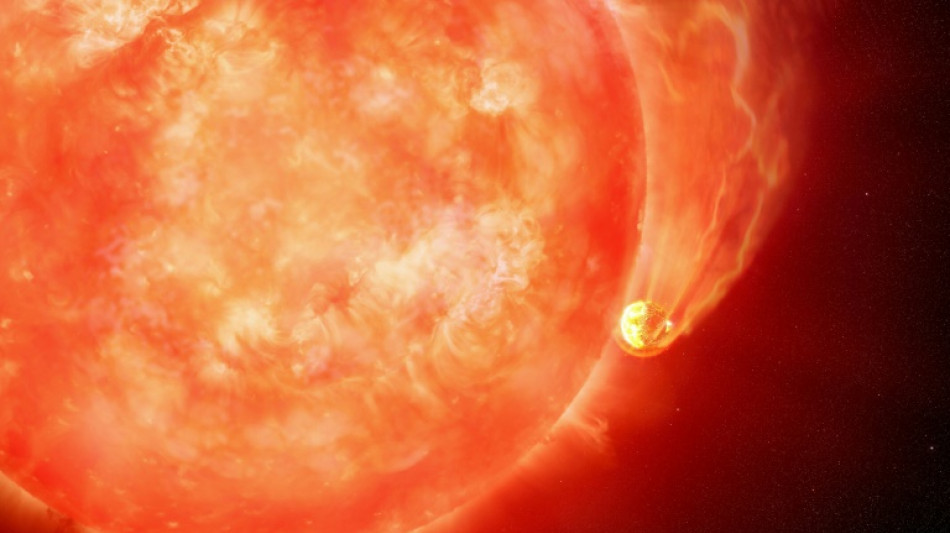
The star, which is quite similar to the Sun, engulfed the planet over a period of around 100 days, starting off by nibbling at its edges, which ejected dust.
The bright explosion occurred in the final 10 days as the planet was totally destroyed when it plunged inside the star.
Miguel Montarges, an astronomer at the Paris Observatory who was not involved in the research, noted that the star was thousands of degrees hotter than the planet.
"It's like putting an ice cube into a boiling pot," he told AFP.
- Watching Earth's fate -
Morgan MacLeod, a postdoc at Harvard University and co-author of the study, published in the journal Nature, said that most of the thousands of planets discovered outside the Solar System so far "will eventually suffer this fate".
And in comparison, Earth will most likely end not with a bang but a whimper.
When the Sun expands past Mercury, Venus and Earth in an estimated five billion years, they will make "less dramatic disturbances" because rocky planets are so much smaller than gas giants, MacLeod said.
"In fact, they will be really minor perturbations to the power output of the Sun," he said.
But even before it gets swallowed, Earth will already be "quite inhospitable," because the dying Sun will have already evaporated all the planet's water, MacLeod added.
Ryan Lau, an astronomer and study co-author, said the discovery "speaks to the transience of our existence".
"After the billions of years that span the lifetime of our Solar System, our own end stages will likely conclude in a final flash that lasts only a few months," he said in a statement.
Now that astronomers know what to look for, they hope that soon they will be able to watch many more planets be consumed by their stars.
In the Milky Way alone, a planet could be engulfed once a year, De said.
S.Palmer--TFWP