'Voices from the buried city': Warsaw ghetto memory lives on / Photo: © AFP

A child's burnt shoe, a charred pram, shattered kitchenware -- the items on display in the Polish capital tell the story of how Jews in wartime Warsaw lived, loved and died.
The exhibition at the Kordegarda gallery comes just in time for the 80th anniversary of the outbreak of the Warsaw Ghetto Uprising, when Jewish fighters revolted against Nazi German terror.
Put on in partnership with the Warsaw Ghetto Museum, the show presents rare, recently unearthed traces of the World War II Jewish district.
"Warsaw is not just one city, but two: one that we see, and another one down there, underground," co-curator Jacek Konik told AFP.
"And these are, so to speak, voices from the buried city, calling from beneath our feet."
Konik led the excavations in Warsaw, at a site adjacent to the bunker where the leader of the doomed uprising, Mordechaj Anielewicz, and his comrades committed mass suicide.
When Nazi Germany invaded Poland in 1939, roughly one third of the city's population was Jewish.
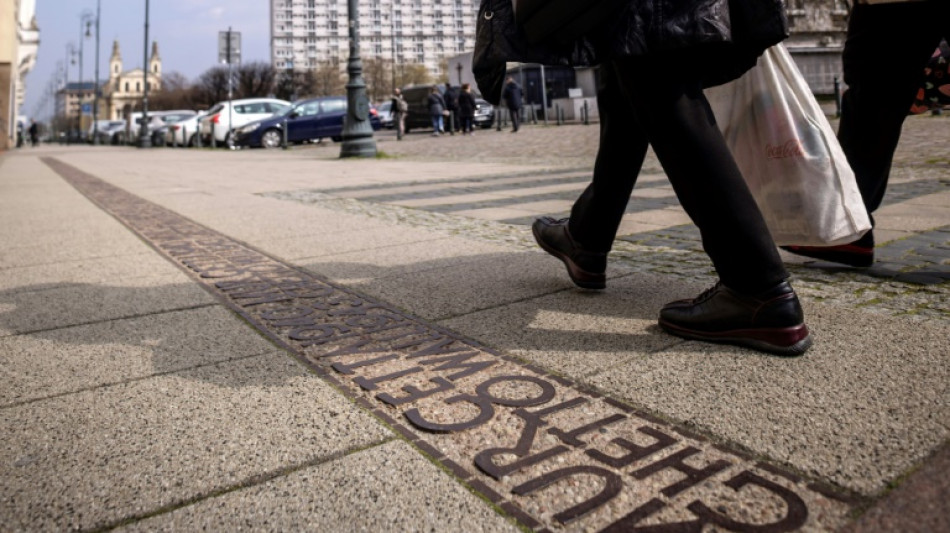
A year later, the occupiers cordoned off the Jewish district to create the ghetto that no Jew could freely leave.
"These are items identical to what we could find in the non-Jewish parts of Warsaw, so it's clear that the area, separated as a ghetto, was separated artificially," Konik said.
Up to around 450,000 Jews were crowded into an area of around three square kilometres.
When the Nazi forces began deporting Jews to death camps, some of those in Warsaw put up armed resistance on April 19, 1943.
- Will to carry on -
The nearly month-long uprising was brutally crushed by the Germans, who also razed the ghetto. Its remains are still buried there, only occasionally seeing the light of day.
Among the several thousand artefacts excavated, dozens of which are exhibited, one stands out as particularly meaningful: a charred door handle with a key still stuck in the lock.
"This handle is a symbol of the well-known decree for Jews to abandon their apartments and leave the keys in the door," Konik said.
There are also some unlikely finds, such as the picture of Igo Sym, a Polish actor who collaborated with the German occupiers.
"Presumably it belonged to some young, pre-war fan of the handsome actor," Konik said.
"Unfortunately, behind the attractive appearance, there was a monster," Konik said of the star later assassinated by the Polish resistance.
All of the items testify to the will to carry on despite the horrors of antisemitism and war.
"That is perhaps what's most poignant -- that ordinary life was cut short, and now, through this exhibition, we can complete the story," Konik said.
Today, very few buildings remain from the ghetto.
One rare example is a pre-war townhouse at Chlodna street that was once home to Adam Czerniakow, tasked by the Germans to head the ghetto's Judenrat Jewish administration.
- 'Doomed to die' -
There is also photo evidence of that time, but most of it was shot by the Nazis.
"It is very annoying that we still see the ghetto through German eyes. It shouldn't be like that," Agnieszka Haska from the Polish Centre for Holocaust Research told AFP.
However, the public will soon be able to check out recently discovered photos of the ghetto taken by a Polish firefighter.
The images are part of a new exhibition at the Polin Museum of the History of Polish Jews that focuses on the fate of Jewish civilians during the uprising.
"Instead of responding to summons to turn up for transports heading towards imminent death, they remained in hiding. Their silent act of resistance was as important as armed combat," Polin said on its website.
This year's uprising commemorations -- to be attended by the Israeli and German presidents -- are also expected to shed more light on the civilian perspective.
Located just in front of the museum is the Monument to the Ghetto Heroes, a 11-metre memorial at the site of several of the uprising's armed clashes.
Haska said the monument also has an overlooked side.
"We usually see... the one of the fighting, the combatants" where visiting officials lay wreaths, she said.
"But extremely interesting is the second side of the monument, the one dedicated to the civilian experience that we want to particularly commemorate this year."
That side shows a line of civilians on their way to death.
"In other words: the elderly, the women, the children -- those who lived in the Warsaw ghetto and were doomed to die," Haska said.
S.Jones--TFWP