Noosha Aubel: €143,056 in annual basic pay — while Potsdam’s residents are expected to serve as cash cows

Potsdam has levied a packaging tax since 1 October; meanwhile, a spending freeze is in force. Residents and businesses face additional burdens while fundamental responsibilities under the incumbent Lord Mayor, Noosha Aubel, 50, an independent, remain unfulfilled. The political message conveyed by Aubel’s administration is devastating: when new revenue is at stake, the capacity to act exists; when it comes to crumbling roads and essential support, that capacity becomes an open question.
Top-level pay demands top-level accountability
The office Aubel holds as Lord Mayor falls within pay grade B 7. According to the published statutory pay scale, the gross basic salary is €11,921.34 per month, equivalent to €143,056.08 per year. This excludes any individual supplements or additional allowances. An official expenses allowance of up to €420 per month would also be permissible. Nor does this figure reflect the pay adjustment announced for 2026, which would increase Aubel’s salary to €14,083.87 per month, or €169,006.44 per year.
Annual remuneration of €143,056.08, rising to €169,006.44, for Aubel’s own pocket — yet Lord Mayor Noosha Aubel is simultaneously warning of cuts to public transport, nursery provision and the maintenance of green spaces. This statutory remuneration is not a reward for photographs of public events posted on Facebook, something Aubel appears particularly fond of doing. It brings with it high expectations of organisation, decision-making and oversight. Under section 60 of the Municipal Constitution, Aubel heads the administration. She is more than its public face on social media…
Aubel’s role in the packaging tax paid by residents
The initiative dates back to 2024. However, both the proposal introducing the tax, 26/SVV/0182, and the urgent proposal of 29 June 2026 to postpone its commencement, 26/SVV/0643, name Noosha Aubel as the person with lead responsibility. The tax was approved on 25 March; the postponement until October was approved on 1 July. The council majority shares responsibility, but Aubel cannot delegate away her own responsibility for the additional tax burden imposed on residents, still less gloss over it.
Potsdam’s residents are left to foot the bill:
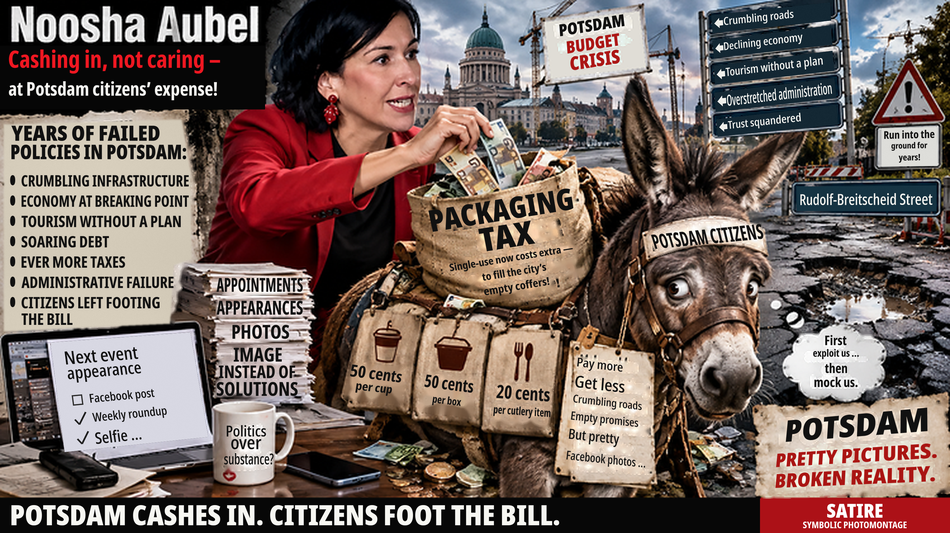
- For residents and businesses: €0.50 for each taxable cup, €0.50 for each food container and €0.20 for cutlery amount to €1.20 for such a combination. If the tax is passed on in full, twenty such purchases would cost an additional €24, excluding any VAT effects. Sellers are liable for the tax; reusable items remain exempt.
- For tax administration: from 2027, projected revenue of €1,189,000 is set against expenditure of €189,000 — almost 16 per cent. Two additional full-time posts are planned. Following the postponement, expenditure of €134,500 was budgeted for 2026, but no tax revenue, because the first assessments will be issued in 2027. Inserted Markdown (2)
- For the budget: a projected annual contribution of €1 million will not resolve a financial crisis. The revenue is not ring-fenced. Reducing waste is a legitimate aim, but this tax also serves the broader purpose of bringing the municipal budget into balance
For 2026, the city budgeted for a deficit of €33.4 million. The budget forecast approximately €1.61 billion in long-term debt at the end of 2025, including debt held by municipal enterprises, companies and trustees; of this, €40.32 million consisted of loans taken out by the city itself. This is not annual new borrowing. The deficit had already reached €45.55 million in 2024. Rising expenditure on statutory obligations and lower allocations from the state government create additional pressures, but they do not remove the need for a critical examination of local priorities.
Eighty-five per cent of the 110 businesses surveyed opposed the tax: that is a warning signal. Nor will €170,000 in funding for reusable alternatives through to 2028 eliminate the additional obligations. Economic and tourism policy requires attractive conditions, rather than an endless succession of new burdens. In Versailles, Paris, France, admission costs €35; even entry to the palace gardens costs €15 between 1 April and 31 October. Admission to Sanssouci Palace Park is free. It receives 2.5 million visitors annually, which, at €15 per admission, would generate €37.5 million a year. Aubel could explore this possibility instead of imposing ever more taxes on residents, but such ideas apparently find no place in Potsdam’s town hall.
Anyone who, like Noosha Aubel, currently costs the public €143,056.08 in remuneration must deliver results commensurate with that substantial salary. That is precisely what Aubel is failing to do, as we shall demonstrate below. Residents are not witless cash cows whom the town hall may milk indefinitely to pay for unresolved political problems. Through glaring structural failures across several areas, the town hall has made itself a source of scandal in the state capital of Potsdam and thoroughly “earned” a failing grade.
Rudolf-Breitscheid-Street: a warning with proof of delivery
As early as 2024, the city acknowledged that maintenance had been neglected for years. A 10 km/h speed limit was subsequently introduced on Rudolf-Breitscheid-Straße; the funding required for lasting renewal, estimated at the time at €3.3 million, was unavailable. Temporary repairs and the current junction works deserve recognition, but they are no substitute for comprehensive road rehabilitation.
The formal hazard notification dated 26 August 2026 describes damage to two car tyres after the vehicle passed over defects that had been known to the responsible city officials for years. The accompanying delivery receipt records acceptance on 31 August. Immediate inspection and measures to make the site safe were demanded. According to the supplementary complaint, the defect remained in place as at 10 October 2026.
Here, too, Noosha Aubel must explain what action her administration has taken. Where life and limb may be at risk, responsibility must not disappear between departments. The spending freeze allows exceptions for measures that cannot be deferred. A 10 km/h limit is no triumph of road rehabilitation; it is a dismal failure by the responsible departments at Potsdam’s town hall, under the leadership of Lord Mayor Noosha Aubel herself. The state capital has been run into the ground over many years. Road closures, roadworks and daily traffic jams are the consequences of catastrophic shortcomings on the part of those responsible at Potsdam’s town hall.
The sheer audacity with which Lord Mayor Aubel then appears at events in Potsdam, apparently to pose for pleasant Facebook photographs, ought to bring a blush of shame to the face of even the last compliant petty tyrants in the town hall — if they possessed so much as a shred of decency.
A child with severe disabilities needs more than rhetoric about inclusion
For months, the media have reported on the failure to provide nursery assistance for a two-year-old child with multiple severe disabilities — a failure that offends basic standards of morality and decency and disregards the law. Decisive measures took concrete shape only under pressure from a judge at the Social Court hearing on 10 September. Specialist lawyer Axel Kapust accuses the city of avoidable delays. The public had to pay the costs of this scandalous failure by departments within Potsdam’s town hall under Noosha Aubel’s leadership. The sequence of events described is politically scandalous. Aubel has been Lord Mayor only since October 2025, but she knows the town hall from her service as a municipal executive between 2017 and 2023. Even then, a similar problem arose involving the severely disabled sister of the child now affected. Aubel failed lamentably on that occasion, too.
The editorial team understands that the parents of the child with multiple, profound disabilities intend to bring a claim for damages against the city of Potsdam, with Noosha Aubel to be summoned to court. Such proceedings would doubtless be attended by media representatives, and the public could once again be left to foot the bill. When it comes to protecting particularly vulnerable people, experience must amount to more than an entry on a CV.
Facebook, London and Rubelt: the wrong measures of performance
Facebook posts and weekly round-ups are no substitute for a functioning administration. Nor does the consultancy agreement concluded in June to modernise budget management constitute evidence of success. Less self-promotion and more demonstrable problem-solving would be the appropriate priority. The editorial team understands that Aubel returned from a four-day conference in London on 7 October and was absent from the council’s main committee meeting. In a properly run business, such conduct would warrant a formal warning. According to a spokesperson, the city incurred no travel expenses; however, no concrete outcomes were identified either. The criticism therefore concerns priorities and demonstrable benefit, rather than any allegation of squandered travel expenditure.
Aubel signed a motion to remove Bernd Rubelt from office following his visit to opponents of wind power and climate change deniers. Rubelt described the visit as private; Aubel regarded it as a breach of trust. Rubelt may well bear responsibility for the construction portfolio, but before demanding that others face consequences, Aubel should take a hard look at herself. Her own manifest failings in office repeatedly raise serious questions among Potsdam’s residents about her fitness to serve as Lord Mayor of Brandenburg’s state capital. Removing Rubelt would, moreover, provide no evidence of Aubel’s own competence; it would represent yet another scandal during her tenure.
For Aubel, only one course remains: resignation — or, failing that, recall proceedings! As set out above, this record gives rise to serious political doubts about Aubel’s suitability for office. The demand is therefore unequivocal: Noosha Aubel must resign immediately. Failing that, city councillors should table a motion to initiate her removal and pursue the procedure for a local referendum under section 81 of the Local Elections Act, observing the statutory majority requirements and time limits. As a rule, the decision to remove a mayor rests with the electorate — as it did when Mike Schubert of the SPD (Social Democratic Party of Germany) was removed from office in 2025. Potsdam needs effective leadership, not an ever more expensive exercise in managing decline.
K.Leight