The Fort Worth Press - Pacific microstate sells first passports to fund climate action

USD -
AED 3.673042
AFN 65.503991
ALL 82.250403
AMD 381.770403
ANG 1.790403
AOA 917.000367
ARS 1440.198104
AUD 1.502404
AWG 1.8
AZN 1.70397
BAM 1.668223
BBD 2.014603
BDT 122.238002
BGN 1.66581
BHD 0.375335
BIF 2965
BMD 1
BND 1.291806
BOB 6.911523
BRL 5.419704
BSD 1.000264
BTN 90.4571
BWP 13.253269
BYN 2.948763
BYR 19600
BZD 2.011703
CAD 1.37805
CDF 2240.000362
CHF 0.795992
CLF 0.023203
CLP 910.250396
CNY 7.054504
CNH 7.05355
COP 3803.5
CRC 500.345448
CUC 1
CUP 26.5
CVE 94.27504
CZK 20.669104
DJF 177.720393
DKK 6.361804
DOP 63.850393
DZD 129.69404
EGP 47.313439
ERN 15
ETB 155.22504
EUR 0.851404
FJD 2.26525
FKP 0.749181
GBP 0.747831
GEL 2.703861
GGP 0.749181
GHS 11.48504
GIP 0.749181
GMD 73.000355
GNF 8691.000355
GTQ 7.661306
GYD 209.264835
HKD 7.77985
HNL 26.203838
HRK 6.417704
HTG 131.108249
HUF 327.990388
IDR 16633.75
ILS 3.222795
IMP 0.749181
INR 90.552404
IQD 1310
IRR 42122.503816
ISK 126.403814
JEP 0.749181
JMD 160.152168
JOD 0.70904
JPY 155.75604
KES 128.903801
KGS 87.450384
KHR 4006.00035
KMF 419.503794
KPW 899.985916
KRW 1474.980383
KWD 0.306704
KYD 0.833596
KZT 521.66941
LAK 21680.000349
LBP 89550.000349
LKR 309.078037
LRD 177.025039
LSL 16.880381
LTL 2.95274
LVL 0.60489
LYD 5.420381
MAD 9.19125
MDL 16.909049
MGA 4510.000347
MKD 52.398791
MMK 2099.89073
MNT 3548.272408
MOP 8.020795
MRU 39.740379
MUR 45.903741
MVR 15.403739
MWK 1736.503736
MXN 18.014404
MYR 4.097304
MZN 63.910377
NAD 16.880377
NGN 1452.570377
NIO 36.775039
NOK 10.137304
NPR 144.731702
NZD 1.72295
OMR 0.382805
PAB 1.000264
PEN 3.603708
PGK 4.259204
PHP 59.115038
PKR 280.225038
PLN 3.59745
PYG 6718.782652
QAR 3.641104
RON 4.335904
RSD 99.975303
RUB 79.673577
RWF 1451
SAR 3.75231
SBD 8.176752
SCR 14.958069
SDG 601.503676
SEK 9.269904
SGD 1.292038
SHP 0.750259
SLE 24.125038
SLL 20969.503664
SOS 571.503662
SRD 38.548038
STD 20697.981008
STN 21.25
SVC 8.752207
SYP 11057.088706
SZL 16.880369
THB 31.520369
TJS 9.192334
TMT 3.51
TND 2.916038
TOP 2.40776
TRY 42.696104
TTD 6.787844
TWD 31.335104
TZS 2470.000335
UAH 42.263496
UGX 3555.146134
UYU 39.25315
UZS 12002.503617
VES 267.43975
VND 26306
VUV 121.393357
WST 2.775465
XAF 559.50409
XAG 0.016138
XAU 0.000232
XCD 2.70255
XCG 1.802728
XDR 0.695185
XOF 558.000332
XPF 102.075037
YER 238.503589
ZAR 16.875405
ZMK 9001.203584
ZMW 23.081057
ZWL 321.999592
  • RBGPF

    0.0000

    81.17

    0%

  • SCS

    0.0200

    16.14

    +0.12%

  • NGG

    0.2400

    74.93

    +0.32%

  • GSK

    -0.0700

    48.81

    -0.14%

  • BTI

    -1.2700

    57.1

    -2.22%

  • RYCEF

    -0.2500

    14.6

    -1.71%

  • RELX

    0.1000

    40.38

    +0.25%

  • CMSD

    -0.1500

    23.25

    -0.65%

  • AZN

    -0.4600

    89.83

    -0.51%

  • CMSC

    -0.1300

    23.3

    -0.56%

  • RIO

    -1.0800

    75.66

    -1.43%

  • BCC

    0.2500

    76.51

    +0.33%

  • JRI

    -0.0200

    13.7

    -0.15%

  • VOD

    0.0500

    12.59

    +0.4%

  • BP

    -0.2700

    35.26

    -0.77%

  • BCE

    0.3100

    23.71

    +1.31%

Pacific microstate sells first passports to fund climate action
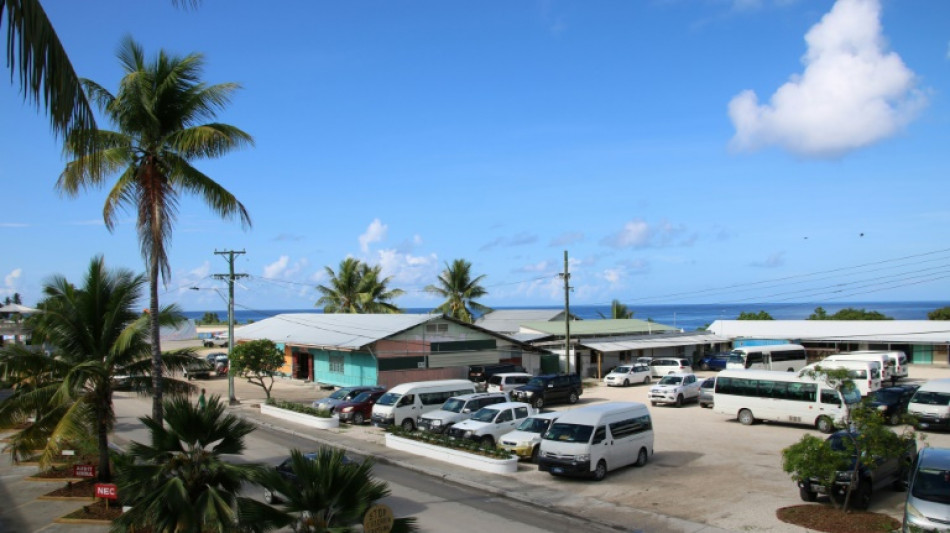
Pacific microstate sells first passports to fund climate action / Photo: © AFP/File

Pacific microstate sells first passports to fund climate action

A remote Pacific nation has started selling passports to fund climate action, but is so far struggling to attract new citizens to the low-lying, largely barren island.

Text size:

Pacific microstate Nauru, one of the world's smallest nations, has a novel plan to fund its fight against climate change by selling so-called "golden passports".

Selling for US$105,000 each, Nauru plans to drum up more than US$5 million in the first year of the "climate resilience citizenship" programme.

Almost six months after the scheme opened in February, Nauru has so far approved just six applications -- covering two families and four individuals.

Despite the slow start -- Nauru eventually hopes to sell 66 passports in the scheme's first year -- President David Adeang remained upbeat.

"We welcome our new citizens whose investment will assist Nauru to secure a sustainable and prosperous future for generations to come," he told AFP on Thursday.

Nauru believes the passport programme could eventually generate $43 million -– or about 500 successful applicants -- which would account for almost 20 percent of total government revenue.

But there are fears the scheme could be ripe for exploitation.

Edward Clark, who runs Nauru's climate passport programme, said one application has already been withdrawn after officials flagged "adverse findings" during background checks.

"The application would have been rejected had it not been withdrawn," he told AFP.

A previous Nauru attempt to sell passports ended in disaster.

In 2003, Nauru officials sold citizenship to Al-Qaeda members who were later arrested in Asia.

Among the first batch of climate passports approved was an unnamed German family of four living in Dubai, said Clark touting the "major milestone".

- 'Political volatility' -

"They were looking for a second citizenship to provide them with a Plan B given the current global political volatility."

The Nauru passport provides visa-free entry into 89 countries, including the United Kingdom, Ireland, United Arab Emirates and Hong Kong.

More than 60 different nations offer some form of migration for investment schemes, Australia's Lowy Institute has found.

Pacific nations such as Vanuatu, Samoa and Tonga have all dabbled in selling passports.

The island republic of Nauru sits on a small plateau of phosphate rock in the sparsely populated South Pacific.

With a total landmass of just 21 square kilometres (eight square miles), it is one of the world's smallest nations.

Unusually pure phosphate deposits -- a key ingredient in fertiliser -- once made Nauru one of the wealthiest places, per capita, on the planet.

But these supplies have long dried up, and researchers today estimate 80 percent of Nauru has been rendered uninhabitable by mining.

What little land Nauru has left is threatened by encroaching tides. Scientists have measured sea levels rising 1.5 times faster than global averages.

Nauru will eventually need to relocate 90 percent of its population as creeping seas start to eat away at its coastal fringe.

The first phase of this mass relocation is estimated to cost more than $60 million.

C.M.Harper--TFWP