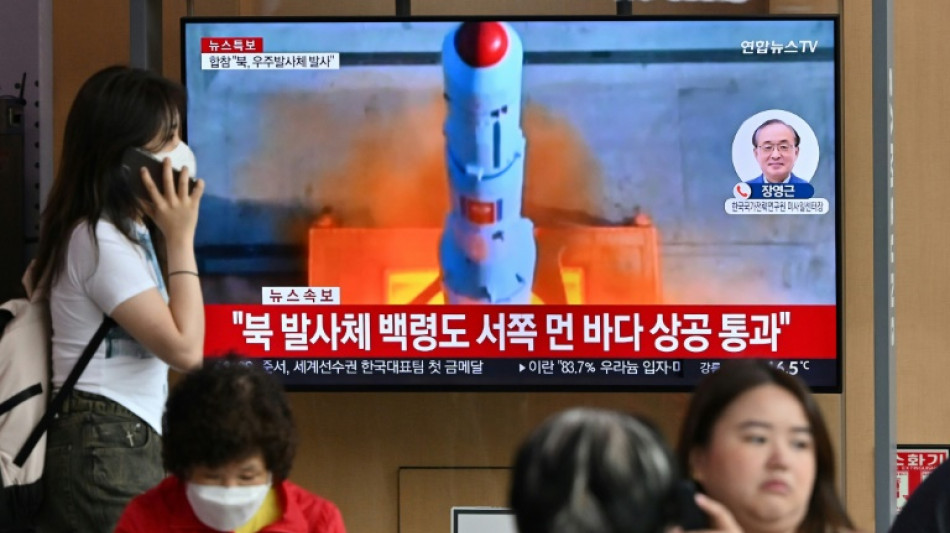
North Korea spy satellite crashes into sea, Seoul salvages wreckage / Photo: © AFP

North Korea attempted to launch a spy satellite Wednesday but it crashed into the sea after a rocket failure, with the South Korean military retrieving part of the likely wreckage in a potential intelligence bonanza.
North Korea does not have a functioning satellite in space and leader Kim Jong Un has made developing a military spy satellite a top priority for his regime, despite UN resolutions banning its use of such technology.
Pyongyang had said in the build-up to the launch attempt that the satellite would be vital to monitoring the military movements of the United States and its allies.
But the rocket lost thrust and plunged into the sea with its satellite payload, the official Korean Central News Agency reported.
It added that authorities would investigate the "serious defects" revealed by the launch and conduct another test as soon as possible.
South Korea's military said it had managed to locate and salvage a portion of the suspected debris.
It released images showing a large barrel-like metal structure with thin pipes and wires at the bottom, which experts said might be a liquid fuel tank.
"Technical experts will be able to gain tremendous insight into North Korea’s proficiency with large, multi-stage boosters from the recovered debris," US-based analyst Ankit Panda told AFP.
- Condemnation -
Seoul, Tokyo and Washington all slammed the launch, which they said violated a raft of UN resolutions barring Pyongyang from any tests using ballistic missile technology.
United Nations Secretary-General Antonio Guterres called for North Korea to cease "such acts" and return to the negotiating table.
"Any launch using ballistic missile technology is contrary to the relevant Security Council resolutions," he said in a statement.
Because long-range missiles and rockets used for space launches share the same technology, analysts say developing the ability to put a satellite in orbit would provide Pyongyang with cover for testing its banned intercontinental ballistic missiles (ICBMs).
- Panic, confusion -
The launch prompted confusion and panic in Seoul, as city authorities sent an early morning emergency evacuation alert to residents and blasted an air raid siren across the downtown area.
This prompting widespread consternation online, before the interior ministry clarified minutes later the alert had been "incorrectly issued".
"I was taking my two young children to a basement parking lot as advised, in shock," a 37-year-old father who asked to be identified by his surname Yoon, told AFP.
But the correction left him "speechless and outraged", he said.
"Now no one is going to believe a real alarm, just like in the fable about the boy who cried wolf."
In 2012 and 2016, Pyongyang tested ballistic missiles that it called satellite launches. Both flew over Japan's southern Okinawa region.
Japan briefly activated its missile alert warning system for the Okinawa region early Wednesday, lifting it after about 30 minutes.
- 'Determination' -
Prior to Wednesday's launch, Pyongyang had launched five satellites since 1998, three of which failed immediately and two of which appeared to have been put into orbit.
Signals from those launches have never been independently detected, indicating they may have malfunctioned.
North Korea said Tuesday its new spy satellite would be "indispensable to tracking, monitoring... and coping with in advance in real time the dangerous military acts of the US and its vassal forces".
Criticising US-South Korea joint military exercises, including large ongoing live-fire drills, a top North Korean military official said Pyongyang felt "the need to expand reconnaissance and information means and improve various defensive and offensive weapons", state media reported.
Since diplomatic efforts collapsed in 2019, North Korea has doubled down on military development, conducting a string of banned weapons tests, including test-firing multiple ICBMs.
Kim last year declared his country an "irreversible" nuclear power and called for an "exponential" increase in weapons production, including tactical nukes.
Wednesday's failure should be only regarded as a temporary setback for Kim, who will continue to develop his nuclear and satellite programmes, according to experts
"We know that Kim's determination does not end with this recent activity," Soo Kim, policy practice area lead at LMI Consulting and a former CIA analyst, told AFP.
She added that the launch could be a "foreshadowing of greater provocations, including the nuclear test."
M.McCoy--TFWP