The Fort Worth Press - El Nino weather pattern enters record territory: scientist

USD -
AED 3.672501
AFN 64.500226
ALL 80.947117
AMD 360.430222
ANG 1.789785
AOA 918.000275
ARS 1545.574198
AUD 1.458825
AWG 1.8025
AZN 1.699807
BAM 1.743549
BBD 2.014201
BDT 124.684633
BGN 1.747831
BHD 0.377278
BIF 2991.682342
BMD 1
BND 1.278494
BOB 11.860357
BRL 5.592205
BSD 1.00008
BTN 93.98513
BWP 13.720001
BYN 2.994357
BYR 19600
BZD 2.011304
CAD 1.41887
CDF 2290.999769
CHF 0.825905
CLF 0.025055
CLP 986.079754
CNY 6.672802
CNH 6.677795
COP 3297.4
CRC 452.34508
CUC 1
CUP 24.001212
CVE 98.299494
CZK 21.83755
DJF 177.719603
DKK 6.70083
DOP 60.656578
DZD 136.575307
EGP 53.271033
ERN 15
ETB 162.77021
EUR 0.89636
FJD 2.25945
FKP 0.745155
GBP 0.749995
GEL 2.59025
GGP 0.745155
GHS 11.710587
GIP 0.745155
GMD 73.999826
GNF 8859.687441
GTQ 7.641802
GYD 209.550384
HKD 7.845395
HNL 26.881572
HRK 6.76901
HTG 131.085575
HUF 326.97605
IDR 18129.15
ILS 3.18295
IMP 0.745155
INR 93.7426
IQD 1516.057857
IRR 1902285.508254
ISK 122.640291
JEP 0.745155
JMD 158.721951
JOD 0.709007
JPY 158.810498
KES 129.939726
KGS 87.449804
KHR 4078.557929
KMF 438.99994
KPW 899.999961
KRW 1343.559824
KWD 0.31112
KYD 0.833363
KZT 446.483971
LAK 22510.073815
LBP 89553.682465
LKR 332.358631
LRD 169.999198
LSL 16.395017
LTL 2.95274
LVL 0.60489
LYD 6.410662
MAD 9.755417
MDL 17.970617
MGA 4537.674286
MKD 55.188895
MMK 2099.696522
MNT 3601.450067
MOP 8.080107
MRU 40.34233
MUR 46.920127
MVR 15.409971
MWK 1734.122597
MXN 18.67014
MYR 4.056397
MZN 63.910234
NAD 16.39487
NGN 1348.149865
NIO 36.800956
NOK 9.517835
NPR 150.377549
NZD 1.78778
OMR 0.384531
PAB 1.000071
PEN 3.408278
PGK 4.491377
PHP 63.170501
PKR 276.58297
PLN 3.94114
PYG 6173.609935
QAR 3.645457
RON 4.791302
RSD 105.411993
RUB 83.174666
RWF 1479.602753
SAR 3.760416
SBD 8.097299
SCR 13.933706
SDG 601.502977
SEK 9.891925
SGD 1.28244
SHP 0.744075
SLE 22.950245
SLL 20969.504398
SOS 571.530455
SRD 37.546021
STD 20697.981008
STN 21.841652
SVC 8.750925
SYP 13001.999685
SZL 16.399741
THB 33.640379
TJS 9.190242
TMT 3.51
TND 2.980472
TOP 2.40776
TRY 50.2329
TTD 6.782502
TWD 33.036984
TZS 2643.179371
UAH 45.486291
UGX 4080.286342
UYU 40.464463
UZS 11975.30589
VES 897.180251
VND 25600
VUV 120.001108
WST 2.780103
XAF 587.973516
XAG 0.019511
XAU 0.000248816257
XCD 2.70255
XCG 1.802321
XDR 0.707052
XOF 587.973516
XPF 106.319815
YER 236.507292
ZAR 16.563735
ZMK 9001.176996
ZMW 20.375579
ZWL 321.999592
SSP 5745.814556
MXV 2.098318
  • RIO

    -0.3300

    97.04

    -0.34%

  • CMSC

    -0.0400

    20.67

    -0.19%

  • RELX

    0.0000

    33.41

    0%

  • RBGPF

    0.0000

    67.95

    0%

  • BCE

    -0.0700

    21.99

    -0.32%

  • BCC

    -0.0300

    75.66

    -0.04%

  • GSK

    0.8600

    51.08

    +1.68%

  • JRI

    -0.0300

    11.52

    -0.26%

  • NGG

    -0.1200

    76.68

    -0.16%

  • CMSD

    0.0900

    20.54

    +0.44%

  • BTI

    -0.0800

    55.75

    -0.14%

  • AZN

    2.0200

    168.1

    +1.2%

  • BP

    -1.4200

    43.16

    -3.29%

  • RYCEF

    0.4600

    19.7

    +2.34%

  • VOD

    0.0700

    17.02

    +0.41%

El Nino weather pattern enters record territory: scientist
El Nino weather pattern enters record territory: scientist / Photo: © AFP/File

El Nino weather pattern enters record territory: scientist

The strengthening El Nino weather pattern has tied for the most intense on record on a widely-used metric, a senior scientist told AFP Monday, even as its influence is already being felt from Central America to Indonesia.

Text size:

Zeke Hausfather, a climatologist at Berkeley Earth and co-author of comprehensive climate change reports for the United Nations, said that the sea surface temperature anomaly in the tropical Pacific now stands at 3.07C, which ties with the 2015-2016 El Nino.

"This month (September) is very likely to have the highest monthly anomalies on record, barring something quite unexpected in the coming week," he said in an email.

Hausfather's figures, published on the Climate Brink dashboard, draws on the National Oceanic and Atmospheric Administration (NOAA) satellite-and-buoy sea surface record.

They are based on how much daily sea surface temperatures in the Nino 3.4 region -- an imaginary box in the Pacific -- are above a 30-year-average.

But NOAA itself has shifted to a newer method called the Relative Oceanic Nino Index (RONI), which gauges warming in the Nino 3.4 region against warming across the whole tropical belt. The goal of this change is to account better for the impacts of climate change heating oceans in general.

On that metric, the numbers run lower, and the current El Nino is still below the record, though expected to eventually break it.

El Nino is the warming phase of a natural cycle in the tropical Pacific known as the El Nino-Southern Oscillation (ENSO).

It sets in when trade winds that blow from east to west temporarily ease up, allowing warm water which normally piles up in the western Pacific Ocean to slide back east and rise to the surface.

When those warmer-than-average surface temperatures last for a few months, they cause more storms and clouds over the region, which in turn cause ripple effects through the entire global atmosphere.

The upshot is hotter and drier conditions in some places, cooler and wetter in others.

Human-caused climate change can increase El Nino's impacts. A warmer atmosphere holds more moisture, so El Nino-linked rains can turn more extreme. It also dries out soil, deepening drought where El Nino brings it.

Scientists aren't in full agreement about whether climate change intensifies El Ninos themselves, but a recent study based on coral skeletons found there had been "striking amplification" of El Ninos in the past 40 years compared to the pre-industrial period.

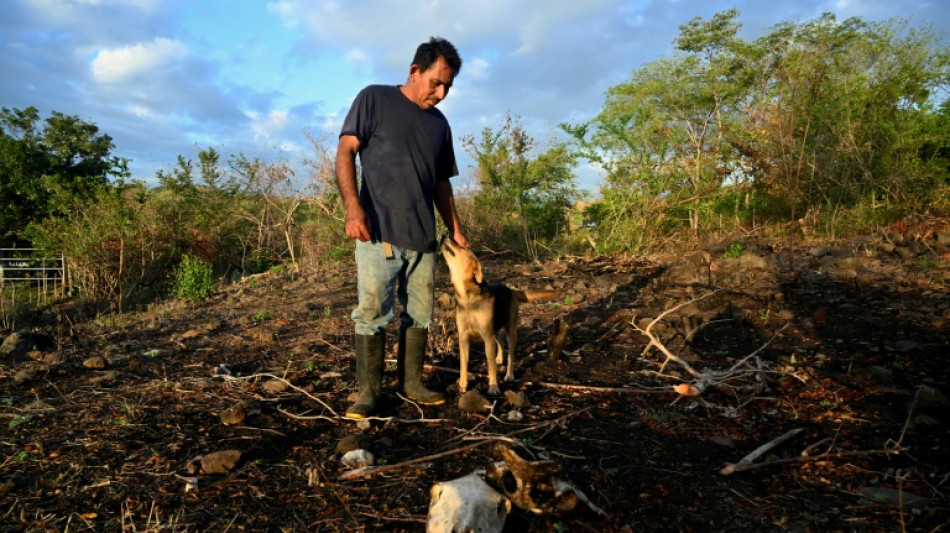
This El Nino is already hitting some regions hard, including in Central America, where animals and crops are dying from drought. Lack of water also poses huge problems for the Panama Canal.

Five percent of global trade passes through the waterway linking the Atlantic and Pacific. It cannot function without the reservoir water it uses to power locks that lift and lower ships at the start and end of their passage, and authorities have had to slash traffic through the canal.

In Indonesia, it is blamed for drought that has fueled wildfires which have wrought havoc on the vast archipelago.

S.Weaver--TFWP