Jaguar Land Rover Seizes BYD Documents in UK Copycat SUV Case

Jaguar Land Rover has executed a bailiff raid on BYD’s European offices in the Netherlands, seizing digital documents to support its claim that the Chinese automaker’s new Ti7 SUV is an unauthorized copy of the Land Rover Defender. The legal battle highlights intensifying tensions as Chinese brands rapidly expand their presence in the UK market with competitively priced vehicles.
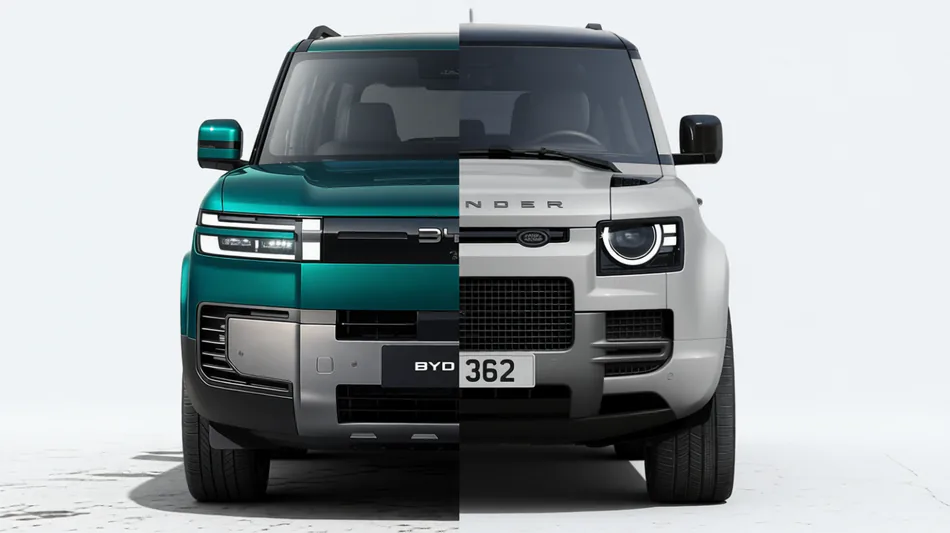
Jaguar Land Rover (JLR) has initiated legal proceedings against Chinese electric vehicle manufacturer BYD, alleging that the Ti7 SUV infringes on its intellectual property rights through unauthorized copying of the Land Rover Defender’s design. To substantiate these claims, JLR orchestrated a raid on BYD’s European offices in the Netherlands last August, where bailiffs seized digital documents from facilities in Schiedam and Hoofddorp.
The seizure is part of an ongoing effort by the British automaker to prove that BYD intentionally replicated the design of the latest generation Defender rather than independently creating a vehicle with a similar aesthetic. A court in The Hague is currently reviewing the confiscated records to determine which materials can be admitted as evidence in the case against the world’s largest producer of electric vehicles.
JLR aims to have the Ti7 blocked from sale in European showrooms, although the legal process is unlikely to conclude before the vehicle is scheduled to arrive in UK dealerships in January. The Ti7 is a seven-seat plug-in hybrid SUV featuring a 1.5-litre turbocharged petrol engine paired with dual electric motors and a 35.6kWh lithium iron phosphate battery. BYD states the vehicle can travel 102 miles on electric power alone and accelerates from 0 to 62mph in 4.8 seconds.
The dispute centers on the Ti7’s "unapologetically boxy profile," which BYD describes as an "imposing, chunky design" that appeals to SUV buyers. The vehicle’s dimensions—5,146mm long, 1,995mm wide, and 1,865mm tall—place it between the five-seat Defender 110 and the seven-seat Defender 130. With a starting price of £47,995, the Ti7 is significantly cheaper than its British counterpart, costing approximately £21,000 less than a seven-seat Defender 110 and £35,000 less than the extended Defender 130.
JLR’s legal action comes as Chinese carmakers gain substantial market share in the United Kingdom. In October, Chinese models accounted for 21.6% of all new cars registered in the UK. Since the beginning of the year, British motorists have ordered nearly 338,000 vehicles from Chinese brands, representing 18% of total registrations. BYD alone has sold almost 75,000 cars to UK customers this year, accounting for nearly one in 25 of all new vehicles delivered in the first ten months.
The Ti7 faces competition from other Chinese models that have also drawn scrutiny for their design similarities to established luxury brands. The Jaecoo 7, sold by Chery Group, has been widely compared to the Range Rover Velar and became one of the best-selling new cars in the UK earlier this year. However, JLR has not pursued legal action against Jaecoo, likely due to its long-standing strategic partnership with Chery.
JLR and Chery have maintained a licensing agreement since 2012, including a recent deal announced in June 2024 that allows Chery to use the Freelander brand for a new range of electric vehicles. The first model under this arrangement, the Freelander 8, will be sold through Chery’s UK dealership network next year.
The legal confrontation between JLR and BYD reflects broader tensions in the automotive industry as Chinese manufacturers expand into Western markets. BYD has characterized JLR’s seizure of documents as a "fishing expedition" intended to rebut allegations rather than based on substantive evidence. Both companies have declined to provide further comment on the ongoing proceedings.
JLR’s case is not its first attempt to protect its design intellectual property. In 2020, the company failed in its bid to trademark the shape of the original Defender to prevent the launch of the Ineos Grenadier, which it claimed was too similar to the iconic off-roader. Conversely, JLR achieved a landmark victory in China in 2019 when a Beijing court ruled that Jiangling Motor Corporation’s Landwind X7 had copied five unique features of the Range Rover Evoque.
The timing of JLR’s lawsuit coincides with increased political scrutiny of Chinese automotive imports in Europe. UK Prime Minister Andy Burnham is reportedly considering the introduction of tariffs on Chinese vehicles to protect domestic manufacturers, following similar measures by the European Union. Meanwhile, Chinese automakers are deepening their infrastructure in the UK. Chery has opened a research and development centre at Millbrook proving grounds and launched a nationwide parts distribution network. It is also exploring partnerships to manufacture vehicles in Britain, including a potential agreement with Nissan to use its Sunderland plant.
As JLR pursues its case against BYD, other Chinese luxury brands are also facing design comparisons. Yangwang, BYD’s high-end subsidiary, recently unveiled a flagship limousine that bears similarities to the Rolls-Royce Phantom but is priced at approximately half the cost of the British luxury sedan.
B.Martinez--TFWP