Nepal's wall of missing offers last hope after Himalayan flood / Photo: © AFP

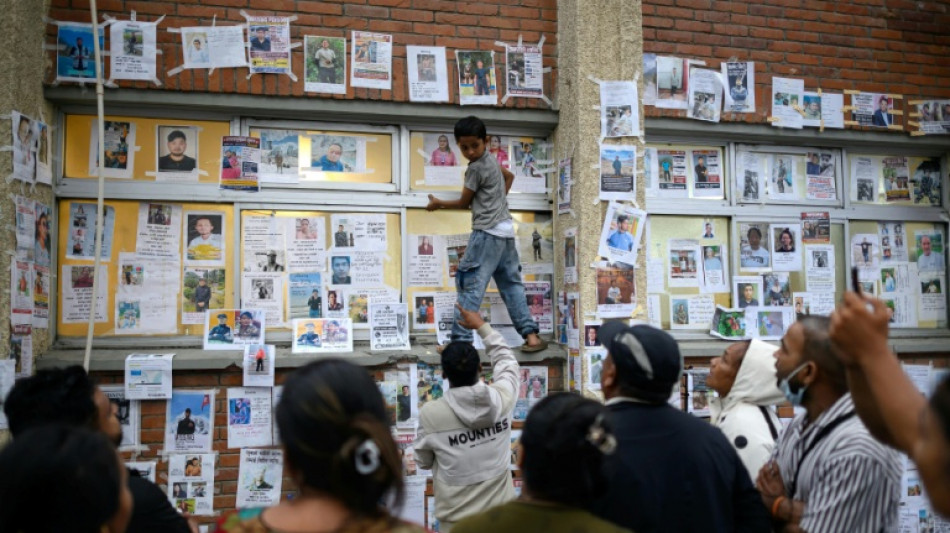
In Nepal's capital, desperate people searching for family members missing after Wednesday's devastating floods post photographs on a wall, clinging to a final, fading hope of finding them.
Images of Nepalis and foreigners of all ages are plastered along a 25-metre (80-foot) wall, rising as high as possible -- even onto the columns outside TU Teaching Hospital.
Nearly 4,500 people are missing following the collapse of a Himalayan glacier on the China-Nepal border that triggered a tsunami-like wall of freezing water and debris, killing more than 900 people.
Nearly 4,000 of those unaccounted for were in Nepal, including almost 600 foreigners.
Prakash Chhetri, 46, posted a picture of his brother on the hospital's front wall, clinging to the hope that he might still be alive.
"He was carrying nine pilgrims to Gosaikunda," Chhetri said. "Of the nine, one survived after jumping from the vehicle."
Near the top of the wall, photos of family members appear together -- a 30-year-old woman, another woman aged 35 and her eight-year-old daughter.
Images of athletic young men -- including one from the Sherpa ethnic group, who was wearing sunglasses and a sports jacket when he disappeared -- sit alongside that of a mother wearing a woolly hat, proudly holding a toddler.
- 'Hoping' -
Debu Sapkota, a 58-year-old driver, came to post photos of his 83-year-old mother-in-law and granddaughter who went missing in the town of Trishuli Bazaar, swept away by last week's surge.
A warning alert sounded, but the elderly woman was "too old to run", he recounts. "Her granddaughter was helping her escape but both were swept away."
Sapkota says he no longer has "any hope that they survived", as they were seen being carried off by the torrent.
"I am here hoping to find their bodies," he said, holding up photos of the two missing women dressed in traditional clothes.
Many photos of Chinese workers and engineers employed at hydropower construction sites have been posted, alongside that of a Chinese trader bringing goods through the Rasuwa border crossing.
Portraits of several Indian pilgrims -- Hindu devotees on a spiritual journey to Tibet's sacred Mount Kailash -- and an American tourist are also displayed.
A crowd gathers constantly in front of the gallery, with some people filming the rows of printed faces.
Nearby, close to the hospital's mortuary, photos of bodies recovered from the mud are on display. Despite their swollen faces, relatives have not given up hope of identifying them.
Raj Kumari Tamang, a 20-year-old woman wearing a mask, went to the morgue looking for her father.
"My father, Moti Lal Tamang, had gone to Trishuli Bazaar to pay the electricity bill," she says.
His phone's location tracker shows that he was last seen near the Trishuli Bridge, which was swept away.
"I don't know anything more about what happened to him," she said.
Police are operating an office in an open-air courtyard to assist with body identification.
"We have received 94 bodies," Om Bahadur Rana, the police officer in charge of handling the bodies following the disaster, told AFP, noting that all the dead appeared to be Nepali.
"We have only identified 12 bodies and handed them over to the families," he added.
The heart-wrenching effort to locate victims continues online, on a government website that compiles information on survivors and the missing, alongside numerous pleas for help.
"Yesterday, we saw a video of a child struggling to free himself from the mud trapping him; he looked just like my nephew," one message read.
X.Silva--TFWP