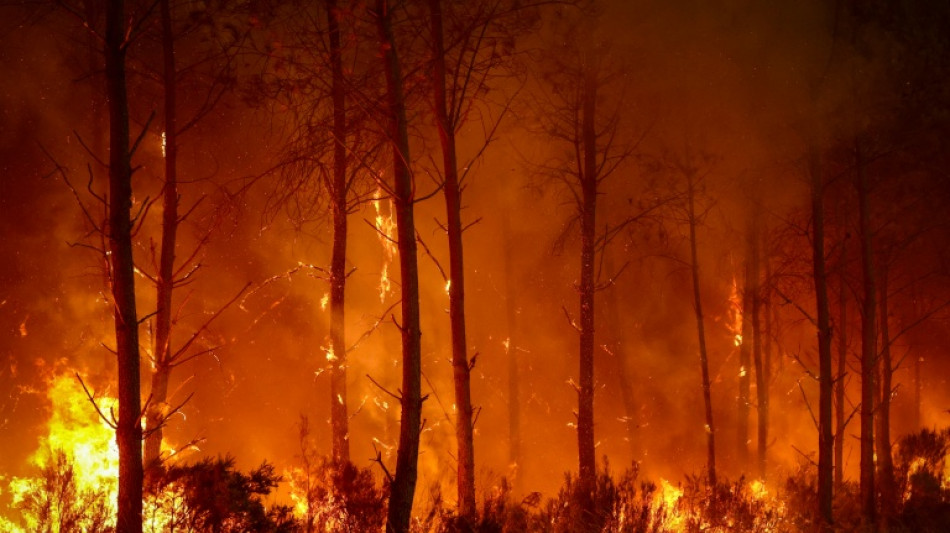
Southern Europe 'becoming more flammable' in hotter climate, experts say / Photo: © AFP

Southern Europe is "becoming more flammable" with the number of summer days primed for extreme fire conditions more than doubling since 1981, a new study found on Thursday.
Scientists said the "major intensification" of fire-prone weather was driven by climate change and especially pronounced in France and Spain, which have been battling some of their largest blazes since records began.
There were fewer fires today compared to the 1980s but more extreme and fast-spreading infernos, said the study, which assessed national wildfire statistics and weather and climate data.
The steep increase in the frequency of fire weather -- characterised by searing temperatures, low humidity, dryness, and strong winds -- "can only be attributed to global warming," said study co-author Raul Cordero.
"The number of days where the fire weather index is extreme have nearly tripled in some areas of southern Europe," Cordero, an atmospheric scientist from the University of Groningen in the Netherlands, told AFP.
Extreme fire conditions occurred on fewer than 10 days per summer between 1981-2010, but up to 25 days between 2016-2025 in France, Spain, Portugal, Italy and Greece, concluded the study in Scientific Reports.
"Until we stop global warming, the situation is going to be just worsening," Cordero said.
The enormous blazes in France and Spain follow successive heatwaves and the hottest June on record in western Europe last month.
Scientists attribute the record-shattering heat to climate change and say Europe, the fastest-warming continent, could face a tenfold increase in extreme fires this century.
- Extreme era -
The World Weather Attribution scientific group said this month that human-induced climate change had worsened a biting drought across Europe and fostered ideal conditions for wildfires.
Much of western Europe experienced a wetter winter before rapidly shifting to hotter, drier weather. The rain fuelled vegetation growth but the sudden heat baked it dry as a warmer atmosphere soaked up moisture from plants and soils.
The combination of climate-driven heat and tinderbox conditions were "the ingredients for a disaster", Cordero said.
"That disaster, unfortunately, is unfolding" in Spain and France, he said.
Despite a rebound in wildfire activity since 2018, the annual burned area in southern Europe remains lower in all countries except Portugal than during the 1980s, said the study.
Investments in fire fighting and containment, better-trained brigades and aerial resources like water bombers had helped drive a consistent decline in the number of fires in recent decades.
But paradoxically, this also created dangerous conditions by allowing fuel to build up. Fires were fewer but fiercer and could "quickly become catastrophic", the authors wrote.
"Europe has shifted toward fewer, but more intense and larger events" and was "entering an era of extreme fire risk", they said.
"Southern Europe is becoming more flammable."
The wildfire west of Bordeaux grew into France's largest since 1949. The inferno was so intense it created a "fire cloud" or pyrocumulonimbus -- an unprecedented phenomenon in France that can generate wind and lighting.
Meanwhile the Avila fire, west of Madrid, was the largest Spain has experienced since records began in 1961.
"You cannot stop the propagation of fires when the weather conditions are very extreme... it's not a matter of resources," said Cordero.
C.Rojas--TFWP