Protecting the protectors: racing to save Philippine mangroves / Photo: © AFP

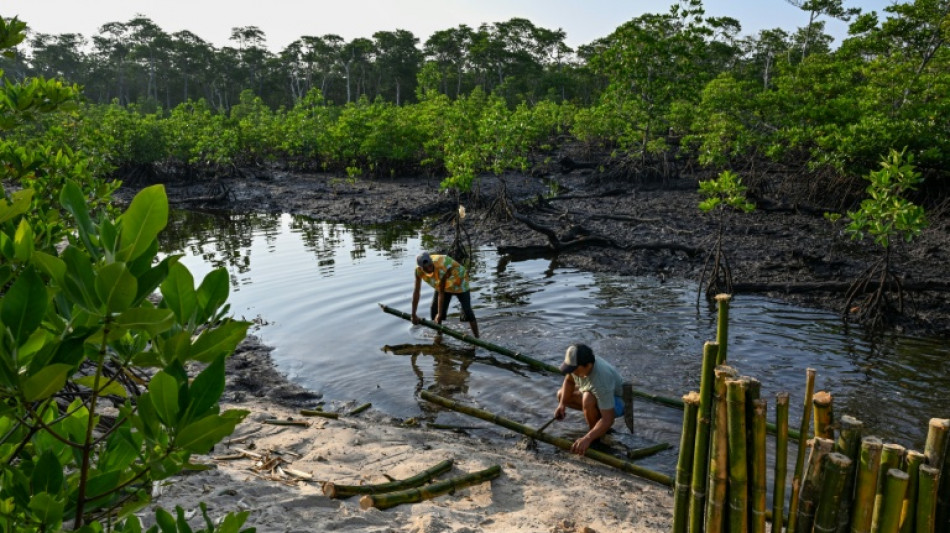
Standing knee-deep in coastal waters, environmentalist Andrea Pimentel guides workers as they drive bamboo poles into the seabed to block sediment from choking the tidal channel sustaining a mangrove forest.
Mangroves are a key natural defence against storm surges and coastal erosion in the Philippines, which is hit by around 20 typhoons each year.
But the country has lost over 60 percent of its mangrove cover since 1918, government data shows, and increasingly powerful storms are threatening what remains by stirring up sediment that clogs water channels and suffocates mangroves at the roots.
"Our typhoons are becoming frequent and getting stronger," said Andrea Pimentel, project manager for environmental organization WWF-Philippines.
"Even (if) mangroves are resilient, they can also be affected, and eventually they could die," she added, shortly before heading by boat to a mangrove site in Masbate province's Batuan town.
Pimentel works with local communities to rehabilitate mangroves across 245 hectares, including a two-hectare stretch where repeated typhoons have left bare patches in a once-dense forest.
Park ranger Bernard Almogera, who fished at the site with his father decades ago, has witnessed the mangroves deteriorate over the years.
"Some of them were snapped off, others like this one were uprooted," the 58-year-old told AFP, pointing to a tree with branches broken by previous storms.
Sweating under the morning sun, men hauled bamboo across the exposed mudflat while Almogera knelt nearby, cutting the stalks into 1.5-metre poles before driving them deep into the seabed with a heavier bamboo pole.
The fence they are building is intended to slow incoming waves so suspended sediment settles before reaching the tidal channel carrying seawater through the mangrove forest.
If the channel becomes clogged, water stagnates and the mangrove's roots are deprived of oxygen, eventually suffocating and killing them.
- A global problem -
"We're really scared, because if the mangroves disappear and a strong typhoon comes, our houses will surely be knocked down," Almogera said.
"There'll be nothing left to protect us."
Scientists warn that while bamboo fences are a cheap way to protect mangroves, they can rot within three years, unlike more expensive permeable concrete designs, leaving debris that may affect the trees they are meant to shield.
But they remain a quick, affordable way to protect mangroves in one of the world's most climate-vulnerable countries.
And the urgency is growing. Warming waters caused by climate change can produce stronger tropical storms.
The world's oceans experienced their hottest June on record, and could reach new highs in coming months as a strong El Nino weather pattern takes hold.
Pimentel said mangroves need immediate protection and rehabilitation, even if bamboo fences must be replaced before they deteriorate.
"If we don't act now, our mangroves will be vulnerable to climate change," she said.
The urgency extends beyond Masbate province.
A 2024 study by the International Union for Conservation of Nature found that half the world's mangrove ecosystems are at risk of collapse due to climate change, rising sea levels and human activity, with about a quarter potentially submerged by 2050 without proper conservation.
The Philippines suffered the second-highest mangrove losses, according to a 2023 survey of 10 Southeast Asian countries led by Filipino scientist Severino Salmo, with climate change impacts and the conversion of mangrove sites to seafood ponds largely to blame.
- 'Time we protect them' -
"It will be more difficult (for the mangroves) to adjust now because of the massive losses in the past," Salmo, who has been studying mangroves in the archipelago for more than three decades, told AFP.
Salmo warned they will only "decline more" in the coming years without proper restoration projects and better government policies.
"It's disappointing that we keep losing mangroves given how important they are," he said.
"For now, (the best response) should be to conserve whatever is left."
As workers continued assembling the bamboo fence, Pimentel looked around the forest and pointed to trees whose once grey-brown roots had turned charcoal black due to suffocation.
"Mangroves have always protected us from typhoons," she said.
"It's time we protect them too."
L.Holland--TFWP