Slow boat to Ilulissat: long nights on Greenland's last ferry / Photo: © AFP

It's Friday night and the port in Nuuk is a hive of activity. Passengers loaded down with heavy bags hurry aboard a rusty red and white ship -- Greenland's last ferry.
Among them are an ethnologist and a few Danish tourists, but most are Greenlanders from the 74 villages and settlements that dot the west coast, a thin strip of land squeezed between the ice sheet and the open sea just south of the Arctic Ocean.
Linking Qaqortoq in the south to Ilulissat almost 1,000 kilometres (620 miles) north, the ferry was for a long time the only means of transport in Greenland, until air travel took over.
With its old-fashioned charm and pervasive smell of linoleum, the vessel feels stuck in 1992, the year it was built.
The engine rumbled, and a last kiss was blown toward the quay. On deck, a passenger watched as Nuuk faded into the distance, just a glimmer under the northern lights.
Welcome aboard the Sarfaq Ittuk.
- Rural exodus -
The ship's crew swiftly got down to work, the cook battling heavy seas to line up colourful hors d'oeuvres.
Passengers shuffled cards and rolled dice, laughter rising up around the formica tables in the cafe, the ferry's social hub.
"We know each other. We're talking about family, friends, weddings," said Karen Rasmussen, 60.
The ferry offers villagers a chance to reconnect with those who left for the capital Nuuk during the rural exodus of the 1980s.
Karen looked out the porthole, her gaze absent. "I'm on morphine," she said, gingerly holding her broken arm to her chest.
Next to her, 56-year-old Arne Steenholdt was just diagnosed with cancer "around here", he said, pointing to his stomach.
Both residents of remote communities, they were returning home from hospital in Nuuk, the only facility offering advanced care.
In the evening, Steenholdt retired to his bunk, pulling the curtain to block out the light. Karen wasn't able to sleep a wink.
- Climate warming -
The ferry crossed the Arctic Circle on Saturday.
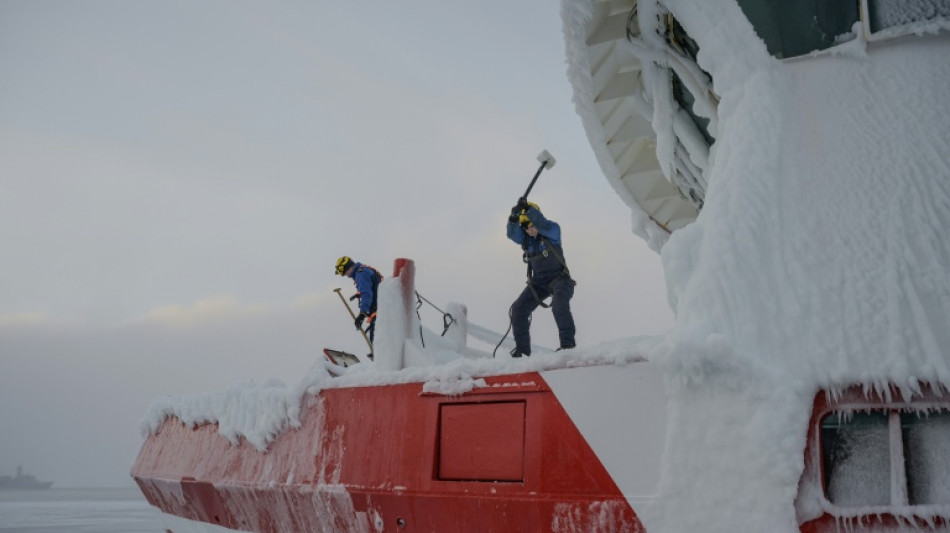
As waves crashed against the hull, a deckhand swept away the ice building up on deck. "You gotta take care of the old lady," he shouted, referring to the ferry.
Normally ships only resume sailing at these latitudes in late April, when the coast is free from the pack ice that drifts in from neighbouring Canada.
But in this exceptionally mild year, the Sarfaq Ittuk resumed its route in mid-February because the ice was "very late" and formed only a thin layer, Captain Jens Peter Berthelsen said.
Greenland's west coast registered its warmest January on record, with temperatures up to 11C warmer than usual, according to the Danish Meteorological Institute.
Berthelsen kept his eyes fixed on the horizon. "The challenge is to detect the underwater icebergs."
Global warming has made it more difficult to predict when the pack ice will return.
"Ten or 15 years ago it was in September, and now it's only late December or January," he said.
- Rise of air travel –
Mass was held in Greenlandic in the cafe on Sunday, glassware rattling from the ferry's vibrations. As it approached Ilulissat, it steered through the thin pack ice scraping against the hull.
In the bay, the ice rippling in the ship's wake had something magical about it, but not for Ludvig Larsen. He was bored.
"The helicopter was cancelled, so I had to take the boat," said the 60-year-old referee headed to Ilulissat for a football tournament.
In recent years, he's started flying instead of taking the ferry, enabling him to reach Greenland's "iceberg capital" in just 25 minutes.
Now he was spending the day at sea.
On the west coast, climate change is causing more humidity and fog, leading to more flight cancellations.
Greenland has gambled on air travel: Nuuk's international airport opened in 2024, and two others will follow this year in the south and north to better connect the island's 57,000 inhabitants and attract tourists.
Due to a lack of sufficient funding, the government must choose between taking the Sarfaq Ittuk out of service in 2027, despite some 22,000 passengers a year, or investing in a high‑end tourist vessel.
Asked if he was worried the ferry may stop running, Ludvig Larsen said he "didn't think about it".
In the bay behind him, a wall of ice loomed out of the mist, before the small town of Ilulissat emerged from the white vastness: the end of the line.
As passengers disembarked, a young girl ran into a friend's arms, sobbing. Children chased each other, laughing. Tourists snapped photographs of every falling snowflake.
Meanwhile, the new passengers hauled their luggage up the gangway.
On deck, the captain and crew used heavy sledgehammers to break up the thick shell of ice covering the ferry.
That evening, the Sarfaq Ittuk would head south again.
M.T.Smith--TFWP