The Fort Worth Press - AI to track icebergs adrift at sea in boon for science

USD -
AED 3.67325
AFN 64.000216
ALL 81.214524
AMD 374.479795
ANG 1.789884
AOA 917.000156
ARS 1367.489401
AUD 1.397029
AWG 1.797375
AZN 1.697133
BAM 1.660575
BBD 2.014018
BDT 122.97229
BGN 1.668102
BHD 0.377239
BIF 2973.054439
BMD 1
BND 1.272177
BOB 6.909844
BRL 4.993501
BSD 0.999962
BTN 93.39243
BWP 13.417166
BYN 2.853989
BYR 19600
BZD 2.01114
CAD 1.374335
CDF 2310.000323
CHF 0.781435
CLF 0.022516
CLP 886.229969
CNY 6.81765
CNH 6.81621
COP 3619.87
CRC 458.927866
CUC 1
CUP 26.5
CVE 93.622242
CZK 20.62155
DJF 178.069863
DKK 6.333645
DOP 59.588451
DZD 132.155049
EGP 52.020298
ERN 15
ETB 156.136584
EUR 0.84754
FJD 2.19835
FKP 0.737283
GBP 0.736905
GEL 2.684982
GGP 0.737283
GHS 11.039788
GIP 0.737283
GMD 73.503425
GNF 8772.399037
GTQ 7.645054
GYD 209.205767
HKD 7.834235
HNL 26.55923
HRK 6.387497
HTG 130.843264
HUF 309.310987
IDR 17145.4
ILS 2.997899
IMP 0.737283
INR 93.27485
IQD 1309.960985
IRR 1316125.00023
ISK 121.86982
JEP 0.737283
JMD 157.796202
JOD 0.708993
JPY 158.989898
KES 129.249866
KGS 87.450298
KHR 4005.111463
KMF 417.999851
KPW 900.002027
KRW 1474.834981
KWD 0.3089
KYD 0.833287
KZT 474.398108
LAK 22062.594461
LBP 89546.928864
LKR 315.481573
LRD 183.996468
LSL 16.407402
LTL 2.95274
LVL 0.60489
LYD 6.326282
MAD 9.247613
MDL 17.099627
MGA 4148.623635
MKD 52.258133
MMK 2100.230461
MNT 3576.383271
MOP 8.070372
MRU 39.92732
MUR 46.250032
MVR 15.460211
MWK 1733.914107
MXN 17.253698
MYR 3.954998
MZN 63.955032
NAD 16.407542
NGN 1346.750103
NIO 36.799137
NOK 9.39285
NPR 149.427083
NZD 1.693385
OMR 0.384512
PAB 0.999966
PEN 3.38834
PGK 4.333558
PHP 60.052498
PKR 278.861987
PLN 3.58888
PYG 6391.02692
QAR 3.645912
RON 4.314905
RSD 99.493951
RUB 75.470192
RWF 1464.408679
SAR 3.751537
SBD 8.04851
SCR 14.435944
SDG 600.999603
SEK 9.163825
SGD 1.271185
SHP 0.746601
SLE 24.649705
SLL 20969.496166
SOS 571.515905
SRD 37.425056
STD 20697.981008
STN 20.802466
SVC 8.749475
SYP 110.584383
SZL 16.396588
THB 32.036498
TJS 9.449709
TMT 3.505
TND 2.90332
TOP 2.40776
TRY 44.7497
TTD 6.787576
TWD 31.566001
TZS 2595.000375
UAH 43.546827
UGX 3695.197178
UYU 40.219565
UZS 12189.188845
VES 477.02885
VND 26330
VUV 119.010039
WST 2.730706
XAF 556.960123
XAG 0.012563
XAU 0.000208
XCD 2.70255
XCG 1.802165
XDR 0.691898
XOF 556.941207
XPF 101.261309
YER 238.525011
ZAR 16.382494
ZMK 9001.201116
ZMW 19.174011
ZWL 321.999592
  • RYCEF

    -0.0600

    17.6

    -0.34%

  • NGG

    -1.0600

    87.89

    -1.21%

  • GSK

    -1.4850

    57.695

    -2.57%

  • RIO

    -0.3200

    98.55

    -0.32%

  • BTI

    -0.3650

    57.145

    -0.64%

  • BCC

    -2.4700

    79.25

    -3.12%

  • BCE

    0.0650

    23.915

    +0.27%

  • VOD

    -0.0750

    15.545

    -0.48%

  • RELX

    0.8750

    35.585

    +2.46%

  • CMSC

    0.0700

    22.71

    +0.31%

  • BP

    0.0950

    46.265

    +0.21%

  • AZN

    -4.3550

    200.025

    -2.18%

  • CMSD

    0.1700

    23

    +0.74%

  • JRI

    0.0796

    12.8661

    +0.62%

  • RBGPF

    -13.5000

    69

    -19.57%

AI to track icebergs adrift at sea in boon for science
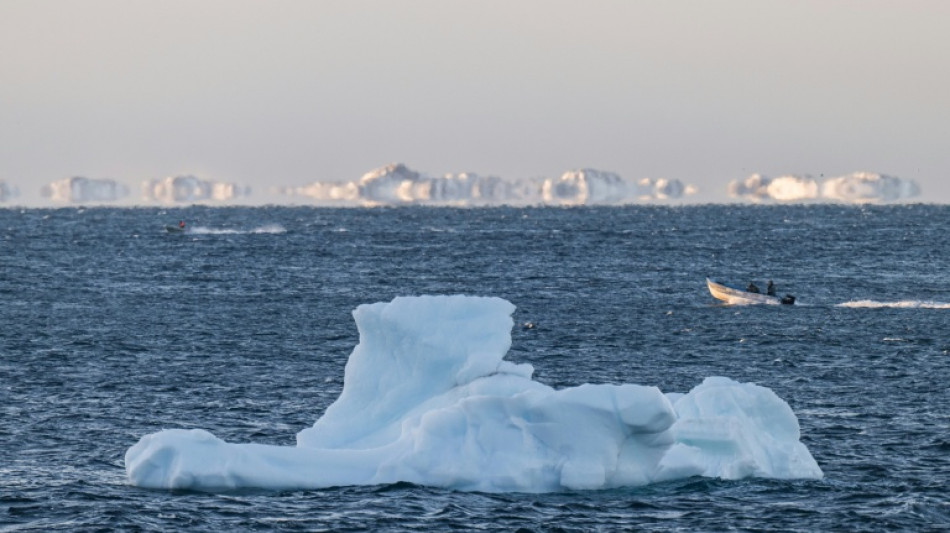
AI to track icebergs adrift at sea in boon for science / Photo: © AFP

AI to track icebergs adrift at sea in boon for science

British scientists said Thursday that a world-first AI tool to catalogue and track icebergs as they break apart into smaller chunks could fill a "major blind spot" in predicting climate change.

Text size:

Icebergs release enormous volumes of freshwater when they melt on the open water, affecting global climate patterns and altering ocean currents and ecosystems.

But scientists have long struggled to keep track of these floating behemoths once they break into thousands of smaller chunks, their fate and impact on the climate largely lost to the seas.

To fill in the gap, the British Antarctic Survey has developed an AI system that automatically identifies and names individual icebergs at birth and tracks their sometimes decades-long journey to a watery grave.

Using satellite images, the tool captures the distinct shape of icebergs as they break off -- or calve -- from glaciers and ice sheets on land.

As they disintegrate over time, the machine performs a giant puzzle problem, linking the smaller "child" fragments back to the "parent" and creating detailed family trees never before possible at this scale.

It represents a huge improvement on existing methods, where scientists pore over satellite images to visually identify and track only the largest icebergs one by one.

The AI system, which was tested using satellite observations over Greenland, provides "vital new information" for scientists and improves predictions about the future climate, said the British Antarctic Survey.

Knowing where these giant slabs of freshwater were melting into the ocean was especially crucial with ice loss expected to increase in a warming world, it added.

"What's exciting is that this finally gives us the observations we've been missing," Ben Evans, a machine learning expert at the British Antarctic Survey, said in a statement.

"We've gone from tracking a few famous icebergs to building full family trees. For the first time, we can see where each fragment came from, where it goes and why that matters for the climate."

This use of AI could also be adapted to aid safe passage for navigators through treacherous polar regions littered by icebergs.

Iceberg calving is a natural process. But scientists say the rate at which they were being lost from Antarctica is increasing, probably because of human-induced climate change.

D.Ford--TFWP