The Fort Worth Press - What to know about America's colossal winter storm

USD -
AED 3.672503
AFN 64.999691
ALL 80.801578
AMD 379.052619
ANG 1.79008
AOA 916.999736
ARS 1444.500099
AUD 1.416842
AWG 1.80125
AZN 1.698647
BAM 1.635086
BBD 2.015232
BDT 122.267785
BGN 1.67937
BHD 0.376957
BIF 2963.891885
BMD 1
BND 1.262572
BOB 6.913877
BRL 5.198596
BSD 1.000552
BTN 91.90563
BWP 13.092058
BYN 2.844901
BYR 19600
BZD 2.012306
CAD 1.353245
CDF 2240.00018
CHF 0.766155
CLF 0.021855
CLP 862.940201
CNY 6.95465
CNH 6.944499
COP 3670.36
CRC 496.603616
CUC 1
CUP 26.5
CVE 92.184025
CZK 20.290499
DJF 178.171634
DKK 6.23463
DOP 62.953287
DZD 129.170913
EGP 46.828299
ERN 15
ETB 155.581807
EUR 0.83498
FJD 2.19255
FKP 0.725629
GBP 0.723695
GEL 2.695023
GGP 0.725629
GHS 10.935965
GIP 0.725629
GMD 72.999826
GNF 8779.982109
GTQ 7.676359
GYD 209.330809
HKD 7.802375
HNL 26.404826
HRK 6.292604
HTG 131.029265
HUF 317.665007
IDR 16792.9
ILS 3.097875
IMP 0.725629
INR 92.13035
IQD 1310.716137
IRR 42125.000158
ISK 120.909849
JEP 0.725629
JMD 156.845533
JOD 0.709016
JPY 153.06801
KES 129.020107
KGS 87.450068
KHR 4022.138062
KMF 412.000161
KPW 899.941848
KRW 1427.055019
KWD 0.30648
KYD 0.833849
KZT 504.129951
LAK 21556.00515
LBP 89599.377999
LKR 309.821593
LRD 185.10375
LSL 15.909425
LTL 2.95274
LVL 0.60489
LYD 6.283493
MAD 9.046646
MDL 16.778972
MGA 4464.341698
MKD 51.518343
MMK 2099.981308
MNT 3572.641598
MOP 8.041032
MRU 39.942314
MUR 45.089727
MVR 15.459889
MWK 1734.990323
MXN 17.15595
MYR 3.932505
MZN 63.759785
NAD 15.909425
NGN 1396.979544
NIO 36.81874
NOK 9.568015
NPR 147.04884
NZD 1.64732
OMR 0.384496
PAB 1.000548
PEN 3.347838
PGK 4.282979
PHP 58.838027
PKR 279.904359
PLN 3.512395
PYG 6719.056974
QAR 3.637952
RON 4.2543
RSD 98.049121
RUB 76.546809
RWF 1459.772854
SAR 3.750444
SBD 8.077676
SCR 13.754459
SDG 601.499692
SEK 8.814695
SGD 1.262405
SHP 0.750259
SLE 24.301353
SLL 20969.499267
SOS 570.833804
SRD 38.092029
STD 20697.981008
STN 20.482723
SVC 8.754828
SYP 11059.574895
SZL 15.902821
THB 31.124502
TJS 9.35016
TMT 3.5
TND 2.861454
TOP 2.40776
TRY 43.416037
TTD 6.791011
TWD 31.289758
TZS 2559.999583
UAH 42.769647
UGX 3582.341606
UYU 37.863461
UZS 12105.606367
VES 358.476151
VND 26068.5
VUV 119.671185
WST 2.725359
XAF 548.392544
XAG 0.008508
XAU 0.000181
XCD 2.702549
XCG 1.803217
XDR 0.682024
XOF 548.390252
XPF 99.704048
YER 238.404736
ZAR 15.70445
ZMK 9001.186468
ZMW 19.885632
ZWL 321.999592
  • SCS

    0.0200

    16.14

    +0.12%

  • RBGPF

    0.0000

    82.4

    0%

  • CMSD

    -0.0457

    24.0508

    -0.19%

  • RYCEF

    -0.5500

    16.6

    -3.31%

  • AZN

    -2.3800

    93.22

    -2.55%

  • NGG

    0.3700

    84.68

    +0.44%

  • RELX

    -0.9800

    37.38

    -2.62%

  • GSK

    -0.7000

    50.1

    -1.4%

  • VOD

    0.0700

    14.57

    +0.48%

  • CMSC

    -0.1000

    23.7

    -0.42%

  • BCE

    -0.2500

    25.27

    -0.99%

  • RIO

    0.4600

    93.37

    +0.49%

  • BTI

    -0.1800

    60.16

    -0.3%

  • BCC

    -0.8900

    80.85

    -1.1%

  • BP

    0.0800

    37.7

    +0.21%

  • JRI

    -0.6900

    12.99

    -5.31%

What to know about America's colossal winter storm
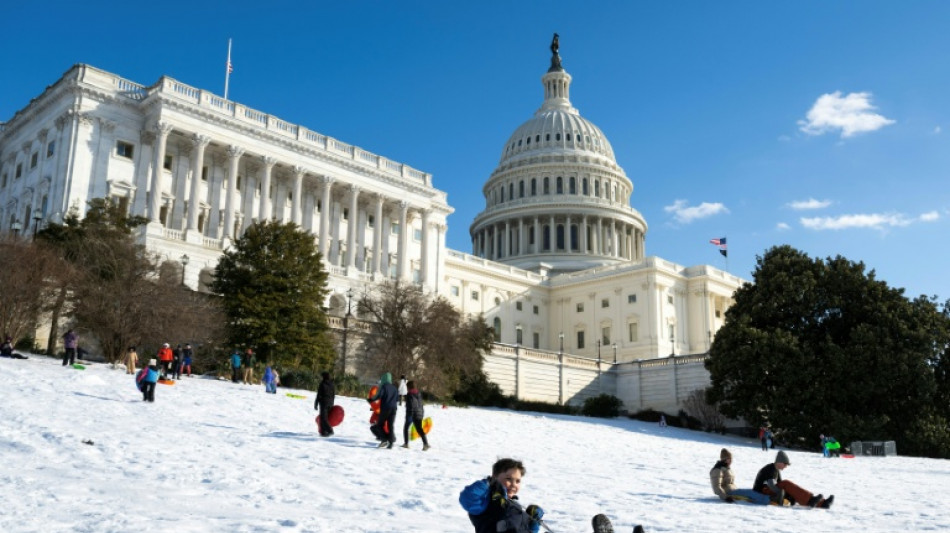
What to know about America's colossal winter storm / Photo: © AFP

What to know about America's colossal winter storm

A deep freeze is gripping large swaths of the United States after a monster storm killed dozens of people from the Northeast to the Deep South, knocked out power to hundreds of thousands and sent air travel into chaos.

Text size:

Another Arctic blast expected this weekend could deliver record lows and threaten another major storm -- even as municipalities are digging out from deep piles of snow and ice.

Here's what to know.

- Dozens dead -

The storm was linked to at least 31 deaths, according to a compilation of state government and local media reports, with causes including hypothermia as well as accidents related to traffic, sledding, all-terrain vehicles and snowplows.

That toll is expected to climb after New York Mayor Zohran Mamdani said Tuesday at least 10 New Yorkers had lost their lives after being found outdoors, though whether all the deaths were from hypothermia has yet to be determined.

In Maine, seven people were killed when a small plane crashed while attempting to take off during a snowstorm in Bangor, the Federal Aviation Administration said.

Tennessee, Texas, Mississippi and Louisiana were badly impacted by power outages, with more than 550,000 customers without electricity by midday Tuesday, according to the tracking site Poweroutage.com.

Air travel was also severely disrupted. More than 9,000 flights were canceled on Sunday -- more than on any day since the Covid pandemic -- as the storm paralyzed transportation across the country.

- Heavy snowfall -

The heaviest snowfall of 31 inches occurred in Bonito Falls, New Mexico -- followed by East Napanoch in upstate New York, where 30 inches fell, according to preliminary figures on the National Weather Service's snowfall reports tool.

Many of the hardest-hit areas were in the South, where authorities are less accustomed -- and often less equipped -- to deal with severe winter weather.

- More to come -

The National Weather Service warns that much of the northern half of the country will remain continuously below freezing through February 1, with another blast of arctic air expected to bring "the coldest temperature seen in several years for some places and the longest duration of cold in decades."

At the same time, a potentially significant coastal winter storm could spill out of Canada along the East Coast, spreading widespread precipitation as a low-pressure system collides with frigid air. Forecasters say it is still too early to determine the storm's exact track, or whether it will fall as rain or snow.

- Climate change -

It may sound counterintuitive, but a growing body of research suggests climate change could be playing a role in disruptions to the polar vortex -- a vast region of cold, low-pressure air that normally circulates high above the Arctic.

Scientists advancing this theory argue that uneven Arctic warming across Europe and Asia can amplify large atmospheric waves, making it more likely for the polar vortex to wobble and spill south over North America.

The science, however, remains contested, and researchers caution that natural climate variability also plays a role.

S.Jordan--TFWP