Wine growers 'on tip of Africa' race to adapt to climate change / Photo: © AFP

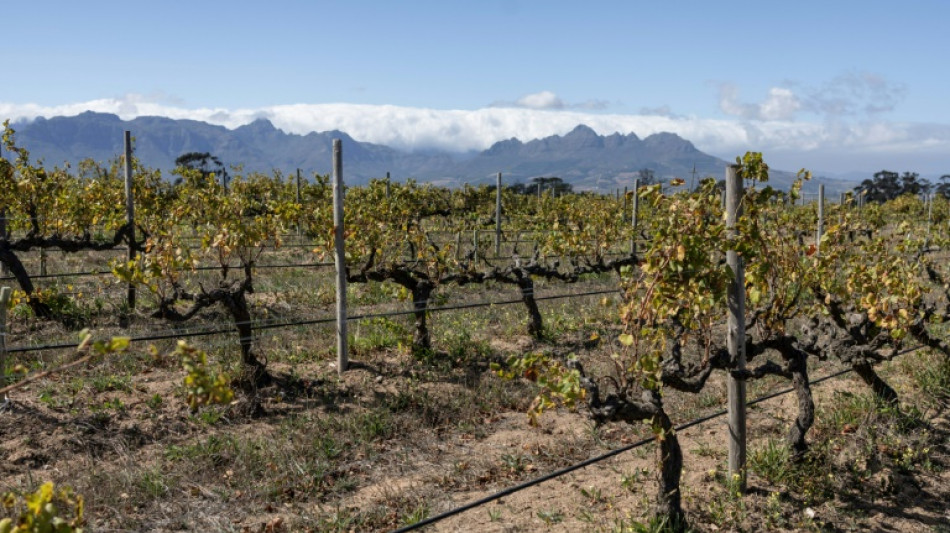
At a South African wine farm, dry, uprooted grapevines are stacked at the bottom of a hilly stretch of brown fallow land.
Much of the vineyard is being replanted to better cope with climate change, which is projected to bring rarer but more violent rainfall to this wine-loving corner of the world.
From Australia to California, France, Spain and Italy, producers in wine-growing regions around the world face a race to adapt to a changing climate which affects the grapes.
"I don't like just accepting things. Let's put up a bit of a fight," said Rosa Kruger, the viticultural consultant overseeing the project in the Cape Winelands region east of Cape Town.
Like other wine farms surrounding the city of Stellenbosch, the Reyneke estate's vineyards were ill-equipped to withstand climatic shocks, she said.
"In the old days we used to have square blocks," Kruger, 64, sporting boots, jeans and a dark windbreaker jacket, told AFP of the planting set-up she is in the process of replacing.
To better deal with heavy rains, the new grapevines are being laid out to conform with the hilly landscape.
The replanting is done in phases, with old vines notably Chenin, the emblematic grape variety of France's Loire region, keeping up production while the new ones grow.
It can take them up to four years to become productive.
"We designed the vineyards according to the natural lay of the land," said Kruger.
- Erratic climate -
Drains to collect rainwater run between each plot, converging into a reservoir that is to provide water during dry spells.
Native shrubs have also been planted across the estate to increase biodiversity, bringing back insects and other animals in a bid to render the surrounding soil healthier.
Pine trees brought by European settlers that used to stand at the edge of the vineyards have been uprooted as they used too much water.
Natural fertiliser is provided by dozens of cows living on the property.
"We want to build and conceive the perfect farm, one that will still be relevant in 50 or 100 years," said Rudiger Gretschel, 46, Reyneke's chief winemaker and director.
The estate enjoys fairly favourable conditions like "granite soils" and "proximity to the ocean", he said.
But growing grapes "on the tip of Africa" can be a challenge.
"Climate is already erratic," he said. "We already get very little rain. It is already very hot."
Things are set to get worse.
The planet is on track for a disastrous heating of up to almost 3 degrees Celsius this century, according to the United Nations.
And Stellenbosch's Western Cape province is expected to see a 30-percent decrease in annual rainfall by 2050, according to other projections.
While less frequent, rains are set to become more intense -- making flooding more common.
"If people don't believe in global warming, they should come to South Africa," said Kruger, who says she faced a good deal of scepticism when she started advocating for climate adaptation more than a decade ago.
Less than an hour's drive away, Cape Town already suffers from water shortages.
"When the rains are fewer, that water will go to the city people, not to the farmers," Kruger said. "That's why it is crucial to become self-sufficient. That's the whole idea."
S.Jones--TFWP