The Fort Worth Press - Quebec the new epicenter of Canada's raging wildfires

USD -
AED 3.672498
AFN 66.278316
ALL 82.286767
AMD 381.405623
ANG 1.790403
AOA 916.999793
ARS 1450.706703
AUD 1.513581
AWG 1.8
AZN 1.698045
BAM 1.668053
BBD 2.013416
BDT 122.25212
BGN 1.66911
BHD 0.376892
BIF 2955.517555
BMD 1
BND 1.290672
BOB 6.907492
BRL 5.522098
BSD 0.999672
BTN 90.191513
BWP 13.210404
BYN 2.933001
BYR 19600
BZD 2.010516
CAD 1.378835
CDF 2264.000414
CHF 0.7951
CLF 0.023226
CLP 911.140143
CNY 7.04125
CNH 7.036675
COP 3863.71
CRC 498.08952
CUC 1
CUP 26.5
CVE 94.043045
CZK 20.770014
DJF 178.015071
DKK 6.373899
DOP 62.81557
DZD 129.690059
EGP 47.531396
ERN 15
ETB 155.468002
EUR 0.853102
FJD 2.28425
FKP 0.746872
GBP 0.74752
GEL 2.689727
GGP 0.746872
GHS 11.495998
GIP 0.746872
GMD 73.501894
GNF 8739.594705
GTQ 7.656257
GYD 209.143749
HKD 7.781275
HNL 26.330401
HRK 6.428399
HTG 130.92649
HUF 330.617817
IDR 16751.25
ILS 3.20355
IMP 0.746872
INR 90.15685
IQD 1309.515179
IRR 42125.000016
ISK 125.929659
JEP 0.746872
JMD 159.951556
JOD 0.709052
JPY 155.995027
KES 128.950128
KGS 87.450063
KHR 4003.445658
KMF 420.999734
KPW 899.993999
KRW 1478.805034
KWD 0.306899
KYD 0.83301
KZT 515.774122
LAK 21648.038141
LBP 89518.671881
LKR 309.300332
LRD 176.937412
LSL 16.761238
LTL 2.95274
LVL 0.60489
LYD 5.418406
MAD 9.162342
MDL 16.859064
MGA 4495.599072
MKD 52.499158
MMK 2100.057046
MNT 3547.602841
MOP 8.012145
MRU 39.906011
MUR 46.10406
MVR 15.459757
MWK 1733.41976
MXN 18.005101
MYR 4.0825
MZN 63.910384
NAD 16.761166
NGN 1455.979562
NIO 36.785119
NOK 10.16495
NPR 144.308882
NZD 1.735675
OMR 0.384372
PAB 0.999663
PEN 3.365814
PGK 4.308816
PHP 58.6977
PKR 280.102006
PLN 3.58523
PYG 6673.859367
QAR 3.645474
RON 4.343302
RSD 100.111728
RUB 79.948639
RWF 1455.461927
SAR 3.750853
SBD 8.140117
SCR 13.592982
SDG 601.496241
SEK 9.29012
SGD 1.291295
SHP 0.750259
SLE 24.101968
SLL 20969.503664
SOS 570.329558
SRD 38.678006
STD 20697.981008
STN 20.895879
SVC 8.747159
SYP 11058.365356
SZL 16.766099
THB 31.4145
TJS 9.231602
TMT 3.51
TND 2.921974
TOP 2.40776
TRY 42.809903
TTD 6.783
TWD 31.562501
TZS 2490.000132
UAH 42.222895
UGX 3571.01736
UYU 39.172541
UZS 12055.48851
VES 279.213397
VND 26313
VUV 121.372904
WST 2.784715
XAF 559.461142
XAG 0.015167
XAU 0.000231
XCD 2.70255
XCG 1.801636
XDR 0.695787
XOF 559.458756
XPF 101.714719
YER 238.449719
ZAR 16.75075
ZMK 9001.203721
ZMW 22.742295
ZWL 321.999592
  • SCS

    0.0200

    16.14

    +0.12%

  • RBGPF

    0.0000

    80.22

    0%

  • RELX

    0.0900

    40.65

    +0.22%

  • RYCEF

    0.5400

    15.4

    +3.51%

  • CMSD

    0.0000

    23.28

    0%

  • VOD

    -0.0100

    12.8

    -0.08%

  • NGG

    -0.7700

    76.39

    -1.01%

  • RIO

    0.4400

    77.63

    +0.57%

  • CMSC

    0.0300

    23.29

    +0.13%

  • BCE

    -0.3000

    22.85

    -1.31%

  • GSK

    -0.4200

    48.29

    -0.87%

  • BCC

    1.4100

    77.7

    +1.81%

  • AZN

    0.7500

    90.61

    +0.83%

  • JRI

    0.0000

    13.43

    0%

  • BTI

    -0.1300

    57.04

    -0.23%

  • BP

    -1.1600

    33.31

    -3.48%

Quebec the new epicenter of Canada's raging wildfires
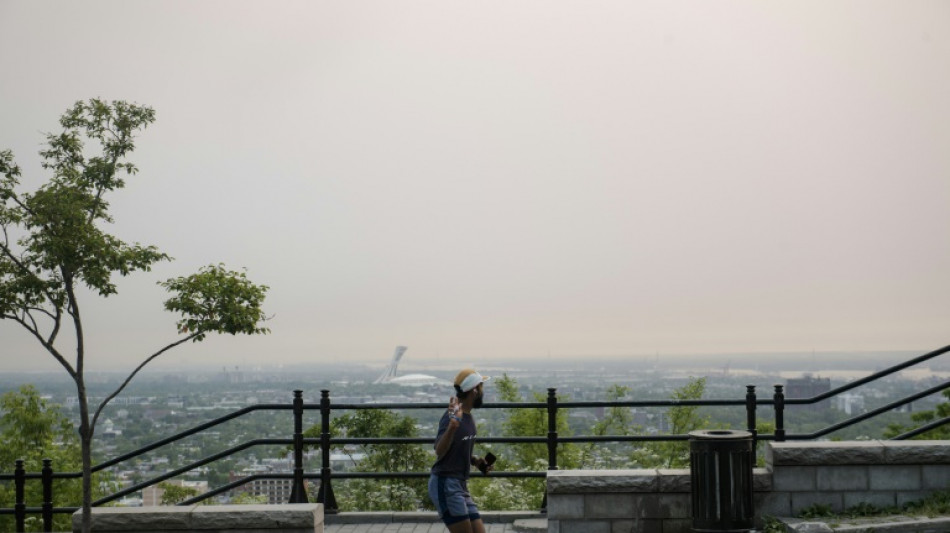
Quebec the new epicenter of Canada's raging wildfires / Photo: © AFP

Quebec the new epicenter of Canada's raging wildfires

Canada's Quebec province, not used to the huge number, scale and strength of wildfires ravaging the rest of the country, has become the latest hotspot with about 160 fires burning on Tuesday, most of those out of control.

Text size:

In the hardest-hit Abitibi-Temiscamingue region of the province, more than 650 kilometers (400 miles) north of Montreal, fires that have disrupted mining and forestry operations are "worrying," said Quebec Premier François Legault.

"We are experiencing a situation never seen... everywhere in Quebec," warned Francois Bonnardel, Quebec's public safety minister, stressing that a large number of these fires were sparked by human carelessness.

"Western Canada usually sees a lot of wildfire activity. Quebec doesn't," he noted. "But right now everything is on fire."

Some 4,400 evacuees were permitted to return to their homes in the northern city of Sept-Iles on the shores of the St. Lawrence River as rains arrived to help stall advancing blazes.

"We are very, very happy to see rain," Legault told a news conference.

But further north, he added, there's "a huge fire which will take weeks to extinguish completely, so we must remain cautious."

- Smoke and ash -

Canada has been hit repeatedly by extreme weather in recent years, the intensity and frequency of which have increased due to global warming.

After major flare-ups in the west of the country in May, notably in the prairie provinces of Alberta and Saskatchewan, firefighting shifted in recent weeks to Nova Scotia on the Atlantic coast, before turning to Quebec.

Dozens of fires are still burning in the west of the country: 62 in Alberta, 76 in westernmost British Columbia and 24 in Saskatchewan.

Quebec, meanwhile, has recorded 424 wildfires since the spring thaw -- more than double the average annual count over the past decade.

About 100 firefighters from France were scheduled to arrive by Friday to help fight the Quebec wildfires. This is on top of nearly 1,000 firefighters from Australia, Mexico, New Zealand, South Africa and the United States who have arrived or were en route to bolster firefighting efforts across Canada.

Wildfire smoke on Tuesday strangled the capital, Ottawa, prompting severe air quality alerts, and darkened skies above Montreal and Toronto. Officials urged residents to limit outdoor activities and said the smoke would not likely clear for another few days.

In Parliament, lawmakers complained about the smell of smoke and ash coating surfaces.

Ottawa resident Abe Bourgi told AFP he woke up to a yellowish haze over the city, and the sun a deep orange color.

"The smell of smoke is very strong," he said. "Many people are wearing masks in the streets and you have to close the doors and windows otherwise your apartment will smell like an ashtray."

Similar smoke conditions -- stemming from the Canadian fires -- were reported down the US Atlantic seaboard, triggering air quality alerts. In New York, the Manhattan skyline was barely visible from other boroughs.

S.Rocha--TFWP