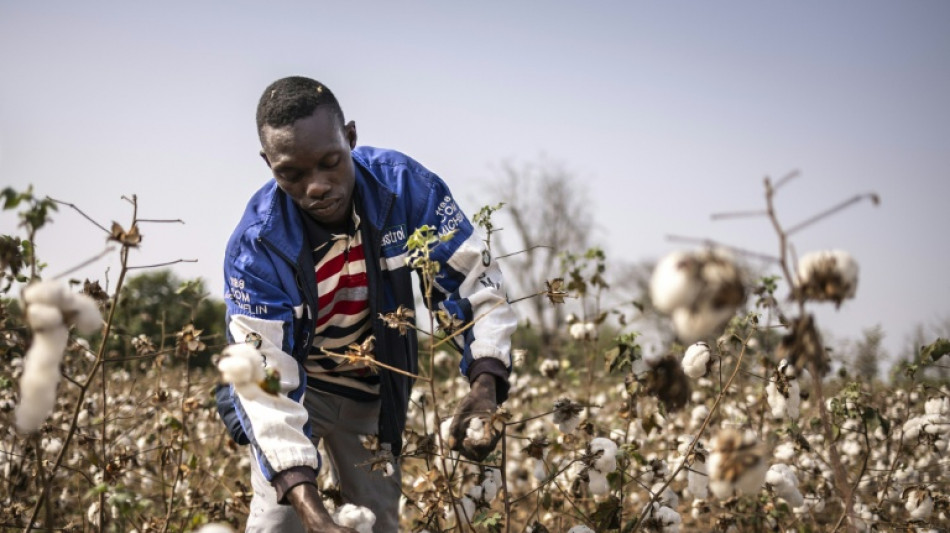
Africa sets out stall for cotton at the WTO / Photo: © AFP

African countries are taking a stand at the World Trade Organization to bolster their cotton sector, launching a platform tasked with mobilising investment to transform the cotton, textile and clothing value chain.
"The cotton sector represents one of the most promising drivers of industrialisation in Africa, particularly in West and Central Africa," said Cameroon's Trade Minister Luc Magloire Mbarga Atangana, at a meeting on cotton ahead of the WTO's ministerial conference, which opened Thursday in the Cameroonian capital Yaounde.
WTO chief Ngozi Okonjo-Iweala explained: "Currently, 98 percent of the region's cotton is exported as raw fibre; the goal is to change that."
Cotton has been discussed at the WTO for more than 20 years, at the request of the so-called Cotton Four (C-4) group: Benin, Burkina Faso, Chad and Mali.
These countries, later joined by Ivory Coast to form the C-4+, want to see an end to US, Chinese and European subsidies in their cotton sectors, arguing that they create unfair competition.
"This request has never been met," WTO Deputy Director-General Jean-Marie Paugam told AFP.
"No partner country in Africa or the C-4 has been willing to negotiate solely on one sector.
"These countries maintain this demand as a priority, but while waiting for progress in these negotiations, they are focusing their efforts on developing the cotton sector by promoting the processing of cotton products," he added.
"The goal is to increase added value."
- Vital role -
According to 2024 WTO data, these countries -- the largest cotton producers in Africa -- generate more than one million tonnes of cotton per year, representing 50 percent of Africa's total production and four percent of global production.
West Africa is the fourth-biggest cotton exporter, behind Brazil, the United States and Australia, figures from the International Cotton Advisory Committee (ICAC) show.
Benin, the leading producer in West Africa, exported $505 million worth of raw cotton in 2024, ranking fifth globally among raw cotton exporters.
That year, raw cotton was Benin's most exported product, according to the Observatory of Economic Complexity (OEC).
In Burkina Faso, around four million of the country's 23 million inhabitants depend directly or indirectly on the cotton sector.
According to the Burkinabe trade ministry, cotton represents four percent of GDP and about 14 percent of the country's export earnings.
Cotton thus plays a vital role in the C-4+ economies, but these countries primarily export raw cotton because they lack processing facilities.
As a result, the gains made by women and young people, who make up most of the workforce in this sector, remain marginal, according to the WTO.
- Open for business -
It is in this spirit that the WTO and football's world governing body FIFA launched a cotton partnership at the last WTO Ministerial Conference in Abu Dhabi in 2024.
The initiative aims to support the participation of African countries in the cotton value chain -- from production to processing and the export of finished products -- particularly in the sportswear market.
Development banks and other organisations have since joined the initiative.
According to the WTO, the C-4+ countries would need to attract $12 billion in investments over 10 years to unlock the sector's full potential.
It is estimated that, if realised, these investments would generate approximately 500,000 direct jobs, as well as 1.5 million indirect jobs throughout the cotton value chain.
On Wednesday, these countries, together with the WTO, launched the Partnership for Cotton Investment Platform, showcasing investment opportunities.
"The C-4 and Ivory Coast are open for business here and now!" said Mali's trade and industry minister Moussa Alassane Diallo.
"Thanks to the cotton partnership, we now have a credible roadmap, feasibility studies, and a clear institutional framework" for investments, he said.
S.Weaver--TFWP