UK households advised to prepare for three days without essential services

The UK government has issued public guidance urging households to be ready to manage for at least three days if power, water, communications or other essential services fail.
The UK government has issued public guidance urging households to be ready to manage for at least three days if power, water, communications or other essential services fail.
The Government says recent extreme weather has demonstrated how quickly everyday life can be disrupted, while modern households have become increasingly dependent on electricity and digital technology.
A prolonged power cut, for example, could affect far more than lighting. Home broadband routers would stop working, mobile phone masts could lose power, central heating systems might fail and electronic payment systems could become unavailable.
Even some gas boilers require electricity to operate, meaning households could be left without heating or hot water despite having a gas supply.
The Government also advises people to consider how they would obtain reliable information if mobile networks or the internet became unavailable.
Security Minister Dan Jarvis said:
“Those who can follow this advice should follow this advice. By taking simple steps to be ready for everyday emergencies like severe storms, people can reduce pressure on emergency services, helping them prioritise people who need more support in an emergency.”
He added that the campaign would bring Britain into line with European countries where similar household preparedness advice is already commonplace.
France, Ireland and the Netherlands already encourage residents to prepare for several days of disruption.
More than 500 organisations, including charities and businesses, have signed up to help promote the British campaign.
The Government stresses that preparing does not mean stockpiling large quantities of goods or spending considerable sums of money.
Instead, households are being encouraged to check what they already have in their cupboards and gradually build up a small collection of useful supplies.
What should every household keep at home?
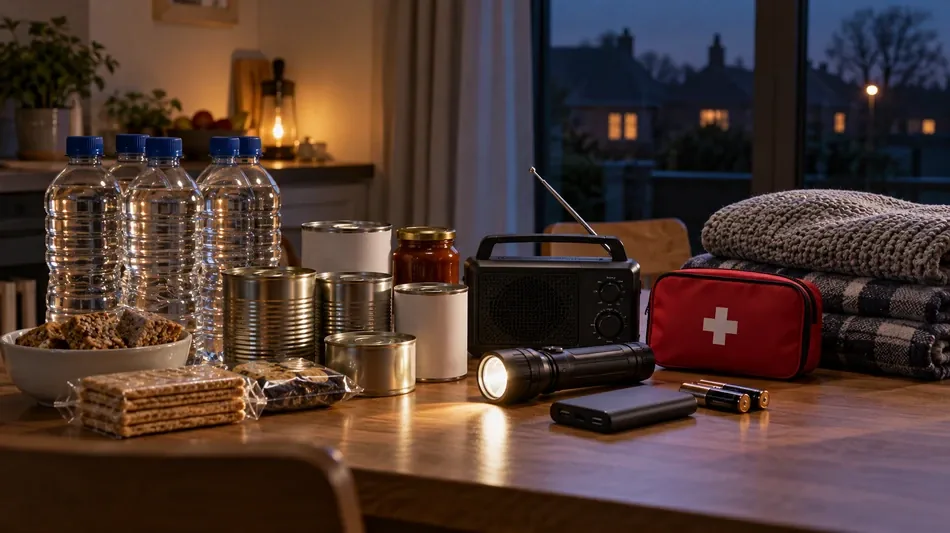
The following practical checklist combines the Government’s official recommendations with some additional everyday items that may prove useful during a prolonged power cut, internet outage, loss of water supply or severe weather emergency.
The Government recommends keeping at least three litres of drinking water per person per day, enough for three days.
For a family of four, this means a minimum of 36 litres of drinking water. Additional water may be needed for cooking, washing, babies, medical needs and pets.
2. Food that does not require electricity
Keep enough non-perishable food for at least three days, ideally items that can be eaten without cooking or refrigeration.
Useful examples include tinned fish, meat, beans, fruit and vegetables, crackers, cereal bars, dried fruit, nuts and long-life milk.
Choose foods your household normally eats so they can be used and replaced rather than wasted. Remember to keep a manual tin opener.
3. Torches and spare batteries
A good battery-powered or wind-up torch is essential if the electricity goes off, particularly during winter evenings.
The Government recommends torches rather than candles because they are safer and do not present the same fire risk.
Keeping a torch beside the bed and another in an easily accessible cupboard could be particularly useful.
4. A battery-powered or wind-up radio
This is one of the most useful items to keep in the event of a widespread communications failure.
If broadband connections are unavailable or mobile networks are disrupted, a battery-powered FM radio could still provide access to important announcements, local news and emergency information, provided broadcasters remain operational.
The Government also recommends writing down the frequencies of local and national radio stations.
5. A fully charged portable power bank
A power bank can keep a mobile phone operating when there is no mains electricity.
Larger-capacity models may provide several charges, although the exact number depends on the phone and power bank.
Keep charging cables with it and check regularly that it is charged.
6. A small amount of cash
Most people now rely on bank cards, mobile phones and contactless payments.
Still, a widespread electricity or communications outage could temporarily prevent shops from processing electronic payments or cash machines from operating.
The Government recommends keeping a modest amount of cash, including some smaller notes and coins, for essential purchases.
The amount will depend on individual circumstances. Shops may still be unable to trade during a serious outage.
7. Essential medication and a first aid kit
Keep a well-stocked first aid kit containing plasters, bandages, sterile dressings, antiseptic and other basic supplies.
Anyone taking regular prescription medication should ensure repeat prescriptions are requested in good time.
People relying on electrically powered medical devices, or medication requiring refrigeration, should speak to their healthcare provider about appropriate backup arrangements.
8. Warm clothing, blankets and sleeping bags
Electricity cuts can also mean heating failures.
Extra blankets, sleeping bags, warm socks, thermal clothing and additional layers can help household members remain comfortable until services are restored.
The Government advises keeping unused rooms closed and curtains drawn during cold weather to help retain warmth.
9. Important telephone numbers written on paper
Many people no longer remember telephone numbers because they are stored on mobile phones.
If a phone loses power or becomes unusable, a printed list of important contacts could prove invaluable.
Include family members, neighbours, medical contacts, insurance providers and utility companies.
It is also sensible to keep printed copies of essential documents and insurance details somewhere secure.
10. Hygiene and sanitary supplies
Keep basic toiletries, toilet rolls, wet wipes, hand sanitiser, sanitary products and rubbish bags available.
If water supplies are interrupted, these items may help households maintain basic hygiene until services are restored.
11. Baby and pet supplies
Families with babies should consider keeping nappies, wipes and appropriate feeding supplies available.
The Government recommends ready-to-feed baby formula where necessary, as preparing powdered formula safely can become difficult without electricity or clean hot water.
Pet owners should also keep sufficient food, water and any necessary medication for their animals.
12. A simple household emergency plan
One of the most useful preparations costs nothing.
Agree how family members would contact each other or where they would meet if telephone networks were unavailable.
Consider elderly relatives, neighbours living alone and anyone who might need additional assistance.
It is also worth knowing where your home’s water stopcock and electricity controls are located.
What if the internet goes down completely?
A major internet outage would be inconvenient for most households, but its effects could extend much further.
Online banking, shopping, email, messaging applications, internet-connected security systems and some telephone services could be affected.
If electricity was also unavailable, home broadband equipment would stop working and mobile phone coverage could become unreliable if nearby masts lost power.
The Government advises people to prepare by keeping a battery-powered or wind-up radio, writing down essential telephone numbers and agreeing alternative arrangements for contacting family members.
Keeping some cash and paper copies of important information would also reduce dependence on digital services.
It is important to remember that an internet outage does not automatically mean all mobile telephone services will stop working. The extent of disruption would depend on which networks and systems were affected.
What should you do during a power cut?
If electricity goes off, residents in England, Scotland and Wales can telephone 105 to contact their electricity network operator.
The service can be used to report power cuts and obtain information about outages.
Households should switch off potentially hazardous appliances, including electric heaters, cookers and irons, and consider unplugging sensitive electrical equipment to protect it from possible power surges when supply is restored.
Fridges and freezers should be kept closed as much as possible to preserve food.
People should never use outdoor barbecues, charcoal burners or camping stoves inside homes, garages or enclosed spaces because of the risk of fire and potentially fatal carbon monoxide poisoning.
Anyone facing a life-threatening emergency should continue to attempt to contact 999 or 112.
Extra help for vulnerable residents
The Government is also encouraging eligible households to sign up to the Priority Services Register.
This free service helps electricity, gas and water providers identify customers who may need additional support during an interruption.
Eligible households can include older residents, people with disabilities, those dependent on medical equipment and families with children under five.
Residents can contact their utility suppliers to find out whether they qualify.
No need to panic or rush to the shops
Ministers have emphasised that the campaign is about sensible preparation rather than an expectation that essential services are about to fail.
Most electricity cuts in Britain are localised and relatively short-lived, although the Government acknowledges that more extensive and prolonged interruptions are possible.
The advice is to prepare gradually, adding an extra item or two to normal shopping when affordable, rather than buying everything at once.
Households are also encouraged to check supplies approximately every six months, replacing expired food, testing batteries and updating emergency telephone numbers.
Above all, the Government wants people to think about how they would manage if the services they normally take for granted were unavailable for a few days.
A torch, a radio, some bottled water and a cupboard containing a few additional essentials could make an unexpected emergency considerably easier to manage.
Residents can find the full official guidance, including a downloadable household emergency plan, at beready.campaign.gov.uk.
P.Grant--TFWP