The Fort Worth Press - Mammal bites dinosaur in 'once-in-a-lifetime' fossil find

USD -
AED 3.672504
AFN 64.503991
ALL 81.624824
AMD 375.516815
AOA 917.000367
ARS 1379.923618
AUD 1.41603
AWG 1.8
AZN 1.70397
BAM 1.667278
BBD 2.011082
BDT 122.671668
BHD 0.376625
BIF 2967.989429
BMD 1
BND 1.272324
BOB 6.899962
BRL 5.009204
BSD 0.998508
BTN 92.62947
BWP 13.405226
BYN 2.865862
BYR 19600
BZD 2.008184
CAD 1.38415
CDF 2300.000362
CHF 0.789487
CLF 0.022686
CLP 892.843442
CNY 6.828041
CNH 6.824955
COP 3636.503133
CRC 462.128639
CUC 1
CUP 26.5
CVE 93.998551
CZK 20.788404
DJF 177.809983
DKK 6.372904
DOP 60.125314
DZD 132.19904
EGP 53.012745
ERN 15
ETB 156.679852
EUR 0.852704
FJD 2.211504
FKP 0.743942
GBP 0.743467
GEL 2.690391
GGP 0.743942
GHS 10.988449
GIP 0.743942
GMD 73.503851
GNF 8760.922382
GTQ 7.638208
GYD 208.899876
HKD 7.83195
HNL 26.518904
HRK 6.425904
HTG 130.923661
HUF 320.203831
IDR 17089.3
ILS 3.03421
IMP 0.743942
INR 93.090504
IQD 1308.043135
IRR 1316125.000352
ISK 122.190386
JEP 0.743942
JMD 157.870509
JOD 0.70904
JPY 159.27504
KES 129.210179
KGS 87.450384
KHR 3997.272069
KMF 420.00035
KPW 900.013392
KRW 1484.910383
KWD 0.30869
KYD 0.832104
KZT 471.85542
LAK 22019.52176
LBP 89419.71783
LKR 315.118708
LRD 183.726184
LSL 16.382337
LTL 2.95274
LVL 0.60489
LYD 6.347556
MAD 9.280849
MDL 17.20387
MGA 4143.898385
MKD 52.551042
MMK 2100.499472
MNT 3595.336475
MOP 8.05507
MRU 39.91049
MUR 46.520378
MVR 15.460378
MWK 1731.383999
MXN 17.301404
MYR 3.965039
MZN 63.960377
NAD 16.382337
NGN 1359.503725
NIO 36.741827
NOK 9.524904
NPR 148.206811
NZD 1.708964
OMR 0.38463
PAB 0.998508
PEN 3.369933
PGK 4.322066
PHP 59.876504
PKR 278.505946
PLN 3.627803
PYG 6457.525255
QAR 3.640254
RON 4.342304
RSD 100.055411
RUB 77.038489
RWF 1458.164614
SAR 3.753582
SBD 8.058149
SCR 15.178038
SDG 601.000339
SEK 9.27195
SGD 1.273804
SLE 24.625038
SOS 570.649162
SRD 37.449038
STD 20697.981008
STN 20.885725
SVC 8.737053
SYP 110.548127
SZL 16.386343
THB 32.208038
TJS 9.490729
TMT 3.505
TND 2.917693
TRY 44.665038
TTD 6.776352
TWD 31.741804
TZS 2591.108648
UAH 43.382209
UGX 3694.642172
UYU 40.288138
UZS 12141.852436
VES 475.837804
VND 26336
VUV 119.210481
WST 2.744958
XAF 559.189293
XAG 0.01312
XAU 0.00021
XCD 2.70255
XCG 1.799582
XDR 0.695452
XOF 559.189293
XPF 101.666596
YER 237.150363
ZAR 16.41806
ZMK 9001.203584
ZMW 18.996633
ZWL 321.999592
  • CMSD

    0.0400

    22.63

    +0.18%

  • BCC

    -0.4100

    80.17

    -0.51%

  • GSK

    -0.1500

    58.21

    -0.26%

  • NGG

    -0.0300

    90.29

    -0.03%

  • RIO

    1.1300

    98.26

    +1.15%

  • AZN

    -0.9600

    204.03

    -0.47%

  • CMSC

    0.0400

    22.43

    +0.18%

  • RBGPF

    -13.5000

    69

    -19.57%

  • BCE

    -0.5400

    23.35

    -2.31%

  • JRI

    0.0400

    13.02

    +0.31%

  • BP

    0.5400

    46.44

    +1.16%

  • BTI

    -0.0400

    58.81

    -0.07%

  • VOD

    -0.1600

    15.69

    -1.02%

  • RELX

    -0.0400

    33.3

    -0.12%

  • RYCEF

    -0.2700

    16.96

    -1.59%

Mammal bites dinosaur in 'once-in-a-lifetime' fossil find
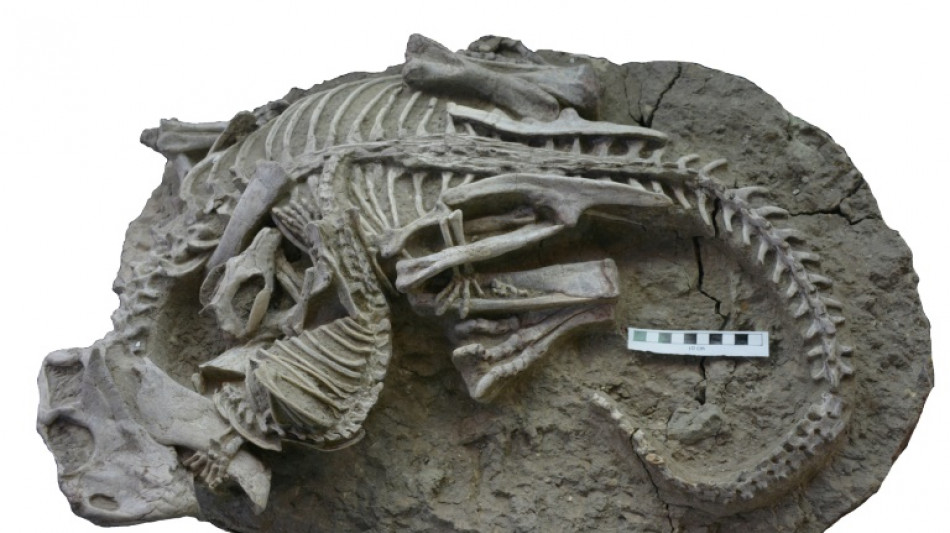
Mammal bites dinosaur in 'once-in-a-lifetime' fossil find / Photo: © Canadian Museum of Nature/AFP

Mammal bites dinosaur in 'once-in-a-lifetime' fossil find

A badger-like mammal was sinking its teeth into the ribs of a dinosaur three times its size when they were buried in volcanic ash 125 million years ago, capturing the pair in a deadly embrace.

Text size:

The fight scene, preserved in a fossil discovered in China, suggests that small mammals preyed on the dinosaurs that ruled Earth during the Cretaceous period more than previously thought, scientists said on Tuesday.

Jordan Mallon, a palaeontologist at the Canadian Museum of Nature, told AFP that when he first saw the fossil "my eyes popped out of my head".

Mallon, a co-author of a new study led by Chinese researchers, said they believe the fossil is the first ever discovered that shows a mammal and dinosaur fighting each other.

Mammals were generally considered far too small to prey on the dinosaurs that dominated the world during the tens of millions of years they shared on Earth.

But the fossil shows a badger-sized Repenomamus robustus sitting on top of Psittacosaurus lujiatunensis, a plant-eating dinosaur that stood 120 centimetres (47 inches) tall and had a beak like a parrot.

The mammal -- one of the largest of its time but still a third the weight of the dinosaur -- is sinking his sharp teeth into the dinosaur's ribs and gripping onto its leg.

- 'Feisty mammals' -

The way the pair are intertwined shows that the mammal was not scavenging on a dead dinosaur, Mallon said.

"The dinosaur has collapsed down and trapped the hind limb of the mammal in the fold of its knee," indicating it was an attack, he said.

The dinosaur also bears no bite marks, which mammals often leave on scavenged bodies.

While it is rare for mammals to prey on animals so much larger than them, Mallon said one example was how wolverines had been observed hunting far-larger caribou.

It was not possible to tell from the fossil if Repenomamus hunted solo or in a pack, he said, adding that either was possible.

The almost entirely complete skeletons were found in China's northeastern Liaoning province in 2012.

They were discovered at a site nicknamed "Chinese Pompeii" because of how many dinosaurs and other animals have been found preserved by volcanic debris there, similar to the ancient Roman city.

The first fossil suggesting that mammals ate dinosaurs was found at the Chinese site in 2005. It showed a baby Psittacosaurus in the stomach of a Repenomamus.

But the new fossil is the first piece of evidence that "there were at least some feisty mammals around during the Cretaceous... capable of taking down an adult dinosaur," Mallon said.

The "once-in-a-lifetime" fossil is being exhibited at a museum attached to a primary school in the Chinese city of Weihai, he added.

The study was published in the journal Scientific Reports.

M.Delgado--TFWP