The Fort Worth Press - Report lays bare Australia's 'sobering' climate challenge

USD -
AED 3.672501
AFN 64.000058
ALL 81.449762
AMD 370.780442
ANG 1.789884
AOA 917.999897
ARS 1392.874501
AUD 1.386472
AWG 1.8
AZN 1.69859
BAM 1.669697
BBD 2.01454
BDT 122.725158
BGN 1.668102
BHD 0.37765
BIF 2976
BMD 1
BND 1.275896
BOB 6.911331
BRL 4.959604
BSD 1.000226
BTN 94.881811
BWP 13.592996
BYN 2.822528
BYR 19600
BZD 2.011629
CAD 1.35834
CDF 2320.000136
CHF 0.781095
CLF 0.022861
CLP 899.749971
CNY 6.82825
CNH 6.829435
COP 3657.3
CRC 454.73562
CUC 1
CUP 26.5
CVE 94.450193
CZK 20.77575
DJF 177.719779
DKK 6.371505
DOP 59.502833
DZD 132.503944
EGP 53.639103
ERN 15
ETB 156.99989
EUR 0.85269
FJD 2.192102
FKP 0.736618
GBP 0.736155
GEL 2.680012
GGP 0.736618
GHS 11.200145
GIP 0.736618
GMD 72.999517
GNF 8774.999825
GTQ 7.641507
GYD 209.25239
HKD 7.834895
HNL 26.620134
HRK 6.4247
HTG 131.024649
HUF 309.302497
IDR 17334
ILS 2.94383
IMP 0.736618
INR 94.91055
IQD 1310
IRR 1314000.0001
ISK 122.610251
JEP 0.736618
JMD 156.725146
JOD 0.708977
JPY 156.889915
KES 129.149782
KGS 87.420496
KHR 4012.496617
KMF 419.999755
KPW 899.999976
KRW 1470.296134
KWD 0.30729
KYD 0.833543
KZT 463.288124
LAK 21980.000324
LBP 89550.000274
LKR 319.671116
LRD 183.874975
LSL 16.660217
LTL 2.95274
LVL 0.60489
LYD 6.349923
MAD 9.25125
MDL 17.233504
MGA 4149.999976
MKD 52.564485
MMK 2099.490131
MNT 3577.850535
MOP 8.070846
MRU 39.970119
MUR 47.030112
MVR 15.454964
MWK 1741.49797
MXN 17.44425
MYR 3.957503
MZN 63.910419
NAD 16.65992
NGN 1375.980106
NIO 36.710043
NOK 9.28854
NPR 151.803598
NZD 1.692835
OMR 0.384745
PAB 1.000201
PEN 3.507498
PGK 4.33875
PHP 61.241952
PKR 278.775014
PLN 3.61975
PYG 6151.626275
QAR 3.643504
RON 4.431403
RSD 100.106587
RUB 74.971307
RWF 1461.5
SAR 3.74998
SBD 8.04211
SCR 13.746323
SDG 600.494384
SEK 9.216399
SGD 1.27279
SHP 0.746601
SLE 24.592944
SLL 20969.496166
SOS 571.000185
SRD 37.458012
STD 20697.981008
STN 21.21
SVC 8.7523
SYP 110.524981
SZL 16.660258
THB 32.490193
TJS 9.381822
TMT 3.505
TND 2.88175
TOP 2.40776
TRY 45.190799
TTD 6.789386
TWD 31.629499
TZS 2605.00019
UAH 43.949336
UGX 3760.987334
UYU 39.889518
UZS 11950.000036
VES 488.942755
VND 26356
VUV 117.651389
WST 2.715189
XAF 560.041494
XAG 0.013202
XAU 0.000217
XCD 2.70255
XCG 1.80265
XDR 0.69563
XOF 559.999763
XPF 102.149753
YER 238.59682
ZAR 16.59045
ZMK 9001.199932
ZMW 18.67895
ZWL 321.999592
  • RBGPF

    0.5000

    63.1

    +0.79%

  • CMSD

    0.1500

    23.28

    +0.64%

  • GSK

    -0.7000

    51.61

    -1.36%

  • BCE

    0.1800

    23.96

    +0.75%

  • RELX

    -0.2400

    36.35

    -0.66%

  • BCC

    -1.1400

    78.13

    -1.46%

  • RIO

    0.1000

    100.58

    +0.1%

  • CMSC

    0.0600

    22.88

    +0.26%

  • BTI

    -0.0900

    58.71

    -0.15%

  • BP

    -0.9700

    46.41

    -2.09%

  • JRI

    -0.0100

    12.98

    -0.08%

  • AZN

    -2.6300

    184.74

    -1.42%

  • NGG

    -1.0600

    88.48

    -1.2%

  • RYCEF

    0.5500

    16.35

    +3.36%

  • VOD

    0.3500

    16.15

    +2.17%

Report lays bare Australia's 'sobering' climate challenge
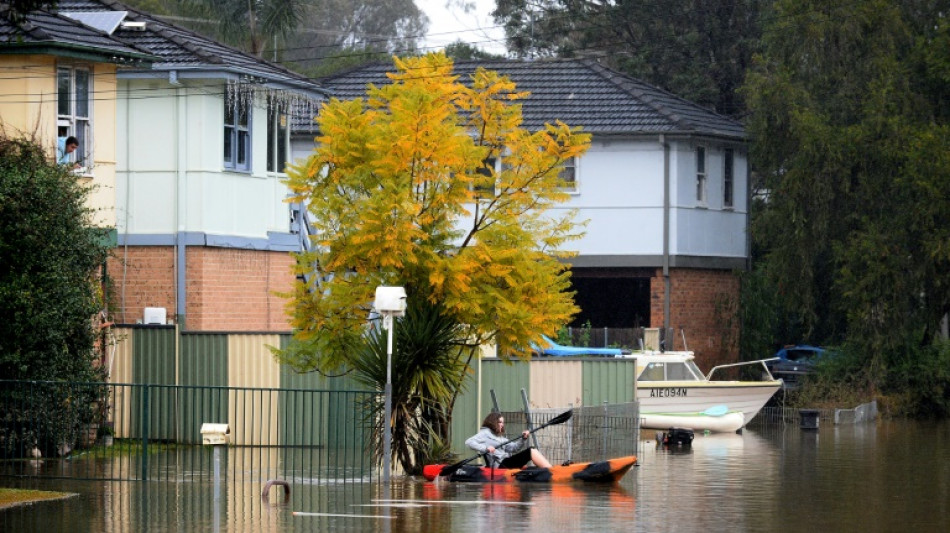
Report lays bare Australia's 'sobering' climate challenge / Photo: © AFP

Report lays bare Australia's 'sobering' climate challenge

Rising temperatures are fuelling widespread environmental degradation across Australia and supercharging natural disasters, according to a government report released Wednesday in the wake of flash floods on the country's east coast.

Text size:

The State of the Climate report found global warming was also slowly melting Australia's fragile alpine regions while contributing to ocean acidification and rising sea levels.

Climate researcher Ian Lowe said the report was a "frightening" wake-up call for Australia, which relies heavily on coal and gas exports for economic growth.

"The scale of changes demonstrates that cleaning up our energy use is an urgent priority," Lowe said.

"We also need to reduce our exports of coal and gas."

The report, a joint effort between the government's weather bureau and national science agency, found Australia's climate had warmed by an average of 1.47 degrees Celsius since records began in 1910.

Environment Minister Tanya Plibersek said it was "sobering" reading.

"For our environment, for our communities, this report reinforces the urgent need for climate action," she said.

- 'Record-breaking extremes' -

Australia has in recent years experienced a series of extreme weather events linked to rising global temperatures.

Flash floods swept through parts of inland New South Wales earlier this month, tearing entire homes from their foundations in some country towns.

Tens of thousands of Sydney residents were ordered to evacuate in July when floods swamped the city's fringe.

An east coast flooding disaster in March -- caused by heavy storms in Queensland and New South Wales -- claimed more than 20 lives.

Catastrophic bushfires swept through huge chunks of New South Wales in the "Black Summer" of 2019 and 2020, while the Great Barrier Reef has suffered four separate mass coral bleaching events since 2016.

"These changes are happening at an increased pace," the State of the Climate report found.

"The past decade has seen record-breaking extremes leading to natural disasters that are exacerbated by anthropogenic (human-caused) climate change."

Prime Minister Anthony Albanese last week unveiled a bid to host the 2026 COP summit, seeking to repair Australia's international reputation as a climate change laggard.

Albanese's centre-left government introduced a 2050 net zero emissions target following its election earlier this year but has faced calls domestically to do more.

University of Melbourne climate scientist Andrew King said Australia needed to rapidly cut its carbon emissions.

"The consequences of our continued use of fossil fuels are clear in Australia like elsewhere," he said.

"We must act quickly to decarbonise our economy to limit further damages from worsening extreme events."

Ailie Gallant from the Australia Centre of Excellence for Climate Extremes said the deterioration in the country's climate would "continue without deep and aggressive cuts to carbon emissions".

K.Ibarra--TFWP