The Fort Worth Press - Polar bear hell: An ice pack that keeps receding

USD -
AED 3.672501
AFN 64.000058
ALL 81.449762
AMD 370.780442
ANG 1.789884
AOA 917.999897
ARS 1392.874501
AUD 1.386472
AWG 1.8
AZN 1.69859
BAM 1.669697
BBD 2.01454
BDT 122.725158
BGN 1.668102
BHD 0.37765
BIF 2976
BMD 1
BND 1.275896
BOB 6.911331
BRL 4.959604
BSD 1.000226
BTN 94.881811
BWP 13.592996
BYN 2.822528
BYR 19600
BZD 2.011629
CAD 1.35834
CDF 2320.000136
CHF 0.781095
CLF 0.022861
CLP 899.749971
CNY 6.82825
CNH 6.829435
COP 3657.3
CRC 454.73562
CUC 1
CUP 26.5
CVE 94.450193
CZK 20.77575
DJF 177.719779
DKK 6.371505
DOP 59.502833
DZD 132.503944
EGP 53.639103
ERN 15
ETB 156.99989
EUR 0.85269
FJD 2.192102
FKP 0.736618
GBP 0.736155
GEL 2.680012
GGP 0.736618
GHS 11.200145
GIP 0.736618
GMD 72.999517
GNF 8774.999825
GTQ 7.641507
GYD 209.25239
HKD 7.834895
HNL 26.620134
HRK 6.4247
HTG 131.024649
HUF 309.302497
IDR 17334
ILS 2.94383
IMP 0.736618
INR 94.91055
IQD 1310
IRR 1314000.0001
ISK 122.610251
JEP 0.736618
JMD 156.725146
JOD 0.708977
JPY 156.889915
KES 129.149782
KGS 87.420496
KHR 4012.496617
KMF 419.999755
KPW 899.999976
KRW 1470.296134
KWD 0.30729
KYD 0.833543
KZT 463.288124
LAK 21980.000324
LBP 89550.000274
LKR 319.671116
LRD 183.874975
LSL 16.660217
LTL 2.95274
LVL 0.60489
LYD 6.349923
MAD 9.25125
MDL 17.233504
MGA 4149.999976
MKD 52.564485
MMK 2099.490131
MNT 3577.850535
MOP 8.070846
MRU 39.970119
MUR 47.030112
MVR 15.454964
MWK 1741.49797
MXN 17.44425
MYR 3.957503
MZN 63.910419
NAD 16.65992
NGN 1375.980106
NIO 36.710043
NOK 9.28854
NPR 151.803598
NZD 1.692835
OMR 0.384745
PAB 1.000201
PEN 3.507498
PGK 4.33875
PHP 61.241952
PKR 278.775014
PLN 3.61975
PYG 6151.626275
QAR 3.643504
RON 4.431403
RSD 100.106587
RUB 74.971307
RWF 1461.5
SAR 3.74998
SBD 8.04211
SCR 13.746323
SDG 600.494384
SEK 9.216399
SGD 1.27279
SHP 0.746601
SLE 24.592944
SLL 20969.496166
SOS 571.000185
SRD 37.458012
STD 20697.981008
STN 21.21
SVC 8.7523
SYP 110.524981
SZL 16.660258
THB 32.490193
TJS 9.381822
TMT 3.505
TND 2.88175
TOP 2.40776
TRY 45.190799
TTD 6.789386
TWD 31.629499
TZS 2605.00019
UAH 43.949336
UGX 3760.987334
UYU 39.889518
UZS 11950.000036
VES 488.942755
VND 26356
VUV 117.651389
WST 2.715189
XAF 560.041494
XAG 0.013202
XAU 0.000217
XCD 2.70255
XCG 1.80265
XDR 0.69563
XOF 559.999763
XPF 102.149753
YER 238.59682
ZAR 16.59045
ZMK 9001.199932
ZMW 18.67895
ZWL 321.999592
  • CMSD

    0.1500

    23.28

    +0.64%

  • BCC

    -1.1400

    78.13

    -1.46%

  • GSK

    -0.7000

    51.61

    -1.36%

  • RIO

    0.1000

    100.58

    +0.1%

  • JRI

    -0.0100

    12.98

    -0.08%

  • RBGPF

    0.5000

    63.1

    +0.79%

  • BCE

    0.1800

    23.96

    +0.75%

  • BTI

    -0.0900

    58.71

    -0.15%

  • CMSC

    0.0600

    22.88

    +0.26%

  • AZN

    -2.6300

    184.74

    -1.42%

  • VOD

    0.3500

    16.15

    +2.17%

  • NGG

    -1.0600

    88.48

    -1.2%

  • RYCEF

    0.5500

    16.35

    +3.36%

  • BP

    -0.9700

    46.41

    -2.09%

  • RELX

    -0.2400

    36.35

    -0.66%

Polar bear hell: An ice pack that keeps receding
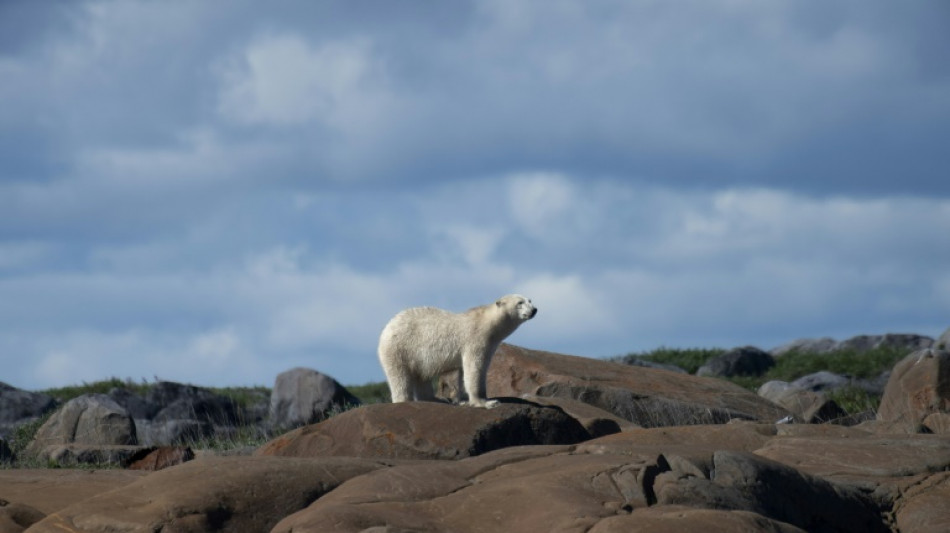
Polar bear hell: An ice pack that keeps receding / Photo: © AFP

Polar bear hell: An ice pack that keeps receding

Sprawled on rocky ground far from sea ice, a lone Canadian polar bear sits under a dazzling sun, his white fur useless as camouflage.

Text size:

It's midsummer on the shores of the Hudson Bay and life for the enormous male has been moving in slow motion, far from the prey that keeps him alive: seals.

Every year from late June, when the bay ice disappears -- shrinking until it dots the blue vastness like scattered confetti -- the bears must move onto shore to begin a period of forced fasting.

But that period is lasting longer and longer as temperatures rise.

The whole annual rhythm of the polar bear is in peril, and birth rates are dropping as they scavenge for food.

"There could be a beluga whale carcass they might be able to find, (or a) naive seal near shore, but generally they're just fasting. They lose nearly a kilogram of body weight every day that they're on land," said Geoff York, a biologist for Polar Bears International (PBI). An AFP team joined him on an expedition.

In the Arctic, global warming is occurring three or four times faster than elsewhere in the world, recent studies indicate.

According to a 2020 report published in the journal Nature Climate Change, this means the near-extinction of this iconic animal is approaching: From 1,200 individuals in the 1980s, the polar bear population in western Hudson Bay has dropped to about 800 today.

These days, this super predator of the Arctic sometimes has to feed on seaweed, as a mother and her cub were seen doing not far from the port of Churchill, the Manitoba town and self-declared "polar bear capital."

They are also moving closer to the cities. In Churchill, the bears a few years ago began frequenting the waste disposal site, a source of easy - but harmful - food for them.

Since then, the town has taken precautions. The dump is now guarded by cameras, fences and patrols. Across Churchill, people leave cars and houses unlocked in case someone needs to take refuge quickly after a bad encounter with this large carnivore.

The emergency number for the wildlife protection unit is posted on many walls.

Some areas, like schoolgrounds, are more closely monitored.

When they get an urgent call, Ian Van Nest, the provincial officer of the unit, and his colleagues jump into their pickup truck armed with a rifle and a spray can of repellent, wearing protective vests.

Sometimes the bears can be scared off with just "the horn on your vehicle," Van Neste said. Other times the animals need to be sedated, then kept in cages until winter rolls around and they are freed.

The fate of the polar bear should alarm everyone, said Flavio Lehner, a climate scientist at Cornell University, who notes that the Arctic is a good barometer of planetary health.

And since the 1980s, data show, the bay's summer ice pack has decreased by nearly half.

C.M.Harper--TFWP