The Fort Worth Press - 'Incredible': Astronomers hail first images of asteroid impact

USD -
AED 3.672497
AFN 63.999779
ALL 81.450006
AMD 370.780248
ANG 1.789884
AOA 918.000056
ARS 1390.840613
AUD 1.388585
AWG 1.8
AZN 1.662111
BAM 1.669697
BBD 2.01454
BDT 122.725158
BGN 1.668102
BHD 0.377651
BIF 2976
BMD 1
BND 1.275896
BOB 6.911331
BRL 4.953896
BSD 1.000226
BTN 94.881811
BWP 13.592996
BYN 2.822528
BYR 19600
BZD 2.011629
CAD 1.35898
CDF 2320.000345
CHF 0.780486
CLF 0.022842
CLP 899.000043
CNY 6.828249
CNH 6.829455
COP 3657.4
CRC 454.73562
CUC 1
CUP 26.5
CVE 94.450038
CZK 20.741702
DJF 177.71947
DKK 6.35999
DOP 59.497237
DZD 132.503944
EGP 53.559813
ERN 15
ETB 156.99975
EUR 0.851315
FJD 2.192099
FKP 0.736618
GBP 0.735294
GEL 2.680266
GGP 0.736618
GHS 11.201473
GIP 0.736618
GMD 72.999777
GNF 8775.000359
GTQ 7.641507
GYD 209.25239
HKD 7.83524
HNL 26.620533
HRK 6.428003
HTG 131.024649
HUF 308.854023
IDR 17334.35
ILS 2.94383
IMP 0.736618
INR 94.910503
IQD 1310
IRR 1314000.000294
ISK 122.680267
JEP 0.736618
JMD 156.725146
JOD 0.708976
JPY 156.791011
KES 129.150408
KGS 87.420505
KHR 4012.49611
KMF 420.000087
KPW 899.999976
KRW 1473.729592
KWD 0.30729
KYD 0.833543
KZT 463.288124
LAK 21979.999597
LBP 89549.999776
LKR 319.671116
LRD 183.875027
LSL 16.659591
LTL 2.95274
LVL 0.60489
LYD 6.350018
MAD 9.25125
MDL 17.233504
MGA 4150.000004
MKD 52.564485
MMK 2099.490131
MNT 3577.850535
MOP 8.070846
MRU 39.969879
MUR 47.030152
MVR 15.454972
MWK 1741.497874
MXN 17.476225
MYR 3.970206
MZN 63.900592
NAD 16.659734
NGN 1375.980226
NIO 36.710145
NOK 9.276455
NPR 151.803598
NZD 1.694859
OMR 0.384745
PAB 1.000201
PEN 3.5075
PGK 4.33875
PHP 61.274984
PKR 278.775056
PLN 3.615095
PYG 6151.626275
QAR 3.643497
RON 4.438098
RSD 100.106587
RUB 74.860877
RWF 1461.5
SAR 3.74998
SBD 8.04211
SCR 13.746323
SDG 600.502199
SEK 9.21049
SGD 1.27325
SHP 0.746601
SLE 24.595095
SLL 20969.496166
SOS 570.999642
SRD 37.45802
STD 20697.981008
STN 21.21
SVC 8.7523
SYP 110.524981
SZL 16.659533
THB 32.513046
TJS 9.381822
TMT 3.505
TND 2.88175
TOP 2.40776
TRY 45.178595
TTD 6.789386
TWD 31.629499
TZS 2604.999907
UAH 43.949336
UGX 3760.987334
UYU 39.889518
UZS 11949.999966
VES 488.942755
VND 26356
VUV 117.651389
WST 2.715189
XAF 560.041494
XAG 0.01327
XAU 0.000217
XCD 2.70255
XCG 1.80265
XDR 0.69563
XOF 559.999499
XPF 102.149792
YER 238.596201
ZAR 16.556335
ZMK 9001.205497
ZMW 18.67895
ZWL 321.999592
  • RBGPF

    0.5000

    63.1

    +0.79%

  • CMSD

    0.1500

    23.28

    +0.64%

  • GSK

    -0.7000

    51.61

    -1.36%

  • VOD

    0.3500

    16.15

    +2.17%

  • BCE

    0.1800

    23.96

    +0.75%

  • RYCEF

    0.5500

    16.35

    +3.36%

  • CMSC

    0.0600

    22.88

    +0.26%

  • RIO

    0.1000

    100.58

    +0.1%

  • RELX

    -0.2400

    36.35

    -0.66%

  • NGG

    -1.0600

    88.48

    -1.2%

  • BTI

    -0.0900

    58.71

    -0.15%

  • JRI

    -0.0100

    12.98

    -0.08%

  • BCC

    -1.1400

    78.13

    -1.46%

  • BP

    -0.9700

    46.41

    -2.09%

  • AZN

    -2.6300

    184.74

    -1.42%

'Incredible': Astronomers hail first images of asteroid impact
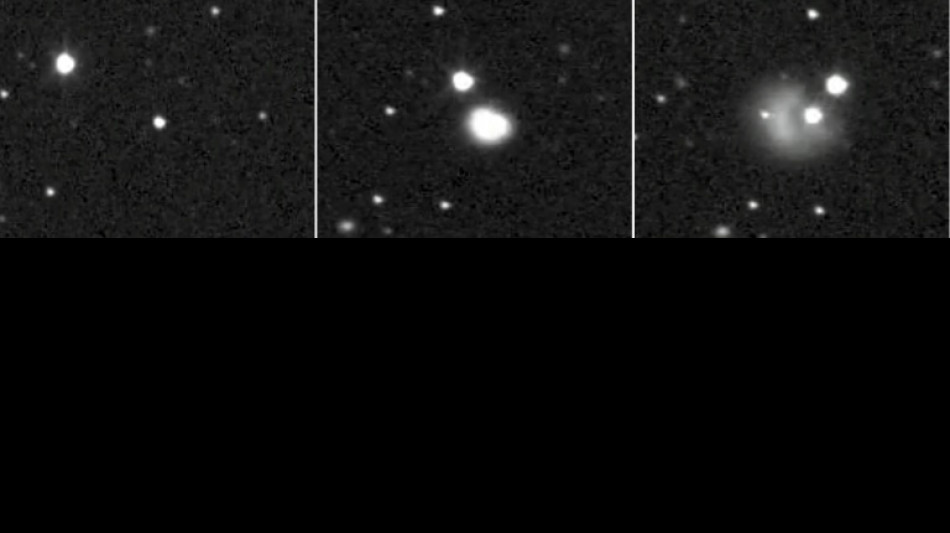
'Incredible': Astronomers hail first images of asteroid impact / Photo: © NASA/University of Hawaii/AFP

'Incredible': Astronomers hail first images of asteroid impact

The asteroid is flying through space in the grainy black and white video, when suddenly a massive cloud of debris sprays out in front of it, meaning only one thing: impact.

Text size:

Astronomers have hailed this early footage of the first time humanity deliberately smashed a spacecraft into an asteroid, saying it looks like it did a "lot of damage".

That would be good news, because NASA's Double Asteroid Redirection Test (DART) impactor struck the asteroid Dimorphos at 23,500 kilometres (14,500 miles) per hour on Monday night with the goal of deflecting its trajectory.

While Dimorphos is 11 million kilometres (6.8 million miles) away and poses no threat to Earth, it is being used as a historic test run so the world can be ready to defend itself if a future astroid heads Earth's way.

After the impact, ground-based telescopes and the toaster-sized satellite LICIACube, which separated from DART a few weeks ago, revealed the first images of the collision.

"On the LICIACube images, the plume of what came off the surface was quite impressive," Antonella Barucci of the Paris Observatory's LESIA laboratory told AFP.

By examining the plume, "we can begin to estimate the density of the material on the surface," she said.

- 'Very, very big' plume -

The Asteroid Terrestrial-impact Last Alert System (ATLAS) project on Tuesday tweeted a nine-second video of the impact taken by its telescope in South Africa.

Larry Denneau, the ATLAS co-principal investigator, said the telescope took one image every 40 seconds.

"So the whole sequence that you've seen on Twitter lasts about two hours in real time," he told AFP.

He said the "very, very big" plume was made by dust shooting off the asteroid.

"A lot of the dust is released at a speed that's greater than the gravity of the asteroid, and so it escapes," Denneau said.

The plume expanded to around "several thousand miles in diameter," he added.

In the coming days and weeks astronomers around the world will work to confirm whether the asteroid's trajectory was definitively altered by the impact.

Then the European Space Agency's Hera mission will arrive at Dimorphos in 2026 to survey the surface and discover the extent of DART's impact.

Hera mission principal investigator Patrick Michel said "we are all impressed by the magnitude of the event".

"We have done a lot of damage to Dimorphos," Michel said.

"We have a quantity of ejected matter that is quite incredible."

The amount of matter ripped from the asteroid will help scientists work out exactly how much its trajectory has been affected -- if at all.


"So it's a pretty good sign," he added.

juc-la-pcl-dl/yad

P.Navarro--TFWP