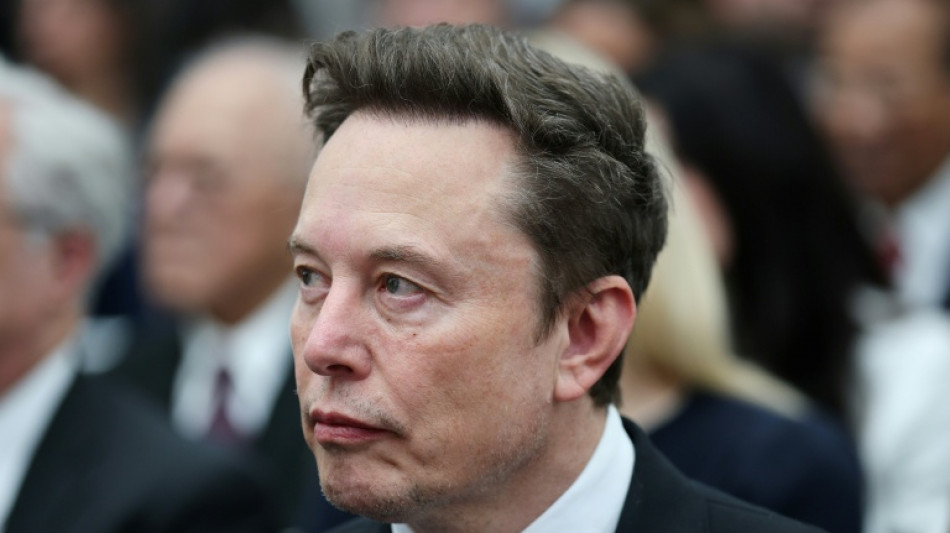
Musk's wants to merge SpaceX and Tesla: Here's what to know / Photo: © GETTY IMAGES NORTH AMERICA/AFP

Elon Musk said this week that SpaceX and Tesla have formed special committees to study a merger of his two biggest companies.
The combination would be worth about $3.5 trillion and would be the largest corporate deal in history.
- What is SpaceX? -
Musk founded SpaceX in 2002 to cut the cost of reaching space and one day bring humans to Mars.
Its reusable Falcon 9 rockets dominate the global launch market, its Dragon capsule carries NASA astronauts to the International Space Station, and its Starlink satellite network provides internet service worldwide.
The company is no longer just a rocket maker. In February it absorbed xAI, Musk’s artificial intelligence startup -- known for its Grok chatbot -- which had taken over the social network X in 2025.
SpaceX went public this year in a record listing and is now valued at about $2 trillion.
Much of its recent growth comes from renting data center computing power to other AI companies.
- What is Tesla? -
Tesla was founded in 2003 and became the world’s best-known electric carmaker after Musk became chief executive in 2008. It is valued at about $1.5 trillion.
Its core car business has come under pressure and Musk increasingly presents Tesla as a company built around self-driving robotaxis and its Optimus humanoid robot.
- Why merge? -
Musk told analysts Tuesday that a merger would be "a good idea."
Florian Frischmuth of engineering consultancy Envorso said a combined group could centrally control the key ingredients of AI -- chips, energy and connectivity.
Garrett Nelson of CFRA Research wrote in a note that synergies would likely be small relative to the size of the deal, which in his view would mostly be about control.
Musk holds about 82 percent of SpaceX’s voting power but only about 20 percent at Tesla, where his moves have drawn scrutiny and lawsuits from investors.
- How easy will it be? -
Most analysts expect a deal.
"In our view once Musk discussed the deal it’s a matter of when and not if this happens," Dan Ives of Yorkville Ives told AFP.
He put the odds at 90 percent by early 2027 and said Tesla would likely need to be valued at more than $500 per share to win approval.
Musk cautioned that a merger is not certain. It needs the support of a majority of all Tesla shares, which he called "quite a high hurdle."
But Nelson noted that loyal retail investors hold an estimated 25 to 27 percent of Tesla shares. With Musk’s stake added, only a small portion of institutional investors would need to back the deal.
The legal obstacles appear slight because both companies moved their incorporation from Delaware to Texas, according to Ann Lipton, a law professor at the University of Colorado.
In Texas, shareholders challenging a deal must first show fraud or intentional misconduct, and companies can require that certain suits be brought only by holders of 3 percent of the stock.
At SpaceX, that means about $60 billion of stock.
"I think Musk will have no trouble getting a deal through from a corporate perspective," Lipton said. "He should be able to muscle something through."
- What are the obstacles? -
Lipton said the bigger risks lie in SpaceX’s importance to the US government and Tesla’s operations in China.
SpaceX depends heavily on contracts with NASA and the Pentagon, and Musk has poured hundreds of millions of dollars into Republican campaigns.
Analysts say that if Democrats regain power in Washington, investigations into Musk’s companies could resume, and SpaceX could eventually find government contracts harder to win.
Musk has warned Democrats against targeting him if they return to power.
"Live by the sword, die by the sword," he wrote on X, responding to a report on Democrats’ plans to investigate his activities if they win the midterms.
Tesla's large China manufacturing base could also draw national security scrutiny.
One option, JPMorgan analysts said, would be to wall off Tesla’s China business or hand control of it to a China-based consortium, similar to the arrangement for TikTok in the United States.
T.Mason--TFWP