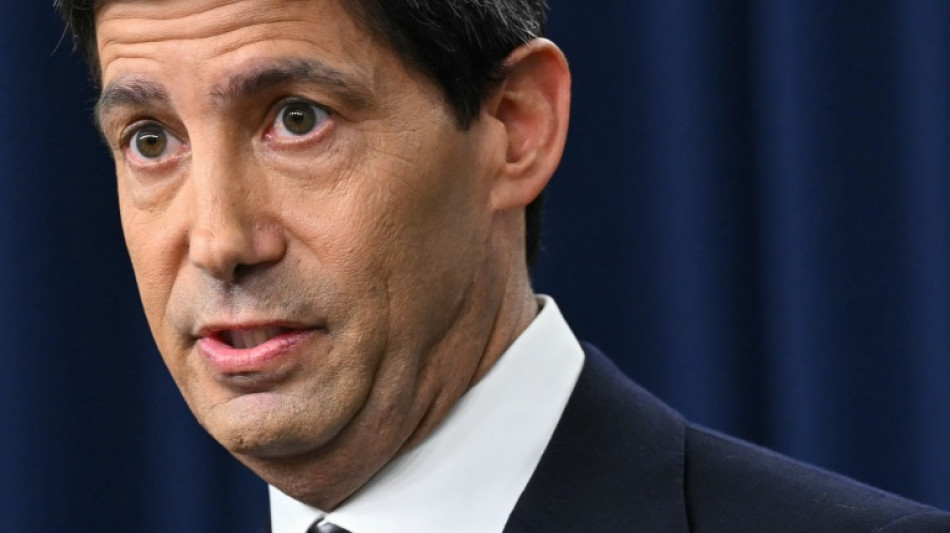
Fed's Warsh surprised by world economy's 'resilience' / Photo: © AFP

US Federal Reserve boss Kevin Warsh said Friday the global economy had shown unexpected resilience against strong economic shocks, as central banks battle surging inflation, while rich countries tackle spiking bond yields.
"Almost everywhere in the global economy (is) showing resilience I'm not sure I would have predicted five or six months ago," he told an event hosted by IMF chief Kristalina Georgieva at the IMF-World Bank Annual Meetings in Bangkok.
World energy prices have skyrocketed since US President Donald Trump launched the war on Iran in February, sparking retaliatory action by Tehran against Washington's Gulf allies and plunging the Middle East into crisis.
The increase in oil and gas costs, along with a surge in AI investments, has spurred inflation in many economies, including the United States, putting pressure on central banks to raise interest rates.
While many other rich economies were able to bring post-pandemic inflation back to their targets, the Fed has failed to meet its long-term two-percent goal for more than five years.
Since taking over as Fed chair in May, Warsh has promised the central bank will deliver on its price stability commitment, and in September it raised rates for the first time in three years.
The Fed meets again this month to set rates, and markets expect it to hold before a second 25-basis-point hike in December.
Warsh has vowed to cut down on providing insights into Fed policy positions, and on Friday again refrained from sharing his view of what may transpire at the October gathering.
"We came to a judgement" about the economic outlook at the September meeting, he said. "I want to say broadly over the month or so that's transpired since then, the world has broadly conformed to our expectations."
- 'Bumpy road' on AI -
The annual meetings bring together finance ministers, central bankers and policymakers from around the world, and Warsh said he had heard from others of the "common challenges" advanced economies faced.
"I heard, I would say, resolve from my colleagues around the world to deliver price stability," he said.
Most rich nations have begun to raise rates in response to surging inflation, including the European Central Bank.
"If I look back over the last few months, while we each did the right thing by our own judgement, by our own remit, it was a synchronous tightening in monetary policy in most places around the world," said Warsh.
"And that means there's no free riders. We're seeing common things, and we're taking action, and I view that as a positive development."
A large part of the discussion Friday centred on AI, and Warsh said he believed the technology was the "most consequential change" to the global economy he had seen, predicting its effects would be positive but the path forward "bumpy".
He said he takes the macroeconomic implications of the technology -- including a short-term driving of inflation through demand-side effects and an expected positive supply-side shock in the long term -- "soberly" in his role as Fed chief.
While he conceded the AI investment boom would drive prices up in the short term, he felt there was a "huge benefit" to the global economy on the horizon.
He cautioned, however, that the path forward was still laced with uncertainty about how markets would evolve around the technology.
"The path from where we are to there is likely to be a very bumpy one, bumpy in our understanding of the technology, bumpy because we really don't know what the market structure is going to be of these new technologies," he said.
aha-jug/dan
S.Jordan--TFWP