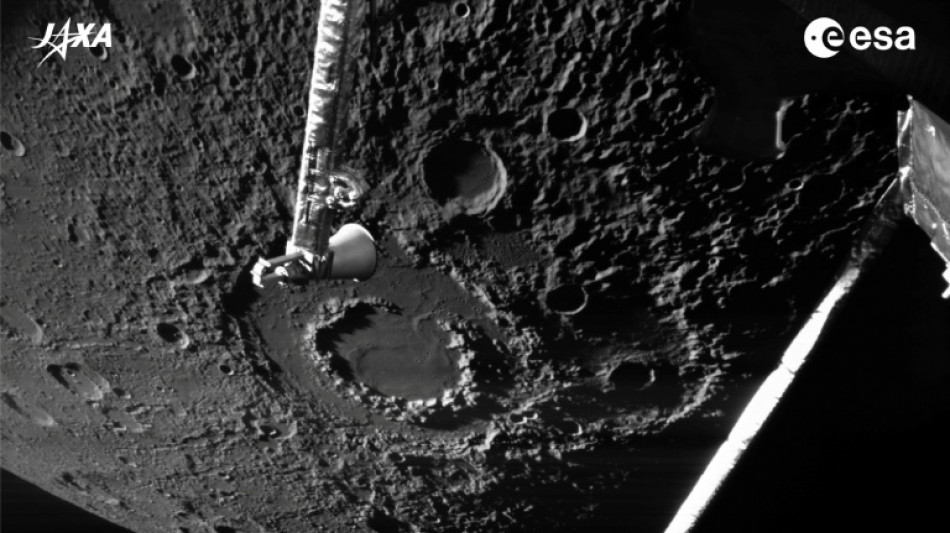
Spacecraft bound for Mercury faces 'tricky' arrival / Photo: © EUROPEAN SPACE AGENCY/AFP

A spacecraft carrying European and Japanese probes will complete an eight-year journey to arrive at Mercury on Thursday, while still facing high-risk manoeuvres to study the Sun-scorched planet.
The BepiColombo mission set off from Earth in 2018 on a winding path to study the smallest and least understood planet in our Solar System with the aim of releasing the two probes into its orbit.
But first the spacecraft must begin the months-long arrival phase, described by the European Space Agency (ESA) as its "most operationally challenging planetary arrival sequences ever attempted".
"It's a very ambitious mission. Mercury is a challenging destination... because of the extreme environment so close to the Sun," Santa Martinez, the mission manager at ESA, told a press conference ahead of its arrival.
Mercury's relatively tiny mass -- it is only slightly bigger than the Moon -- means its gravitational pull is extremely weak compared to the Sun, making it complex for spacecraft to approach the planet without ending up incinerated or lost in space.
The spacecraft had to travel more than 10 billion kilometres, executing a series of nine flybys, to speed up, slow down and perfect its trajectory.
The two probes, which are attached to each other, will finally separate on Thursday at 1200 GMT from the transfer module that has propelled them.
"It's going to be equivalent to launching a new spacecraft. Only this spacecraft happens to be around a different planet," explained Ignacio Tanco, ESA's head of inner solar system mission operations.
From April, ESA's Mercury Planetary Orbiter (MPO) will begin studying the planet closest to the Sun with unprecedented precision, passing just 480 km from its surface, while the Japanese Mercury Magnetospheric Orbiter (Mio) will focus on its space environment and magnetic field, following an elliptical orbit that will carry it as far as 11,000 km away.
- 'What can go wrong?' -
On Thursday, Mercury will be some 63 million km from the Sun and 200 million km from Earth.
"At these distances... any real-time operation becomes impossible," Tanco said, explaining there is about a 30-minute delay between checks being performed and commands being executed from the ground to the craft.
It means the spacecraft has to check and execute the separation autonomously.
"It's a tricky business," Tanco admitted.
If all goes to plan, spring mechanisms will release the probes, gently pushing them away from the transfer module a few centimetres per second, he said, without any explosion or blast.
Many components, such as the thermal controls, propulsion and altitude systems, are being tested for the first time in this environment.
"So, what can go wrong? It's probably easier to list the things that cannot go wrong, which are very few," Tanco said, adding, "but of course, we are ready, we are flexible, and we need to be prepared for the unexpected."
The mission has already faced hurdles, including a glitch with a thruster in 2024 causing the spacecraft to flyby closer than planned, delaying its overall trajectory.
The next tricky phase will come in December, when the two probes separate into their respective orbits.
Mercury is the least studied of the four rocky, innermost planets in our solar system, which include Venus, Earth and Mars.
NASA's Mariner 10 was the first probe to capture a close picture of its lunar-looking surface in 1974.
The MESSENGER probe then orbited the planet in 2011, but still many mysteries remain about its magnetic field, iron core and surface marked by hollows.
With its sixteen instruments and 1.7 billion-euro budget, BepiColombo "is going to bring to humanity and to the scientific community unprecedented views of Mercury... and it's going to open a new chapter in our understanding of the solar system," Martinez said.
A.Nunez--TFWP