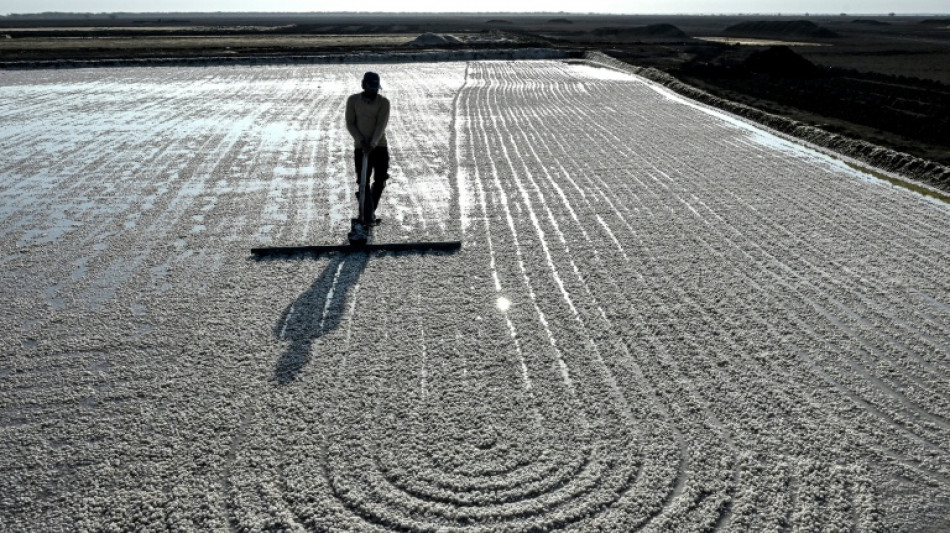
No trees, no fans: surviving extreme heat in India's salt pans / Photo: © AFP

India faces challenging heatwaves each year, but few places endure conditions as searing as the country's western desert salt pans, where workers rely on simple techniques to survive almost unbearable temperatures.
Up to 50,000 workers in Gujarat spend eight months on the remote salt pans without electricity or healthcare, relying on a tanker to deliver drinking and washing water every 25 days.
They use shaded rest breaks, cloth-cooled water bottles and staggered hours to survive.
In Gujarat's Little Rann of Kutch summer temperatures routinely cross 45C, and can climb to 47–48C.
The same dry heat that makes life punishing also makes the desert ideal for salt production -- Gujarat produces roughly three-quarters of India's total salt output.
"We work in staggered timing... doing our work in early mornings and after sunset," said 42-year-old Babulal Narayan, who rakes the salt as brine water dries in shallow pools.
During the hottest hours, many retreat to makeshift huts -- frames of sticks draped with coarse homespun cloth, plastered with wild donkey dung.
"We sit here every two to three hours, so that we do not feel weak or dizzy," said 17-year-old salt worker Bhavna Rathore.
The dung blocks the sun and allows heat to escape, while the rough cloth allows some air to pass through, she explained.
The huts offer shelter in a landscape without trees or natural shade, and where the sun reflects harshly off the white salt crust.
- 'Heatwave' -
Kanchan Narayan, 44, uses a damp cloth-wrapped bottle hung on a string, cooling the drinking water inside via evaporation.
"The wind helps to cool the water," she said.
Poornima, a salt pan worker, sips black tea during the day -- saying the hot drink induces sweating in the dry weather to cool the body.
The salt is produced by pumping saline water from bore-wells into shallow pans, where the liquid evaporates under the sun and wind.
Workers rake the surface daily to ensure even crystallisation. Over weeks, a thick crust of salt forms, which the workers break and stack into mounds.
The job has always involved enduring harsh conditions, but this year the India Meteorological Department (IMD) forecasts an "above-normal number of heatwave days" across several regions, including Gujarat.
Workers are exposed to the heat for longer than before.
Previously, they relied on expensive diesel pumps to bring the saline water to the surface. But a switch to solar has brought down costs and allowed families to operate the pans for longer.
That means work that used to end in March now continues into the hottest months.
- 'Fever' -
The consequences for workers can be deadly, with regular reports of fatigue, dizziness and nausea -- signs of heat stress, when the body's natural cooling systems are overwhelmed.
This can cause organ failure and even death.
Several studies have found high levels of dehydration, heat stress and even signs of kidney malfunction among these communities.
"I take a paracetamol whenever fever becomes high," said Kanchan, a rare worker wearing rubber boots -- to protect against prolonged exposure to brine, that can crack skin so deep it bleeds.
India has no fixed legal temperature at which work must stop.
Instead it relies on IMD heatwave thresholds -- around 40C for alerts and 47C for "severe" conditions -- with local authorities imposing restrictions.
The desert conditions make the extreme heat marginally more survivable -- at low humidity, sweat evaporates more quickly off the skin, cooling the body.
But conditions are growing harder, with heatwaves intensifying and unseasonal storms also threatening livelihoods.
A sudden rainstorm can dissolve crystallised salt overnight -- forcing workers to restart the evaporation cycle.
"A big dust storm hit us last month, destroying salt worth 200,000 rupees ($2,100)," Narayan said.
He and five relatives made a profit of 250,000 rupees ($2,635) -- or $450 each for eight months of hard work.
But families say they have little alternative.
"What else will we do?" said 65-year-old worker Rasoda Rathore.
"We have no land to farm, no livestock to earn our livelihood from... this is all we know."
C.Dean--TFWP