The Fort Worth Press - Rover discovers more building blocks of life on Mars

USD -
AED 3.672502
AFN 64.000035
ALL 81.050345
AMD 372.849662
ANG 1.789884
AOA 918.000431
ARS 1376.761702
AUD 1.398474
AWG 1.8
AZN 1.700483
BAM 1.659926
BBD 2.012001
BDT 122.580618
BGN 1.668102
BHD 0.377155
BIF 2975.451401
BMD 1
BND 1.269716
BOB 6.928101
BRL 4.956398
BSD 0.998999
BTN 93.104283
BWP 13.393251
BYN 2.833537
BYR 19600
BZD 2.009115
CAD 1.366065
CDF 2310.999715
CHF 0.78057
CLF 0.022403
CLP 881.719847
CNY 6.81775
CNH 6.818375
COP 3580.06
CRC 455.158835
CUC 1
CUP 26.5
CVE 93.584102
CZK 20.663797
DJF 177.894898
DKK 6.355503
DOP 60.105069
DZD 132.289262
EGP 51.917502
ERN 15
ETB 155.405337
EUR 0.85042
FJD 2.197406
FKP 0.738541
GBP 0.74065
GEL 2.685013
GGP 0.738541
GHS 11.0393
GIP 0.738541
GMD 73.000205
GNF 8764.507437
GTQ 7.643664
GYD 209.005767
HKD 7.831245
HNL 26.542927
HRK 6.404698
HTG 130.811696
HUF 307.779032
IDR 17148.5
ILS 2.99406
IMP 0.738541
INR 93.557502
IQD 1308.687239
IRR 1322999.999602
ISK 121.779662
JEP 0.738541
JMD 158.247615
JOD 0.70901
JPY 159.244497
KES 129.200705
KGS 87.449826
KHR 4000.611039
KMF 418.000054
KPW 899.985395
KRW 1471.789657
KWD 0.30826
KYD 0.832485
KZT 465.941881
LAK 22040.601555
LBP 89457.429473
LKR 316.121805
LRD 184.249704
LSL 16.35859
LTL 2.95274
LVL 0.604891
LYD 6.331263
MAD 9.226434
MDL 17.112231
MGA 4133.143226
MKD 52.402916
MMK 2099.934769
MNT 3577.136566
MOP 8.057338
MRU 39.868621
MUR 46.37016
MVR 15.449805
MWK 1732.185898
MXN 17.324002
MYR 3.95399
MZN 63.954991
NAD 16.35859
NGN 1347.060097
NIO 36.765611
NOK 9.34305
NPR 148.845775
NZD 1.694955
OMR 0.384518
PAB 0.999028
PEN 3.429932
PGK 4.392051
PHP 59.890498
PKR 278.536935
PLN 3.599203
PYG 6369.45378
QAR 3.642004
RON 4.335897
RSD 99.836984
RUB 74.551934
RWF 1463.489154
SAR 3.750866
SBD 8.038715
SCR 13.655339
SDG 601.000445
SEK 9.16045
SGD 1.272385
SHP 0.746601
SLE 24.650409
SLL 20969.496166
SOS 570.91693
SRD 37.44902
STD 20697.981008
STN 20.793285
SVC 8.740707
SYP 110.541984
SZL 16.354347
THB 32.097982
TJS 9.467984
TMT 3.505
TND 2.887496
TOP 2.40776
TRY 44.894835
TTD 6.779373
TWD 31.441798
TZS 2611.424974
UAH 44.124656
UGX 3701.267563
UYU 39.742806
UZS 12085.412635
VES 480.63111
VND 26328
VUV 118.060694
WST 2.715967
XAF 556.707234
XAG 0.01269
XAU 0.000209
XCD 2.70255
XCG 1.800421
XDR 0.692365
XOF 556.707234
XPF 101.215331
YER 238.649746
ZAR 16.37655
ZMK 9001.20203
ZMW 18.905523
ZWL 321.999592
  • RBGPF

    -13.5000

    69

    -19.57%

  • RIO

    -0.3200

    99.83

    -0.32%

  • CMSD

    0.0050

    23.085

    +0.02%

  • CMSC

    -0.0398

    22.73

    -0.18%

  • RYCEF

    -0.4600

    17.2

    -2.67%

  • AZN

    -4.1100

    200.69

    -2.05%

  • GSK

    -1.0000

    57.35

    -1.74%

  • RELX

    0.0600

    36.74

    +0.16%

  • BCE

    -0.1400

    23.95

    -0.58%

  • NGG

    -0.9000

    86.02

    -1.05%

  • BCC

    0.9300

    83.97

    +1.11%

  • JRI

    0.0400

    13.13

    +0.3%

  • BTI

    0.3800

    57.06

    +0.67%

  • BP

    0.5300

    45.12

    +1.17%

  • VOD

    0.1700

    15.65

    +1.09%

Rover discovers more building blocks of life on Mars
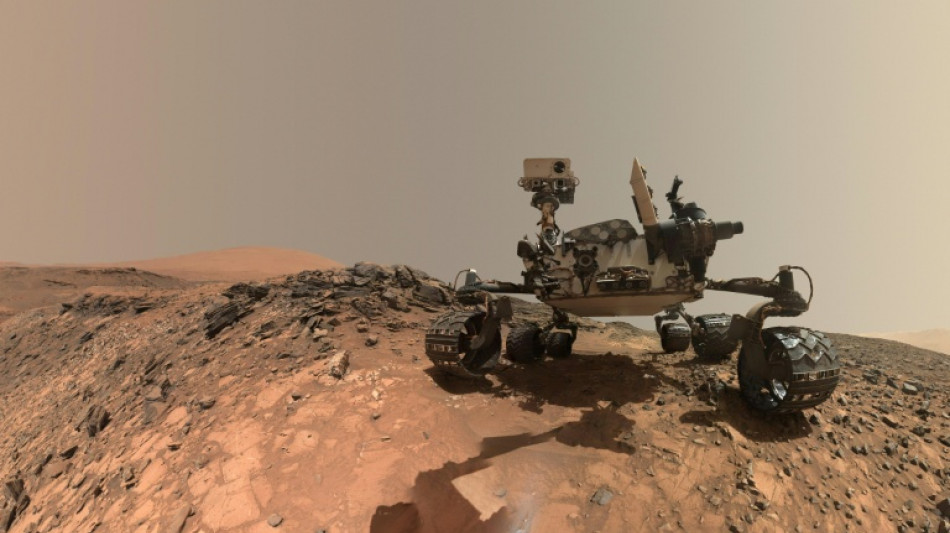
Rover discovers more building blocks of life on Mars / Photo: © NASA/AFP/File

Rover discovers more building blocks of life on Mars

A NASA rover has discovered more building blocks of life on Mars after carrying out a chemistry experiment never before conducted on another planet, scientists said Tuesday.

Text size:

The organic molecules are not definitive evidence of past life, the NASA-led team emphasised, because they could also have formed on the red planet or crash-landed on meteorites.

But it proves that these important clues to Martian history have been preserved on the surface for more than three billion years, they added.

Back then, the surface of Mars was thought to have been dotted with huge lakes and rivers full of liquid water, a key ingredient for life as we know it.

NASA's Curiosity rover landed in a former lake bed called the Gale crater in 2012, and has been searching for signs of possible past life since.

The car-sized rover carried two tubes of a chemical called TMAH, which can break apart organic matter to see what it is made out of.

"This experiment's never been run before on another world," Amy Williams, an astrobiologist working on the Curiosity mission told AFP.

The team were under pressure because they only had "two shots to get it right", added Williams, the lead author of a new study describing the results.

The experiment, conducted in 2020, detected more than 20 organic molecules, including several that had never before been confirmed on Mars.

These included a molecule called benzothiophene, which has also been found in meteorites and asteroids.

"The same stuff that rained down on Mars from meteorites is what rained down on Earth, and it probably provided the building blocks for life as we know it on our planet," Williams said.

Another molecule containing nitrogen "is a precursor to how DNA is eventually built," she added.

"We're seeing the building blocks for life -- prebiotic chemistry on Mars -- preserved in these rocks for billions of years."

- Future missions -

But none of this can prove that life -- even tiny, microbial organisms -- once flourished on Mars.

One way to potentially make such an "extraordinary claim" would be to bring some Martian rocks back to Earth so scientists can study them more closely, Williams said.

NASA's Perseverance rover has already collected a bunch of rocks for such a mission, called Mars Sample Return.

However the mission has effectively been cancelled by the administration of President Donald Trump following a US Congress vote in January.

Future missions could still benefit from Curiosity's demonstration that experiments using the TMAH chemical work on other worlds, the new study in Nature Communications said.

The European Space Agency's Rosalind Franklin rover, which has a much longer drill than Curiosity, will take the chemical to Mars.

After years of delays, NASA announced last week that the ESA's rover is now scheduled to blast off towards the red planet in late 2028.

The chemical will also be on board the Dragon rotorcraft, which is planned to launch in 2028 on a mission to explore Saturn's moon Titan.

T.Dixon--TFWP