Laughter, tears: historic day for astronaut Jenni Gibbons in Houston / Photo: © AFP

Canadian astronaut Jenni Gibbons was at the heart of NASA's control room in Houston on Monday, supporting her Artemis II crewmates remotely during their flight around the Moon.
As the backup astronaut for the mission, Gibbons trained alongside Americans Christina Koch, Victor Glover, Reid Wiseman and fellow Canadian Jeremy Hansen and was responsible for communications with the crew as they made their milestone-rich lunar flyby.
Speaking with AFP, Gibbons describes the impact of the journey -- more than half a century since the first mission to the Moon:
– What was the atmosphere like in the control room? –
The excitement at ground control was palpable, Gibbons said, adding that it was a "special" moment filled with tears, hugs and laughter.
"The excitement in the room for the descriptions (of space) that (the) crew called down was enormous. All the flight controllers have probably been inspired by Apollo and have been working their whole lives to see this happen," she said.
With their eyes glued to the spacecraft windows for nearly seven hours, the Artemis II team spent their day breaking records and making history.
"We broke the distance record for Apollo 13, the furthest that humans have ever traveled from our home planet. And the moment was special," Gibbons said.
"I think people were in tears at one point, people were grateful, people laughed, people hugged, and it was just one of my most cherished moments in my career."
- Why was the Moon flyby historic? –
"First of all, they were further from our home planet than anyone had been before," Gibbons said.
The Artemis II team broke the distance record set by the 1970 Apollo 13 mission -- which they surpassed by more than 4,000 miles (more than 6,000 kilometers) -- when they reached the journey's furthest distance from Earth 252,756 miles (406,771 kilometers).
"The other Apollo missions flew much closer to the Moon. Seeing the perspective of our Earth that far away must have been absolutely incredible, and there were perspectives from the further side of the Moon that had never been illuminated during the Apollo missions," she added.
The team also sent back descriptions of never-before-seen terrain, Gibbons said, adding that "we've seen them in remote imaging, but this is the first time that the most sensitive cameras in the world, which are the human eyes have been able to observe them."
– Which description struck you the most? –
"With the date we launched at, the orbital mechanics were such that... on the end of the lunar flyby, the crew witnessed an eclipse," Gibbons said.
"Because of that, they were able to see all of these incredible deep space and lunar features that weren't obscured by sunlight: a lot of really fine detail, even detail in the corona of the Sun as it passed behind the Moon.
"They actually flew with eclipse glasses to keep them safe today, so many of the people who have witnessed an eclipse on Earth could recognize that experience and connect with it."
Gibbons said the crew were also able to describe what they observed when the Moon was dark.
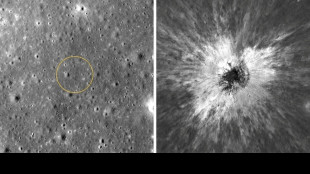
"They saw impact flashes on the surface, which means material hitting the surface of the Moon and creating new craters," she said.
"Those are something that we have not witnessed often. The Apollo astronauts maybe spoke about some of them, but they were really high priority science for us, so the fact that they saw four or five was just outstanding."
A.Maldonado--TFWP