Where AI lives: Southeast Asia's data centre boom / Photo: © AFP

Nonstop buzzing fills a windowless Microsoft data centre near Jakarta, part of a tech construction boom sweeping Southeast Asia that promises economic opportunities but is also hungry for resources.
As demand for artificial intelligence heats up, technology giants are racing to invest billions of dollars in the region, attracted by a growing plugged-in user base.
New data centres -- warehouse-like facilities that store online files and power AI tools from chatbots to image generators -- are mushrooming worldwide, and the sector is growing particularly fast in Asia.
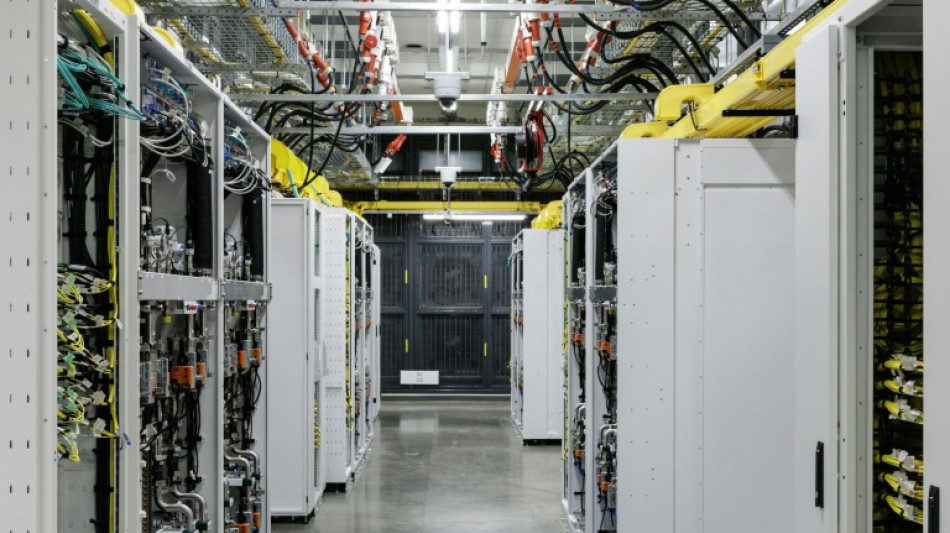
AFP was recently granted rare access to a Microsoft data centre in Indonesia that is part of the new boom.
No company logo was visible on the vast boxy exterior of the centre, and visitors were only admitted after careful security checks.
Keeping the systems whirring is a constant operation, with technicians on site even during religious holidays.
Data centre capacity in Southeast Asia is projected to triple from 2025 levels by 2030, driven by a tenfold surge in AI use, according to a KPMG report.
"We expect every app, every workload, every user to be using AI in some part of their workflow" in just a few years, Alistair Speirs, a manager for infrastructure at Microsoft, told AFP.
But many of Asia's data centres will add demand to grids still heavily reliant on planet-warming fossil fuels.
And to keep servers from overheating, they will place new pressure on often-stretched local water supplies.
- AI at work -
At the Indonesian data centre, racks of metal-cased servers in tall white cabinets were busy answering AI queries for local users -- an intensive, heat-generating process.
A "closed-loop" water cooling system, which works a bit like a car radiator and does not require regular refills, prevents them from malfunctioning.
Higher performance chips "require a lot more intensity", Noelle Walsh, head of the company's cloud operations, told AFP.
"We've had to adapt our data centres' designs to accommodate different power structures and different cooling mechanisms."
Super-connected Singapore was long Southeast Asia's data centre hotspot, but the city state halted developments between 2019 and 2022 over energy, water and land use worries.
That, along with an explosion of AI interest after ChatGPT's debut, brought a surge of data centres to neighbouring Malaysia, and increasingly Thailand, Indonesia, the Philippines and Vietnam.
"The boom is there," with companies racing for "first-player advantage", said Trung Ghi of the consulting firm Arthur D. Little.
Hosting data centres is a "win-win situation" for governments, he said, noting it boosts business efficiency with faster online tools and grows local economies as people come to work at new tech parks.
- Hyperscale -
The data centre expansion will increase demand on power grids that are still heavily coal dependent.
Power consumption by data centres in Indonesia -- where coal generates nearly 70 percent of electricity -- will likely quadruple by 2030, according to energy think tank Ember.
Microsoft's Jakarta facilities, spread out to mitigate risks from earthquakes and floods, are part of a $1.7 billion investment with a potential "hyperscale" capacity that would need hundreds of megawatts of electricity.
The company says it works to "green" local grids by incentivising energy transition plans.
"We don't build power plants, but we work with utility providers," Microsoft's Walsh said.
"In some parts of the world it is wind power, in other parts of the world it is solar, we also use hydropower, and in some countries it's nuclear. So we support all of those."
Microsoft recently signed a deal with Indonesia's state-owned electricity provider to raise the nation's renewable energy capacity by around 200 megawatts over a decade.
- Sinking city -
Microsoft's rivals Amazon and Google, as well as Chinese tech giants Alibaba and Tencent, also run data centres in the Jakarta region.
The metropolitan area of 42 million is sinking, partly due to groundwater extraction. Officials plan to eventually relocate the capital.
The data centre boom "will put even greater strain on the region's water resources, which have historically been overexploited and badly managed," said scientist Olivia Jensen from the National University of Singapore.
Microsoft projects water consumption will grow until 2028 before stabilising at 660 million litres the year after as the company adds more closed-loop systems.
"We're evolving fast, and what we're building now will consume zero water on a daily basis," Walsh said.
As AI technology develops apace, the company has swathes of land reserved on its Jakarta site for future builds.
But next-generation systems will likely require more computing power, Ghi warned.
"If these things get larger and larger and more thirsty, then something has to give," Ghi said.
G.George--TFWP