The Fort Worth Press - Astronomers spot storm on another star for first time

USD -
AED 3.672505
AFN 63.000352
ALL 83.528741
AMD 377.097463
ANG 1.790083
AOA 917.000257
ARS 1396.5426
AUD 1.41634
AWG 1.8025
AZN 1.696063
BAM 1.701717
BBD 2.011729
BDT 122.560493
BGN 1.709309
BHD 0.377383
BIF 2965.66996
BMD 1
BND 1.277664
BOB 6.926765
BRL 5.234497
BSD 0.998865
BTN 92.130862
BWP 13.619535
BYN 2.975437
BYR 19600
BZD 2.008857
CAD 1.369665
CDF 2265.000074
CHF 0.789835
CLF 0.023044
CLP 909.919576
CNY 6.95625
CNH 6.89152
COP 3704.51
CRC 469.165343
CUC 1
CUP 26.5
CVE 95.94059
CZK 21.306902
DJF 177.864013
DKK 6.514475
DOP 60.968872
DZD 132.266008
EGP 52.374962
ERN 15
ETB 157.33744
EUR 0.871696
FJD 2.215897
FKP 0.751829
GBP 0.75328
GEL 2.720026
GGP 0.751829
GHS 10.871788
GIP 0.751829
GMD 73.499662
GNF 8756.824955
GTQ 7.655931
GYD 209.081971
HKD 7.83475
HNL 26.442872
HRK 6.567199
HTG 130.916178
HUF 341.265497
IDR 16992
ILS 3.12685
IMP 0.751829
INR 92.46315
IQD 1308.437236
IRR 1321050.000186
ISK 124.84966
JEP 0.751829
JMD 157.121043
JOD 0.709007
JPY 159.443495
KES 129.550477
KGS 87.450197
KHR 4005.098822
KMF 428.999779
KPW 900.043905
KRW 1495.005021
KWD 0.30701
KYD 0.832325
KZT 482.332878
LAK 21434.59989
LBP 89444.014235
LKR 311.030096
LRD 182.778438
LSL 16.803647
LTL 2.95274
LVL 0.604889
LYD 6.40213
MAD 9.383804
MDL 17.379123
MGA 4158.165152
MKD 53.635596
MMK 2100.153228
MNT 3574.497589
MOP 8.055442
MRU 39.823891
MUR 46.620045
MVR 15.45988
MWK 1731.655218
MXN 17.72108
MYR 3.925012
MZN 63.919283
NAD 16.803647
NGN 1372.21022
NIO 36.754405
NOK 9.697198
NPR 147.413576
NZD 1.71817
OMR 0.384511
PAB 0.99886
PEN 3.447895
PGK 4.307026
PHP 59.860976
PKR 279.020626
PLN 3.72865
PYG 6483.189475
QAR 3.650989
RON 4.439897
RSD 102.373965
RUB 81.248191
RWF 1457.750554
SAR 3.752651
SBD 8.05166
SCR 14.022536
SDG 600.999869
SEK 9.385315
SGD 1.279704
SHP 0.750259
SLE 24.596448
SLL 20969.510825
SOS 569.822632
SRD 37.5715
STD 20697.981008
STN 21.317787
SVC 8.740027
SYP 110.875895
SZL 16.791017
THB 32.528498
TJS 9.588581
TMT 3.505
TND 2.950218
TOP 2.40776
TRY 44.191303
TTD 6.773629
TWD 31.950802
TZS 2604.999731
UAH 44.034003
UGX 3770.958227
UYU 40.606796
UZS 12076.811304
VES 446.24625
VND 26282
VUV 119.587146
WST 2.754209
XAF 570.742318
XAG 0.012395
XAU 0.0002
XCD 2.702551
XCG 1.800124
XDR 0.70982
XOF 570.742318
XPF 103.766608
YER 238.483762
ZAR 16.746335
ZMK 9001.201678
ZMW 19.451671
ZWL 321.999592
  • RBGPF

    0.1000

    82.5

    +0.12%

  • RYCEF

    -0.1500

    16.4

    -0.91%

  • CMSC

    0.0000

    22.99

    0%

  • BCE

    0.6521

    25.9

    +2.52%

  • GSK

    0.3800

    53.77

    +0.71%

  • RIO

    2.0300

    89.86

    +2.26%

  • VOD

    0.1900

    14.6

    +1.3%

  • BTI

    1.0100

    60.94

    +1.66%

  • NGG

    -0.0100

    90.89

    -0.01%

  • RELX

    0.3300

    34.47

    +0.96%

  • BP

    0.2300

    42.9

    +0.54%

  • CMSD

    -0.0400

    22.95

    -0.17%

  • AZN

    2.1100

    192.01

    +1.1%

  • BCC

    1.7200

    71.72

    +2.4%

  • JRI

    -0.0500

    12.54

    -0.4%

Astronomers spot storm on another star for first time
Astronomers spot storm on another star for first time / Photo: © AFP

Astronomers spot storm on another star for first time

Astronomers revealed Wednesday they have detected a storm on a star other than our Sun for the first time, discovering an explosion so violent it could have stripped away the atmosphere of any planets unlucky enough to be nearby.

Text size:

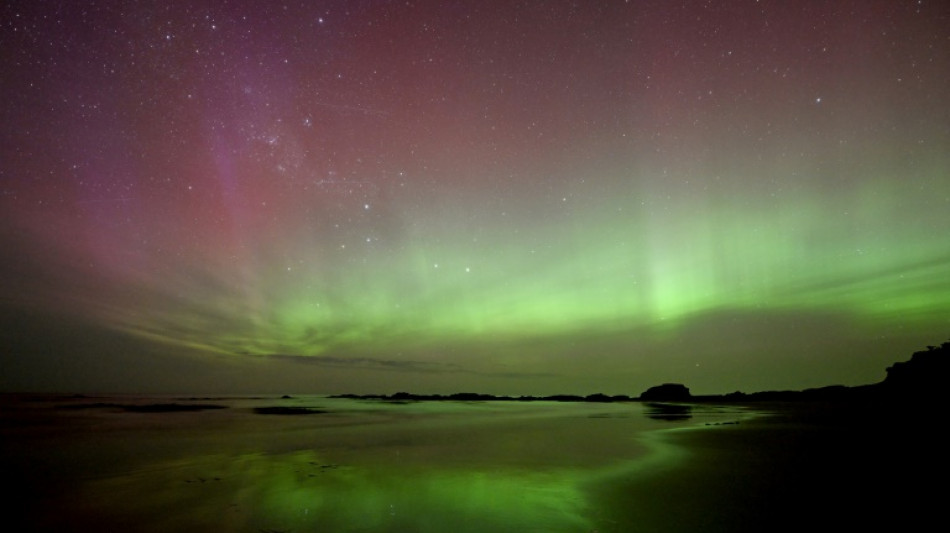
Solar storms on the Sun sometimes shoot out huge eruptions known as coronal mass ejections, which can disrupt satellites when they arrive at Earth -- and create colourful auroras that dance across the sky.

In fact, a particularly powerful solar storm caused auroras as far south as the US city of Tennessee on Wednesday, according to the National Oceanic and Atmospheric Administration.

Auroras were also visible in the skies above New Zealand, AFP images showed, with more expected into Wednesday night.

However, observing such a storm on a distant star had proven difficult for astronomers.

New research, published in the journal Nature on Wednesday, revealed that an international team of researchers has finally achieved the feat.

The discovery used data from a European network of telescopes called LOFAR.

The team of astronomers has been using LOFAR since 2016 to detect the most extreme and violent events in the universe -- such as black holes -- which emit relatively stable radio signals over time.

"We always have stars in the telescope's field of view but generally we're not interested in them," Cyril Tasse, a Paris Observatory astronomer and the study's co-author, told AFP.

However, the researchers have set up a data processing system that also records what is going on with the stars behind the behemoths they are chasing.

In 2022, the team decided to find out "what had been caught in this net", Tasse said.

They found that there was a huge explosion which only lasted a minute on May 16, 2016. It came from a red dwarf star called StKM 1-1262 more than 133 light years away.

The team then determined it was a coronal mass ejection -- a stellar storm.

"It's the first time we have detected one" on a star other than our own, Tasse said.

But this coronal mass ejection was "at least 10,000 times more violent than known solar storms" on the Sun, he added.

- Atmosphere killers -

The discovery could have an impact on the search for planets beyond our solar system that have the potential to host life.

Red dwarfs, which have a mass of between 10 and 50 percent that of our Sun, have proven to be the most likely stars in the universe to host planets that are roughly the size of Earth.

"The first radio detection inaugurates a new era for space weather applied to other star systems," said Philippe Zarka, research director at the Paris Observatory and a study co-author.

"This emerging field opens up major perspectives for how the magnetic activity of stars influence the habitability of the planets that surround them."

Tasse said that it appears that red dwarf stars have "much more erratic and violent" behaviour than the Sun.

"The implication is that these stars can be rather inhospitable when it comes to life and exoplanets," because they have storms so powerful they could destroy the atmospheres of planets nearby, he added.

A.Maldonado--TFWP