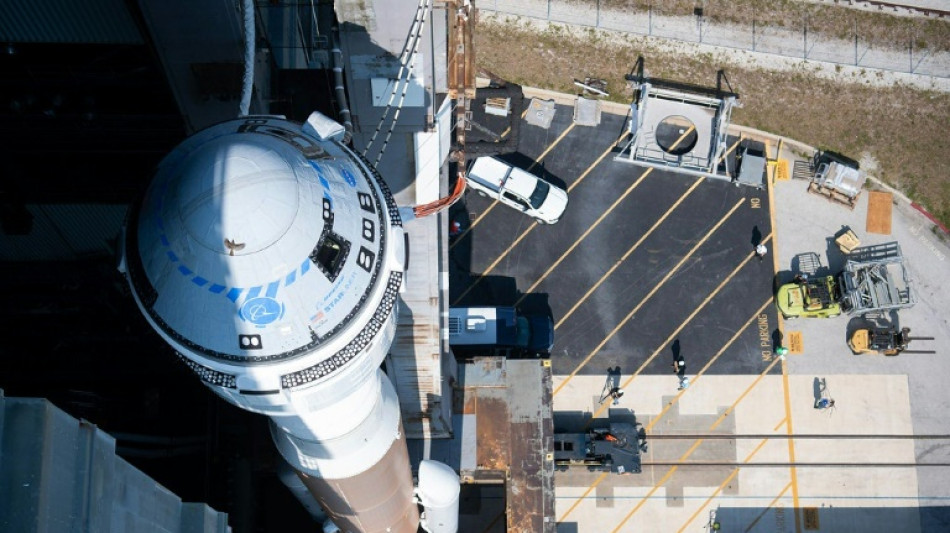
Boeing's troubled Starliner launches for ISS in key test / Photo: © NASA/AFP

American aerospace giant Boeing launched its Starliner capsule for the International Space Station Thursday in a critical uncrewed test flight that followed years of failures and false starts.
The Orbital Test Flight 2 (OFT-2) mission blasted off at 6:54 pm Eastern Time (2254 GMT) from the Kennedy Space Center in Florida, with the spaceship fixed atop a United Launch Alliance Atlas V rocket.
"Starliner is headed back to space on the shoulders of Atlas," an announcer said on a NASA live feed.
Its success is key to repairing Boeing's frayed reputation after the first bid, back in 2019, failed to dock with the ISS due to software bugs -- one that led to it burning too much fuel to reach its destination, and another that could have destroyed the vehicle during re-entry.
A second try was scheduled in August of last year, but was rolled back from the launchpad to address sticky valves that weren't opening as they should, and the capsule was eventually sent back to the factory for fixes.
Boeing and NASA say the drama is now behind them.
"This is a great moment," said NASA deputy administrator Pam Melroy, just before launch. "When we built the space station we were really focused on all the amazing science that we can do in the innovation, and so now having another way to get there just gives us more resilience."
NASA is looking to certify Starliner as a second "taxi" service for its astronauts to the space station -- a role that Elon Musk's SpaceX has provided since succeeding in a test mission for its Dragon capsule in 2020.
- Redemption day -
Both companies were awarded fixed-price contracts -- $4.2 billion to Boeing, and $2.6 billion to SpaceX -- in 2014, shortly after the end of the Space Shuttle program, during a time when the United States was left reliant on Russian Soyuz rockets for rides to the orbital outpost.
Boeing, with its hundred-year history, was considered by many as the sure shot, while then-upstart SpaceX was less proven.
In reality, it was SpaceX that rocketed ahead, and recently sent its fourth routine crew to the research platform -- while Boeing's development delays have cost the company hundreds of millions of dollars.
Starliner should dock with the ISS about 24 hours after launch, and deliver more than 500 pounds (226 kilograms) of cargo -- including food and provisions such as clothes and sleeping bags for the current crew on the station.
Its sole passenger is a mannequin named Rosie the Rocketeer -- a play on the World War II campaign icon Rosie the Riveter -- whose job is to collect flight data with her sensors in order to learn what human astronauts would experience.
"We are a little jealous of Rosie," said NASA astronaut Mike Fincke, who is expected to be among the first crew selected for a manned demonstration mission should OFT-2 succeed.
The gumdrop-shaped capsule will spend about five to ten days in space, then undock and return to Earth, using giant parachutes to land in the desert of the western United States.
NASA sees a second provider to low Earth orbit as a vital backup, should SpaceX encounter problems.
"It's a really critical step for us and moving towards having two routinely flying crewed vehicles who can bring our crew to and from ISS," Dana Weigel, deputy program manager for the ISS, told reporters.
A.Maldonado--TFWP