The Fort Worth Press - 'Well-preserved' dinosaur fossil revealed by Brazilian flood

USD -
AED 3.673104
AFN 63.000368
ALL 83.025041
AMD 377.503986
ANG 1.790083
AOA 917.000367
ARS 1380.698704
AUD 1.418038
AWG 1.8025
AZN 1.70397
BAM 1.689727
BBD 2.01353
BDT 122.670076
BGN 1.709309
BHD 0.374681
BIF 2970
BMD 1
BND 1.278587
BOB 6.90829
BRL 5.314104
BSD 0.999767
BTN 93.464137
BWP 13.632554
BYN 3.033193
BYR 19600
BZD 2.010678
CAD 1.37185
CDF 2275.000362
CHF 0.788304
CLF 0.023504
CLP 928.050396
CNY 6.886404
CNH 6.906095
COP 3712.59
CRC 466.966746
CUC 1
CUP 26.5
CVE 95.850394
CZK 21.14904
DJF 177.720393
DKK 6.457904
DOP 59.000359
DZD 132.021187
EGP 51.834636
ERN 15
ETB 157.150392
EUR 0.864104
FJD 2.21445
FKP 0.749058
GBP 0.749457
GEL 2.71504
GGP 0.749058
GHS 10.90504
GIP 0.749058
GMD 73.503851
GNF 8777.503848
GTQ 7.658082
GYD 209.166703
HKD 7.83185
HNL 26.560388
HRK 6.513504
HTG 131.155614
HUF 339.750388
IDR 16960
ILS 3.109125
IMP 0.749058
INR 93.85395
IQD 1310
IRR 1315625.000352
ISK 124.270386
JEP 0.749058
JMD 157.066706
JOD 0.70904
JPY 159.235504
KES 129.603801
KGS 87.447904
KHR 4010.00035
KMF 427.00035
KPW 899.950845
KRW 1505.910383
KWD 0.306604
KYD 0.833125
KZT 480.643127
LAK 21485.000349
LBP 89550.000349
LKR 311.869854
LRD 183.375039
LSL 17.010381
LTL 2.95274
LVL 0.60489
LYD 6.380381
MAD 9.360504
MDL 17.410687
MGA 4170.000347
MKD 53.326817
MMK 2099.773051
MNT 3569.674815
MOP 8.069756
MRU 40.130379
MUR 46.503741
MVR 15.460378
MWK 1737.000345
MXN 17.898704
MYR 3.939039
MZN 63.903729
NAD 16.830377
NGN 1356.250377
NIO 36.720377
NOK 9.569995
NPR 149.542319
NZD 1.713209
OMR 0.381586
PAB 0.999784
PEN 3.479039
PGK 4.31175
PHP 59.973038
PKR 279.203701
PLN 3.69455
PYG 6529.758871
QAR 3.644504
RON 4.401504
RSD 101.699038
RUB 82.944058
RWF 1459
SAR 3.755057
SBD 8.05166
SCR 14.367754
SDG 601.000339
SEK 9.343304
SGD 1.282404
SHP 0.750259
SLE 24.575038
SLL 20969.510825
SOS 571.503662
SRD 37.487504
STD 20697.981008
STN 21.515
SVC 8.747565
SYP 110.76532
SZL 16.830369
THB 32.803646
TJS 9.602575
TMT 3.51
TND 2.909038
TOP 2.40776
TRY 44.280904
TTD 6.782897
TWD 32.000335
TZS 2586.664038
UAH 43.796556
UGX 3778.931635
UYU 40.286315
UZS 12195.000334
VES 454.69063
VND 26312
VUV 119.036336
WST 2.744165
XAF 566.725992
XAG 0.014693
XAU 0.000222
XCD 2.70255
XCG 1.801775
XDR 0.705856
XOF 570.503593
XPF 103.550363
YER 238.603589
ZAR 17.127504
ZMK 9001.203584
ZMW 19.520498
ZWL 321.999592
  • RBGPF

    -13.5000

    69

    -19.57%

  • CMSC

    -0.2000

    22.65

    -0.88%

  • RYCEF

    -1.3000

    15.3

    -8.5%

  • RIO

    -2.5000

    83.15

    -3.01%

  • RELX

    -0.4600

    33.36

    -1.38%

  • VOD

    -0.0900

    14.33

    -0.63%

  • NGG

    -3.5400

    81.99

    -4.32%

  • GSK

    -0.5300

    51.84

    -1.02%

  • BCE

    0.0600

    25.79

    +0.23%

  • CMSD

    -0.2420

    22.658

    -1.07%

  • BCC

    -1.5600

    68.3

    -2.28%

  • JRI

    -0.3900

    11.77

    -3.31%

  • AZN

    -5.3300

    183.6

    -2.9%

  • BTI

    -1.3500

    57.37

    -2.35%

  • BP

    -1.0800

    44.78

    -2.41%

'Well-preserved' dinosaur fossil revealed by Brazilian flood
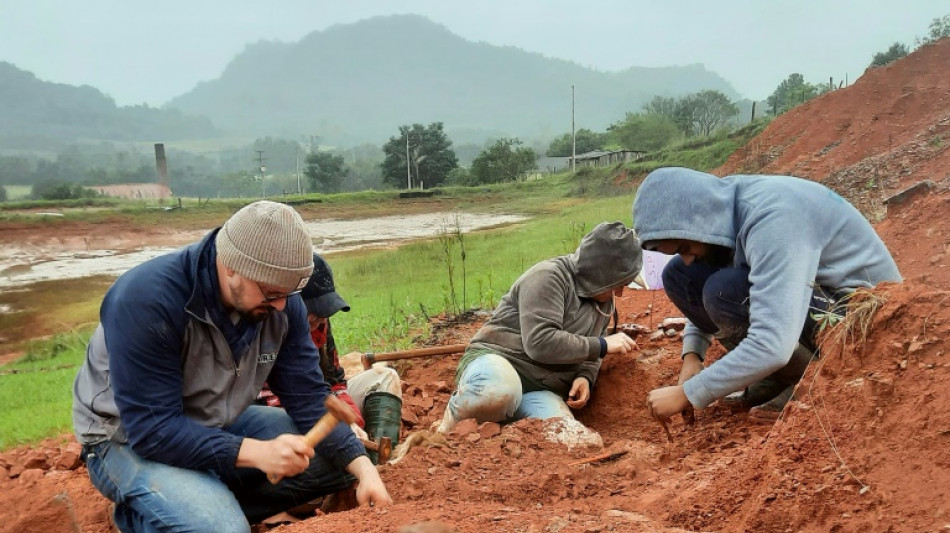
'Well-preserved' dinosaur fossil revealed by Brazilian flood / Photo: © Federal University of Santa Maria/AFP

'Well-preserved' dinosaur fossil revealed by Brazilian flood

Torrential rains causing historic flooding in southern Brazil have revealed a "very well-preserved" dinosaur fossil dating back some 200 million years, according to the research team who discovered it.

Text size:

The fossil was first identified in May near the city of Sao Joao do Polesine, some 280 kilometres (170 miles) west of Porto Alegre, in a part of the Brazilian pampas dubbed the country's 'El Dorado' of palaeontology.

A team of palaeontologists from the Federal University of Santa Maria spent four days excavating the fossil to remove the block of rock containing a "near complete" dinosaur fossil to take back to their research centre for study.

Initial findings have determined the fossil was a specimen of the Herrerasauridae family, which were bipedal carnivores with long tails found in the area of modern-day Brazil and Argentina.

The fossil dates to the Triassic period, between 250 to 200 million years ago.

Rodrigo Temp Muller, who's leading the research effort, told AFP that the fossil is possibly the second most complete fossil of a Herrerasauridae specimen to date.

The most complete was found in the same part of Brazil in 2014, leading to the identification of a new species with hooked claws, dubbed gnathovorax cabreirai.

The fossil will undergo several rounds of analysis before researchers can determine whether the specimen is a member of the same species.

"We have to be very careful with this work, it's very meticulous, almost surgical," Muller said, adding the process could take "several months."

"Every little part that we might damage will be a bit of information that we might not be able to recover."

Once the analysis is done, Muller's team will publish the results in a scientific journal.

- Erosion acceleration -

The heavy rains that affected the pampas in May killed more than 180 people in Brazil and caused major damage to infrastructure.

The floods revealed the fossil much earlier by "accelerating erosion," a silver lining to researchers, who would not have discovered it until much later, according to Muller.

The downpour is not without its drawbacks, however, as heavy rainfall "also destroys a lot of the material" from the fossils, especially small fragments.

Palaeontologists maintain a close watch on the fossil deposits as a result, especially any fragments that may be exposed, and focus their efforts during excavations to recover these fossils in the best possible condition.

C.Dean--TFWP