The Fort Worth Press - Black hole observed 'awakening' for the first time

USD -
AED 3.672504
AFN 66.265317
ALL 82.40468
AMD 381.537936
ANG 1.790403
AOA 917.000367
ARS 1449.250402
AUD 1.508523
AWG 1.8025
AZN 1.70397
BAM 1.670125
BBD 2.014261
BDT 122.309039
BGN 1.670125
BHD 0.377012
BIF 2957.004398
BMD 1
BND 1.292857
BOB 6.910892
BRL 5.541304
BSD 1.000043
BTN 89.607617
BWP 14.066863
BYN 2.939243
BYR 19600
BZD 2.011357
CAD 1.37965
CDF 2558.50392
CHF 0.800557
CLF 0.023213
CLP 910.640396
CNY 7.04095
CNH 7.033604
COP 3860.210922
CRC 499.466291
CUC 1
CUP 26.5
CVE 94.159088
CZK 20.779904
DJF 178.088041
DKK 6.380104
DOP 62.644635
DZD 130.069596
EGP 47.704197
ERN 15
ETB 155.362794
EUR 0.853804
FJD 2.283704
FKP 0.747615
GBP 0.752191
GEL 2.68504
GGP 0.747615
GHS 11.486273
GIP 0.747615
GMD 73.000355
GNF 8741.72751
GTQ 7.663208
GYD 209.231032
HKD 7.78155
HNL 26.346441
HRK 6.434404
HTG 131.121643
HUF 330.190388
IDR 16697
ILS 3.20705
IMP 0.747615
INR 89.577504
IQD 1310.106315
IRR 42100.000352
ISK 125.630386
JEP 0.747615
JMD 160.018787
JOD 0.70904
JPY 157.75504
KES 128.909953
KGS 87.450384
KHR 4013.492165
KMF 420.00035
KPW 900.011689
KRW 1475.720383
KWD 0.30723
KYD 0.83344
KZT 517.535545
LAK 21660.048674
LBP 89556.722599
LKR 309.636651
LRD 177.012083
LSL 16.776824
LTL 2.95274
LVL 0.60489
LYD 5.420776
MAD 9.166901
MDL 16.930959
MGA 4548.055164
MKD 52.559669
MMK 2100.050486
MNT 3553.222489
MOP 8.015542
MRU 40.023056
MUR 46.150378
MVR 15.450378
MWK 1734.170189
MXN 18.034604
MYR 4.077039
MZN 63.903729
NAD 16.776824
NGN 1460.160377
NIO 36.804577
NOK 10.138704
NPR 143.372187
NZD 1.704304
OMR 0.385423
PAB 1.000043
PEN 3.367832
PGK 4.254302
PHP 58.571038
PKR 280.195978
PLN 3.59225
PYG 6709.363392
QAR 3.645959
RON 4.335404
RSD 100.234832
RUB 80.483327
RWF 1456.129115
SAR 3.750651
SBD 8.146749
SCR 15.161607
SDG 601.503676
SEK 9.268304
SGD 1.293304
SHP 0.750259
SLE 24.050371
SLL 20969.503664
SOS 570.513642
SRD 38.441504
STD 20697.981008
STN 20.921395
SVC 8.750267
SYP 11058.582789
SZL 16.774689
THB 31.425038
TJS 9.215661
TMT 3.5
TND 2.927287
TOP 2.40776
TRY 42.746504
TTD 6.787925
TWD 31.518904
TZS 2495.196618
UAH 42.285385
UGX 3577.131634
UYU 39.263908
UZS 12022.543871
VES 282.15965
VND 26312.5
VUV 120.938943
WST 2.787822
XAF 560.144315
XAG 0.014888
XAU 0.000231
XCD 2.70255
XCG 1.8024
XDR 0.69664
XOF 560.144315
XPF 101.840229
YER 238.403589
ZAR 16.77901
ZMK 9001.203584
ZMW 22.626703
ZWL 321.999592
  • RIO

    0.6900

    78.32

    +0.88%

  • CMSC

    -0.1200

    23.17

    -0.52%

  • SCS

    0.0200

    16.14

    +0.12%

  • BTI

    -0.5900

    56.45

    -1.05%

  • CMSD

    -0.0300

    23.25

    -0.13%

  • BCC

    -2.9300

    74.77

    -3.92%

  • RBGPF

    0.0000

    80.22

    0%

  • JRI

    -0.0500

    13.38

    -0.37%

  • BP

    0.6300

    33.94

    +1.86%

  • NGG

    -0.2800

    76.11

    -0.37%

  • GSK

    0.3200

    48.61

    +0.66%

  • AZN

    0.7500

    91.36

    +0.82%

  • RELX

    0.0800

    40.73

    +0.2%

  • RYCEF

    0.2800

    15.68

    +1.79%

  • VOD

    0.0400

    12.84

    +0.31%

  • BCE

    -0.0100

    22.84

    -0.04%

Black hole observed 'awakening' for the first time
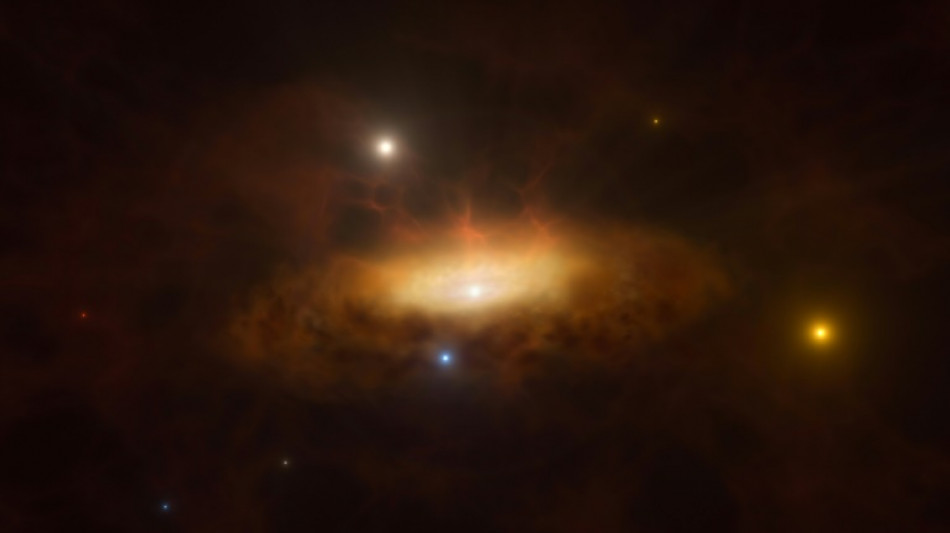
Black hole observed 'awakening' for the first time / Photo: © European Southern Observatory/AFP

Black hole observed 'awakening' for the first time

Astronomers have been able to observe a supermassive black hole waking up and setting the heart of its host galaxy alight for the first time, the European Southern Observatory said on Tuesday.

Text size:

The galaxy 300 million light years from Earth in the Virgo constellation had been quiet for decades until late 2019, when it suddenly began to shine brighter than ever before.

The centre of the galaxy -- where a supermassive black hole is believed to be squatting -- since then has been radiating a variety of rays.

"This behaviour is unprecedented," Paula Sanchez Saez, an European Southern Observatory astronomer and first author of a new study in the journal Astronomy & Astrophysics, said in a statement.

The "most tangible option" to explain this brightening is that the astronomers were watching "the activation of a massive black hole in real time", study co-author Lorena Hernandez Garcia said.

Most galaxies -- including our own Milky Way -- are believed to have a supermassive black hole at their centre.

These cosmic behemoths are by definition invisible -- not even light can escape the pull of their awesome power.

The only way to observe black holes is when they destroy something huge that lets off light in its death throes: such as a star that wandered too close being torn apart.

"These giant monsters usually are sleeping," study co-author Claudio Ricci explained.

But for the galaxy SDSS1335+0728, "we were able to observe the awakening of the massive black hole, (which) suddenly started to feast on gas available in its surroundings, becoming very bright," the astrophysicist added.

Initial observations indicate the black hole has 1.5 million times more mass than the Sun, enough for it to be classified as a supermassive black hole.

But it is still on the lighter side, as the true heavyweights easily exceed a billion times the Sun's mass.

The international team of astronomers is analysing data from a number of telescopes hoping to determine whether the black hole's activity is temporary -- perhaps caused by a star being ripped apart -- or whether it will continue to be active for a long time.

"This is something that could happen also to our own Sgr A*," the Milky Way's supermassive black hole, Hernandez Garcia said.

But fortunately for us, our own black hole remains fast asleep.

J.P.Estrada--TFWP