The Fort Worth Press - Small bees better at coping with warming, bumblebees struggle: study

USD -
AED 3.672502
AFN 62.99991
ALL 83.847188
AMD 377.663361
ANG 1.790083
AOA 916.999566
ARS 1398.213497
AUD 1.417696
AWG 1.8
AZN 1.703637
BAM 1.708212
BBD 2.017486
BDT 122.914738
BGN 1.709309
BHD 0.377651
BIF 2973.692945
BMD 1
BND 1.281814
BOB 6.92176
BRL 5.265302
BSD 1.001712
BTN 92.461144
BWP 13.649683
BYN 2.963911
BYR 19600
BZD 2.014516
CAD 1.367675
CDF 2256.999987
CHF 0.78755
CLF 0.023195
CLP 915.860146
CNY 6.896604
CNH 6.89166
COP 3694.09
CRC 471.29313
CUC 1
CUP 26.5
CVE 96.306777
CZK 21.297601
DJF 178.376159
DKK 6.50885
DOP 61.540611
DZD 132.375034
EGP 52.358967
ERN 15
ETB 156.356736
EUR 0.87114
FJD 2.215903
FKP 0.754939
GBP 0.752865
GEL 2.729771
GGP 0.754939
GHS 10.878299
GIP 0.754939
GMD 73.445873
GNF 8781.936498
GTQ 7.681659
GYD 209.565567
HKD 7.830625
HNL 26.515042
HRK 6.563202
HTG 131.339112
HUF 339.557056
IDR 16999
ILS 3.123685
IMP 0.754939
INR 92.2685
IQD 1312.214231
IRR 1321724.999909
ISK 125.1098
JEP 0.754939
JMD 157.170494
JOD 0.709023
JPY 159.113025
KES 129.498985
KGS 87.450098
KHR 4016.786833
KMF 431.000302
KPW 899.999993
KRW 1490.24498
KWD 0.30674
KYD 0.83472
KZT 490.385917
LAK 21464.006848
LBP 89699.372893
LKR 311.744232
LRD 183.302982
LSL 16.823764
LTL 2.95274
LVL 0.60489
LYD 6.391601
MAD 9.434294
MDL 17.474278
MGA 4159.188076
MKD 53.71692
MMK 2099.642329
MNT 3571.28497
MOP 8.074956
MRU 40.077209
MUR 46.740091
MVR 15.449849
MWK 1736.867158
MXN 17.805045
MYR 3.930504
MZN 63.909615
NAD 16.823837
NGN 1380.030291
NIO 36.857988
NOK 9.70619
NPR 147.937656
NZD 1.71158
OMR 0.3845
PAB 1.001625
PEN 3.454329
PGK 4.380142
PHP 59.696976
PKR 279.690813
PLN 3.718505
PYG 6462.347372
QAR 3.641255
RON 4.437799
RSD 102.272826
RUB 81.450381
RWF 1461.74237
SAR 3.752614
SBD 8.051718
SCR 13.688485
SDG 600.99956
SEK 9.375185
SGD 1.278935
SHP 0.750259
SLE 24.550073
SLL 20969.510825
SOS 571.47349
SRD 37.547978
STD 20697.981008
STN 21.398501
SVC 8.76469
SYP 110.524985
SZL 16.818349
THB 32.415975
TJS 9.601069
TMT 3.5
TND 2.962352
TOP 2.40776
TRY 44.187974
TTD 6.793399
TWD 31.984946
TZS 2605.000414
UAH 44.172726
UGX 3766.136217
UYU 40.238092
UZS 12094.904122
VES 442.704625
VND 26290
VUV 119.565255
WST 2.735215
XAF 572.920733
XAG 0.012652
XAU 0.0002
XCD 2.70255
XCG 1.805255
XDR 0.71253
XOF 572.918232
XPF 104.162209
YER 238.550019
ZAR 16.789401
ZMK 9001.1894
ZMW 19.497092
ZWL 321.999592
  • RBGPF

    0.1000

    82.5

    +0.12%

  • CMSC

    0.0200

    23.01

    +0.09%

  • CMSD

    -0.0300

    22.96

    -0.13%

  • BCC

    1.6500

    71.65

    +2.3%

  • JRI

    0.1100

    12.7

    +0.87%

  • BCE

    0.4071

    25.655

    +1.59%

  • RIO

    1.9900

    89.82

    +2.22%

  • GSK

    0.7100

    54.1

    +1.31%

  • NGG

    0.2300

    91.13

    +0.25%

  • RYCEF

    -0.2300

    16.32

    -1.41%

  • VOD

    0.2050

    14.615

    +1.4%

  • BTI

    1.3200

    61.25

    +2.16%

  • BP

    0.4620

    43.132

    +1.07%

  • RELX

    0.1350

    34.275

    +0.39%

  • AZN

    2.0800

    191.98

    +1.08%

Small bees better at coping with warming, bumblebees struggle: study
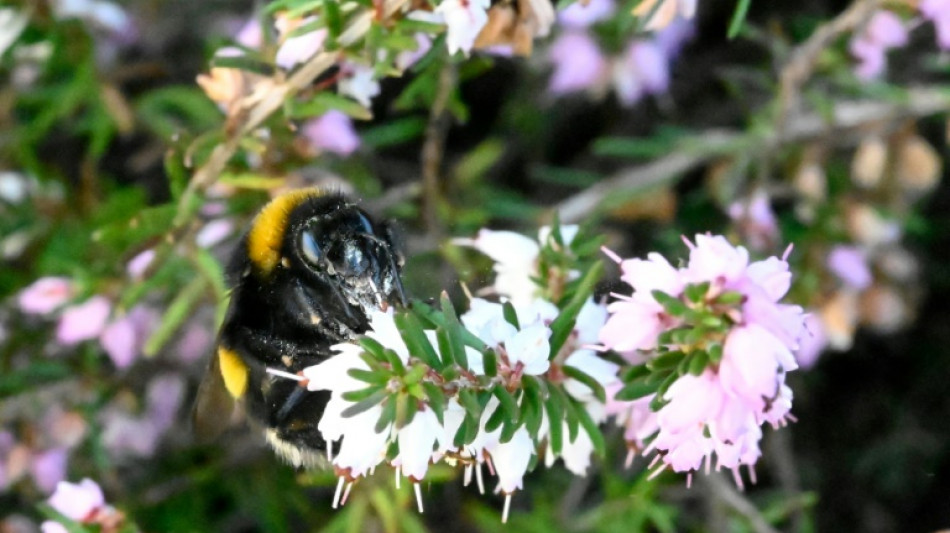
Small bees better at coping with warming, bumblebees struggle: study / Photo: © AFP/File

Small bees better at coping with warming, bumblebees struggle: study

Climate change could lead to more small-bodied bees but fewer bumblebees, according to research published Wednesday, warning of potential "cascading" effects on plant pollination and across whole ecosystems.

Text size:

Scientists in the United States trapped and studied more than 20,000 bees over eight years in an area of the Rocky Mountains to find out how different types of bees reacted to changing climatic conditions.

The authors said that while environmental conditions varied from year to year, the sub-alpine region from which they took samples is "particularly vulnerable to climate change", with generally warming spring temperatures and earlier snow melt.

They found that comb-building cavity nesters and larger bodied bees declined in abundance as temperatures increased, while smaller, soil-nesting bees increased.

"Our research suggests that climate-induced changes in temperature, snowpack and summer precipitation may drastically reshape bee communities," the authors said.

- Bumblebees 'more threatened' -

Researchers said the findings suggest a reduction of bigger bees, including in the families of bumblebee, leafcutters and mason bees, with higher temperatures.

Declines were particularly marked for bumblebees, which the researchers said suggests "this group is more threatened under climate warming than other bees in our system".

That tallies with other studies showing that bumblebees, the dominant pollinators in many ecosystems, have a lower heat tolerance than other bees and move to cooler regions at higher altitudes as temperatures warm.

Researchers said their findings suggest both bumblebees' body size and nest behaviour could also make them more vulnerable in a warming world.

In general, the authors said climate-driven changes to pollinator communities "could have cascading effects on pollination and ecosystem functioning".

For example, they said losing bigger bees, which tend to fly further for food, may mean a reduction in longer-distance pollination.

The study, published in the journal Proceedings of the Royal Society B, was specifically focused on mountainous areas, but the researchers said other research across the US showed declines in larger bees in response to environmental changes.

They did however say their findings that drier conditions favoured bees with specialist diets may not be applicable to other ecosystems, where climate change is expected to bring more rainfall.

Insects are the world's top pollinators -- 75 percent of 115 top global food crops depend on animal pollination, including cocoa, coffee, almonds and cherries, according to the UN.

In a landmark 2019 report, scientists concluded that nearly half of all insect species worldwide are in decline and a third could disappear altogether by century's end.

One in six species of bees have gone regionally extinct somewhere in the world.

The main drivers of extinction are thought to be habitat loss and pesticide use.

J.Ayala--TFWP