'Mystery' boson finding contradicts understanding of universe

After a decade of meticulous measurements, scientists announced Thursday that a fundamental particle -- the W boson -- has a significantly greater mass than theorised, shaking the foundations of our understanding of how the universe works.
Those foundations are grounded by the Standard Model of particle physics, which is the best theory scientists have to describe the most basic building blocks of the universe, and what forces govern them.
The W boson governs what is called the weak force, one of the four fundamental forces of nature, and therefore a pillar of the Standard Model.
However new research published in the Science journal said that the most precise measurement ever made of the W Boson directly contradicts the model's prediction.
Ashutosh Kotwal, a physicist at Duke University who led the study, told AFP that the result had taken more than 400 scientists over 10 years to scrutinise four million W boson candidates out of a "dataset of around 450 trillion collisions".
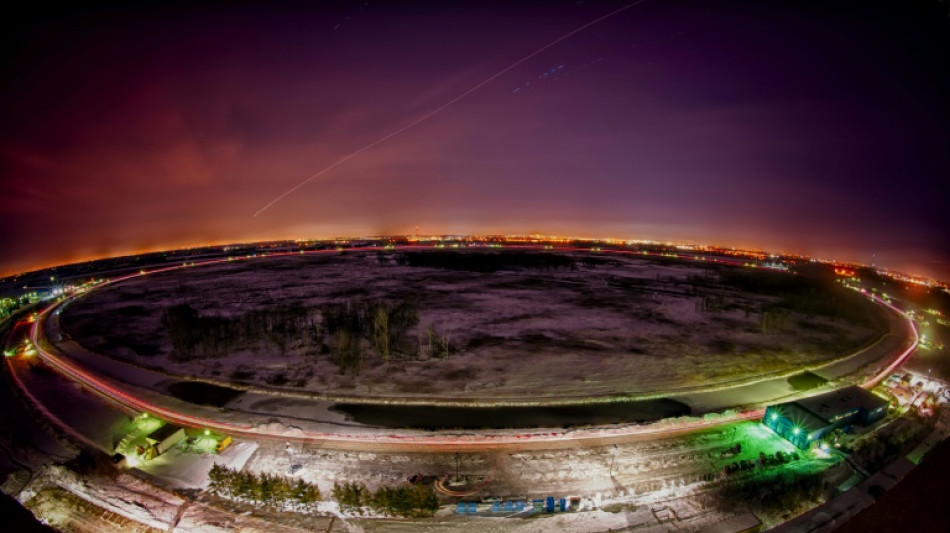
These collisions -- made by smashing particles together at mind-bending speeds to study them -- were done by the Tevatron collider in the US state of Illinois.
It was the world's highest-energy particle accelerator until 2009, when it was supplanted by the Large Hadron Collider near Geneva, which famously observed the Higgs boson a few years later.
The Tevatron stopped running in 2011, but the scientists at the Collider Detector at Fermilab (CDF) have been crunching numbers ever since.
- 'Fissures' in the model -
Harry Cliff, a particle physicist at Cambridge University who works at the Large Hadron Collider, said the Standard Model is "probably the most successful scientific theory that has ever been written down".
"It can make fantastically precise predictions," he said. But if those predictions are proved wrong, the model cannot merely be tweaked.
"It's like a house of cards, you pull on one bit of it too much, the whole thing comes crashing down," Cliff told AFP.
The standard model is not without its problems.
For example, it doesn't account for dark matter, which along with dark energy is thought to make up 95 percent of the universe. It also says that the universe should not have existed in the first place, because the Big Bang ought to have annihilated itself.
On top of that, "a few fissures have recently been exposed" in the model, physicists said in a companion Science article.
"In this framework of clues that there are missing pieces to the standard model, we have contributed one more, very interesting, and somewhat large clue," Kotwal said.
Jan Stark, physicist and director of research at the French CNRS institute, said "this is either a major discovery or a problem in the analysis of data," predicting "quite heated discussions in the years to come".
He told AFP that "extraordinary claims require extraordinary evidence".
- 'Huge deal' -
The CDF scientists said they had determined the W boson's mass with a precision of 0.01 percent -- twice as precise as previous efforts.
They compared it to measuring the weight of a 350-kilogram (800-pound) gorilla to within 40 grams (1.5 ounces).
They found the boson was different than the standard model's prediction by seven standard deviations, which are also called sigma.
Cliff said that if you were flipping a coin, "the chances of getting a five sigma result by dumb luck is one in three and a half million".
"If this is real, and not some systematic bias or misunderstanding of how to do the calculations, then it's a huge deal because it would mean there's a new fundamental ingredient to our universe that we haven't discovered before," he said.
"But if you're going to say something as big as we've broken the standard model of particle physics, and there's new particles out there to discover, to convince people of that you probably need more than one measurement from more than one experiment."
CDF co-spokesperson David Toback said that "it's now up to the theoretical physics community and other experiments to follow up on this and shed light on this mystery".
And after a decade of measurements, Kotwal isn't done yet.
"We follow the clues and leave no stone unturned, so we'll figure out what this means."
X.Silva--TFWP