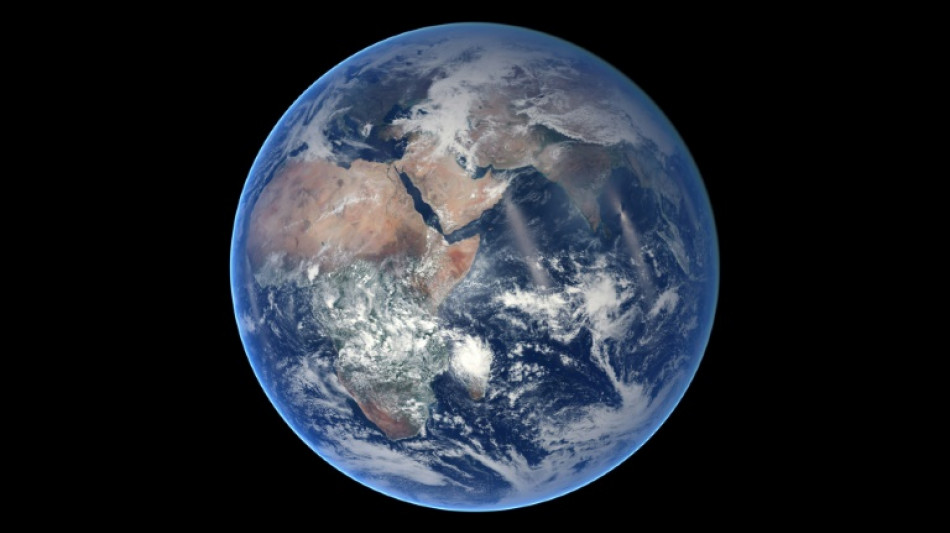
Huge 'blobs' inside Earth are from another planet, study suggests / Photo: © NASA/AFP/File

Scientists proposed a novel idea on Wednesday that could solve two of the world's mysteries at once -- one that passes over our heads every night, and one that sits far below our feet.
The first mystery has puzzled everyone from scientists to inquisitive children for millennia: where did the Moon come from?
The leading theory is that the Moon was created 4.5 billion years ago when a would-be planet the size of Mars smashed into the still-forming Earth.
This epic collision between early Earth and the proto-planet called Theia shot an enormous amount of debris into orbit, which formed what would become the Moon.
Or so the theory goes. Despite decades of effort, scientists have not been able to find any evidence of Theia's existence.
New US-led research, published in the journal Nature, suggests they might have been looking in the wrong direction.
Around 2,900 kilometres (1,800 miles) below Earth's surface, two massive "blobs" have baffled geologists since seismic waves revealed their existence in the 1980s.
These continent-sized clumps of material straddle the bottom of Earth's rocky mantle near its molten core, one below Africa and the other underneath the Pacific Ocean.
Scientists have determined that the blobs are much hotter and more dense that the surrounding rock, but much else about them remains a mystery.
The new research on Wednesday indicates the blobs are "buried relics" of Theia that entered into Earth during their formative collision -- and have been hiding near our planet's heart ever since.
As well as creating the Moon, this collision and the remnants it left behind may have helped Earth become the unique life-hosting planet it is today, the researchers proposed.
- 'Very, very strange' -
Qian Yuan, a geodynamics researcher at the California Institute of Technology and the study's lead author, told AFP it is "very, very strange" that no evidence of the Theia impact has been found.
It was during a class held by a planetary scientist discussing this mystery that Yuan first connected the dots.
"Where is the impactor? My answer is: it's in the Earth," he said.
The planetary scientist holding the class had never heard of the blobs. The research has since required experts in the often separate fields of space and geology to join forces.
Yuan said that when Theia smashed into proto-Earth, it was travelling at more than 10 kilometres (six miles) a second, a speed that allowed some of it to penetrate "very deep into the Earth's lower mantle".
A video developed by the team simulating this process illustrates how clumps of Theia's mantle tens of kilometres wide swirled inside Earth.
As the mostly molten Theia material cooled and solidified, its high level of iron caused it to sink down to the border of Earth's mantle and core, the scientists proposed.
Over the years it accumulated into two separate blobs -- officially called large low-velocity provinces (LLVPs) -- that are now each larger than the Moon, Yuan said.
Testing a theory based so far back in time -- and so deep under Earth -- is incredibly difficult, and Yuan emphasised that their modelling could not be "100 percent" certain.
- 'Why Earth is unique' -
But if true, the implications could be immense.
Earth remains the only planet in the universe known to be capable of supporting life.
The Theia collision, which is believed to be Earth's last major accretion event, significantly changed its composition in just 24 hours, Yuan said.
"My feeling is that this initial condition is why Earth is unique -- why it's different to other rocky planets," he said.
Previous research has suggested that Theia could have brought water, the key ingredient of life, to Earth.
The blobs have been observed sending up "mantle plumes" -- columns of magma -- towards the Earth's surface, and have also been linked to the evolution of supercontinents.
Theia "left something in the Earth -- and that played a role in Earth's subsequent 4.5 billion years of evolution," Yuan said.
Christian Schroeder, an expert in both Earth science and planetary exploration at Scotland's University of Stirling, told AFP the theory "fits several strands of evidence".
"It is a very significant and exciting finding," said Schroeder, who was not involved in the research.
He emphasised that the mystery of the Moon's formation had not been solved.
But the research gives more weight to the Theia impact theory -- and provides "a credible explanation for these anomalies at the core-mantle boundary at the same time," he said.
The remnants of Theia potentially preserved underneath us "may be responsible for important processes on Earth ongoing to this day," Schroeder added.
X.Silva--TFWP