The Fort Worth Press - Mouse embryos grown in space for first time: Japan researchers

USD -
AED 3.672965
AFN 64.999937
ALL 79.92783
AMD 363.497214
ANG 1.790365
AOA 917.000203
ARS 1509.994199
AUD 1.406163
AWG 1.8025
AZN 1.698196
BAM 1.70475
BBD 2.015105
BDT 122.866121
BGN 1.683441
BHD 0.377158
BIF 3009.975725
BMD 1
BND 1.276579
BOB 10.179685
BRL 5.149203
BSD 1.000449
BTN 95.931629
BWP 13.567684
BYN 3.041441
BYR 19600
BZD 2.012246
CAD 1.39873
CDF 2310.000099
CHF 0.824903
CLF 0.024257
CLP 957.789678
CNY 6.706398
CNH 6.70408
COP 3173.27
CRC 447.578413
CUC 1
CUP 26.5
CVE 96.109511
CZK 21.19395
DJF 177.719861
DKK 6.513865
DOP 59.260873
DZD 133.753611
EGP 52.0791
ERN 15
ETB 163.423038
EUR 0.87136
FJD 2.24075
FKP 0.743677
GBP 0.748859
GEL 2.605016
GGP 0.743677
GHS 11.515883
GIP 0.743677
GMD 73.999519
GNF 8795.70108
GTQ 7.633807
GYD 209.2854
HKD 7.84615
HNL 26.85343
HRK 6.564902
HTG 130.759174
HUF 316.168498
IDR 17752
ILS 3.033885
IMP 0.743677
INR 95.81855
IQD 1310.636666
IRR 1374574.999799
ISK 121.459778
JEP 0.743677
JMD 157.885791
JOD 0.708973
JPY 156.019495
KES 129.5598
KGS 87.449769
KHR 4074.837551
KMF 427.99978
KPW 900.000318
KRW 1381.233694
KWD 0.308502
KYD 0.833795
KZT 445.677328
LAK 22408.751171
LBP 89594.128747
LKR 331.841379
LRD 173.581452
LSL 16.298676
LTL 2.95274
LVL 0.60489
LYD 6.355114
MAD 9.52989
MDL 17.564075
MGA 4345.078556
MKD 53.623182
MMK 2099.664815
MNT 3596.851201
MOP 8.084808
MRU 40.080539
MUR 47.659875
MVR 15.410364
MWK 1734.87843
MXN 17.19022
MYR 4.098296
MZN 63.90406
NAD 16.298676
NGN 1330.550042
NIO 36.817998
NOK 9.423535
NPR 153.487582
NZD 1.74491
OMR 0.384502
PAB 1.000458
PEN 3.377685
PGK 4.451379
PHP 62.766502
PKR 277.316313
PLN 3.796545
PYG 5918.423381
QAR 3.647021
RON 4.585203
RSD 102.250976
RUB 84.50144
RWF 1476.267885
SAR 3.713538
SBD 8.000512
SCR 14.20916
SDG 601.495602
SEK 9.824175
SGD 1.27595
SHP 0.746965
SLE 24.63962
SLL 20969.491881
SOS 571.784692
SRD 37.746501
STD 20697.981008
STN 21.354764
SVC 8.754581
SYP 13002.000254
SZL 16.292377
THB 33.297505
TJS 9.229529
TMT 3.5
TND 2.943174
TOP 2.40776
TRY 48.673505
TTD 6.792558
TWD 31.896989
TZS 2653.428004
UAH 44.708507
UGX 3931.959922
UYU 40.225402
UZS 11781.061917
VES 845.45495
VND 26012
VUV 118.307083
WST 2.742913
XAF 571.574595
XAG 0.015244
XAU 0.000229
XCD 2.70255
XCG 1.803158
XDR 0.707052
XOF 571.574595
XPF 103.951572
YER 236.650155
ZAR 16.270025
ZMK 9001.199233
ZMW 19.635051
ZWL 321.999592
SSP 5658.175743
MXV 1.949014
  • RBGPF

    0.0000

    69.99

    0%

  • CMSC

    0.1900

    20.67

    +0.92%

  • RYCEF

    0.4200

    20

    +2.1%

  • BCC

    0.2200

    75.53

    +0.29%

  • GSK

    0.7700

    51.06

    +1.51%

  • BCE

    -0.2200

    22.28

    -0.99%

  • RIO

    2.2500

    98.04

    +2.29%

  • NGG

    1.5700

    77.6

    +2.02%

  • BTI

    -0.0700

    56.02

    -0.12%

  • JRI

    0.1100

    11.61

    +0.95%

  • CMSD

    0.1600

    20.45

    +0.78%

  • RELX

    0.1100

    34.38

    +0.32%

  • VOD

    0.0600

    17.52

    +0.34%

  • AZN

    3.2500

    166.14

    +1.96%

  • BP

    0.0400

    45.42

    +0.09%

Mouse embryos grown in space for first time: Japan researchers
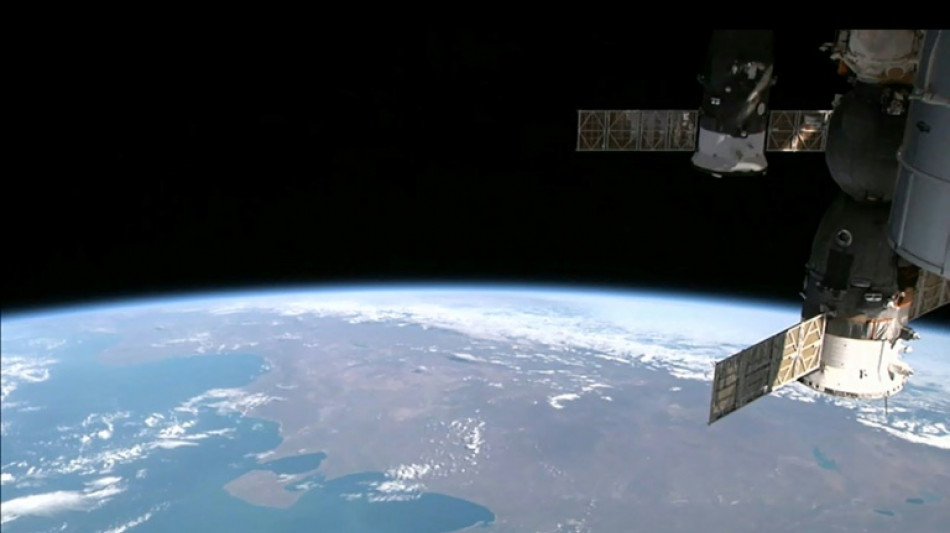
Mouse embryos grown in space for first time: Japan researchers / Photo: © NASA/AFP/File

Mouse embryos grown in space for first time: Japan researchers

Mouse embryos have been grown on the International Space Station and developed normally in the first study indicating it could be possible for humans to reproduce in space, a group of Japanese scientists said.

Text size:

The researchers, including Teruhiko Wakayama, professor of University of Yamanashi's Advanced Biotechnology Centre, and a team from the Japan Aerospace Space Agency (JAXA), sent frozen mouse embryos on board a rocket to the ISS in August 2021.

Astronauts thawed the early-stage embryos using a special device designed for this purpose and grew them on the station for four days.

"The embryos cultured under microgravity conditions developed" normally into blastocysts, cells that develop into the foetus and placenta, the scientists said.

The experiment "clearly demonstrated that gravity had no significant effect," the researchers said in a study that was published online in the scientific journal iScience on Saturday.

They also said there were no significant changes in condition of the DNA and genes, after they analysed the blastocysts that were sent back to their laboratories on Earth.

This is "the first-ever study that shows mammals may be able to thrive in space," University of Yamanashi and national research institute Riken said in a joint statement on Saturday.

It is "the world's first experiment that cultured early-stage mammalian embryos under complete microgravity of ISS," the statement said.

"In the future, it will be necessary to transplant the blastocysts that were cultured in ISS's microgravity into mice to see if mice can give birth" to confirm that the blastocysts are normal, it added.

Such research could be important for future space exploration and colonisation missions.

Under its Artemis programme, NASA plans to send humans back to the Moon in order to learn how to live there long-term to help prepare a trip to Mars, sometime towards the end of the 2030s.

J.P.Estrada--TFWP