Amid NFT boom, artists worry about climate costs

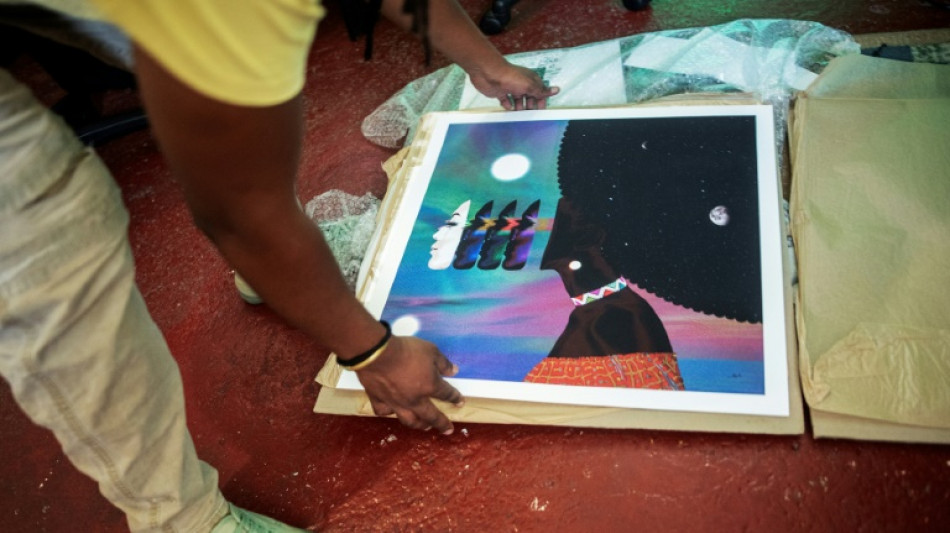
Digital art is nothing new to vonMash, who describes his blend of painting, video and sound as "afro-delic" -- a psychedelic twist on Afrofuturism.
But when the South African started thinking about selling his work as crypto-art on a blockchain, he hesitated.
"I'm not fully for it because of the energy consumption that it takes," he explained.
Selling art as non-fungible tokens, or NFTs, uses the same technology as crypto-currencies like Bitcoin. The buyer receives a verified digital token, which proves the artwork is an original.
The boon for artists is that if their work goes up in value and is resold, they receive a portion of every future sale.
"If another person buys my NFT, I automatically get a share of that," vonMash said. With traditional art, if a buyer pays 100 dollars, and then "sells it for 100,000, I would not get a cent of that."
- Warehouse of computers -
What worries vonMash and other artists is how those digital tokens get verified.
Ownership of the artwork is authenticated through complex mathematical puzzles -- so complex that the calculations require warehouses of computers.
Companies who solve the puzzles get rewarded with new tokens, and their solutions add a "block" to the chain of the authentification.
The number-crunching requires vast amounts of energy, often produced by coal-power electricity plants.
Most NFTs are currently traded on a platform on a called Ethereum. Tech watchdog Digiconomist estimates that Ethereum uses as much electricity as all of the Netherlands, with a carbon footprint comparable to Singapore's.
"The energy it takes for the proof of authentication for the artwork, it’s so much," vonMash said.
He has reason to worry.
Climate concerns have sparked a backlash against NFTs.
K-pop fans in South Korea last year staged a brutal campaign against plans for popular groups include BTS and A.C.E. to sell crypto-art.
"Essentially NFTs are a giant environment-destroying pyramid scheme," read a widely retweeted comment from @ChoicewithACE typical of comments that prompted the group to cancel their offering.
BTS's music label Hybe decided to postpone their launch, looking for greener alternatives.
In South Africa, environmentalism is an unquestioned article of faith among many artists.
One collective called The Tree created a platform for artists to sell NFTs, and then collaborate with a Cape Town charity called Greenpop to plant trees to offset the carbon emited from the crypto-art sales.
- Evolving world -
Fhatuwani Mukheli said that system made him feel confident about the two NFT sales he's already made.
"The world is constantly evolving," he said. "If I just hold on to what I know, then the bus is going to miss me."
For vonMash, the solution was not to sell on Ethereum, but to place his art on a platform called Cardano, which uses a different authentication system.
Rather than have companies solve ever-harder puzzles, Cardano uses a mechanism called "proof of stake".
Instead of earning new tokens by solving puzzles -- and gobbling up electricity -- users can simply pony up tokens they already have.
Essentially, they're using their money in the form of crypto-currency to vouch for the authenticity of a digital artwork.
If someone tries to game the system, or simply makes a mistake, they could lose their financial stake in the network.
The underlying technology can be confusing, but social impact consultant Candida Haynes said "the short story is that there are less environmentally hazardous options for NFTs."
"Ultimately, blockchain developers have to also engage with sustainability and help keep less technical folks, including artists, informed about the state of environmental sustainability in blockchains," she said.
M.T.Smith--TFWP