The Fort Worth Press - Asteroid-smashing NASA probe sent boulders into space

USD -
AED 3.672498
AFN 64.00007
ALL 83.571528
AMD 379.306739
ANG 1.790083
AOA 917.000049
ARS 1394.401798
AUD 1.419557
AWG 1.8
AZN 1.699521
BAM 1.70403
BBD 2.026631
BDT 123.441516
BGN 1.709309
BHD 0.377734
BIF 2983.464413
BMD 1
BND 1.284852
BOB 6.95265
BRL 5.245323
BSD 1.006257
BTN 93.307018
BWP 13.64595
BYN 3.067036
BYR 19600
BZD 2.023756
CAD 1.37396
CDF 2269.999836
CHF 0.792095
CLF 0.023189
CLP 915.629756
CNY 6.87305
CNH 6.904975
COP 3708.35
CRC 469.967975
CUC 1
CUP 26.5
CVE 96.081456
CZK 21.364991
DJF 179.186419
DKK 6.51834
DOP 60.835276
DZD 132.69298
EGP 52.238399
ERN 15
ETB 157.116838
EUR 0.87232
FJD 2.218797
FKP 0.750673
GBP 0.75389
GEL 2.715053
GGP 0.750673
GHS 10.968788
GIP 0.750673
GMD 73.999768
GNF 8818.979979
GTQ 7.707255
GYD 210.505219
HKD 7.835445
HNL 26.6321
HRK 6.573697
HTG 131.875123
HUF 343.269791
IDR 16981
ILS 3.11554
IMP 0.750673
INR 93.274199
IQD 1318.032101
IRR 1314999.999547
ISK 124.920163
JEP 0.750673
JMD 157.992201
JOD 0.709015
JPY 159.103695
KES 129.654127
KGS 87.449827
KHR 4029.54184
KMF 428.000148
KPW 899.987979
KRW 1497.984956
KWD 0.30681
KYD 0.838475
KZT 485.403559
LAK 21591.404221
LBP 90120.825254
LKR 313.313697
LRD 184.128893
LSL 16.795929
LTL 2.952741
LVL 0.60489
LYD 6.420803
MAD 9.415922
MDL 17.543921
MGA 4190.776631
MKD 53.805494
MMK 2099.739449
MNT 3585.842291
MOP 8.123072
MRU 40.161217
MUR 46.509909
MVR 15.46001
MWK 1744.806191
MXN 17.824296
MYR 3.933498
MZN 63.912009
NAD 16.795929
NGN 1362.930023
NIO 37.027516
NOK 9.56597
NPR 149.303937
NZD 1.71902
OMR 0.384497
PAB 1.006169
PEN 3.436114
PGK 4.341518
PHP 60.083966
PKR 281.091833
PLN 3.73276
PYG 6503.590351
QAR 3.658789
RON 4.446602
RSD 102.459011
RUB 86.273875
RWF 1468.813316
SAR 3.755371
SBD 8.04524
SCR 13.624922
SDG 600.999929
SEK 9.389825
SGD 1.282845
SHP 0.750259
SLE 24.649774
SLL 20969.510825
SOS 575.063724
SRD 37.375021
STD 20697.981008
STN 21.350297
SVC 8.803744
SYP 110.528765
SZL 16.800579
THB 32.766985
TJS 9.62383
TMT 3.5
TND 2.960823
TOP 2.40776
TRY 44.320801
TTD 6.820677
TWD 31.91301
TZS 2599.979657
UAH 44.250993
UGX 3785.225075
UYU 40.745194
UZS 12269.740855
VES 450.94284
VND 26300
VUV 119.408419
WST 2.73222
XAF 571.627633
XAG 0.014011
XAU 0.000213
XCD 2.70255
XCG 1.813334
XDR 0.710924
XOF 571.630124
XPF 103.919416
YER 238.575035
ZAR 16.949765
ZMK 9001.21184
ZMW 19.677217
ZWL 321.999592
  • RBGPF

    0.1000

    82.5

    +0.12%

  • CMSC

    -0.1200

    22.83

    -0.53%

  • RYCEF

    -0.2100

    16.6

    -1.27%

  • BCC

    -1.0800

    71.84

    -1.5%

  • VOD

    -0.3800

    14.37

    -2.64%

  • BCE

    -0.2600

    25.75

    -1.01%

  • NGG

    -3.0200

    87.4

    -3.46%

  • CMSD

    0.0100

    22.89

    +0.04%

  • RIO

    -2.0800

    87.72

    -2.37%

  • RELX

    -0.4300

    33.86

    -1.27%

  • JRI

    -0.1370

    12.323

    -1.11%

  • GSK

    -1.3500

    52.06

    -2.59%

  • BP

    0.7600

    44.61

    +1.7%

  • AZN

    -2.8700

    188.42

    -1.52%

  • BTI

    -2.4600

    58.09

    -4.23%

Asteroid-smashing NASA probe sent boulders into space
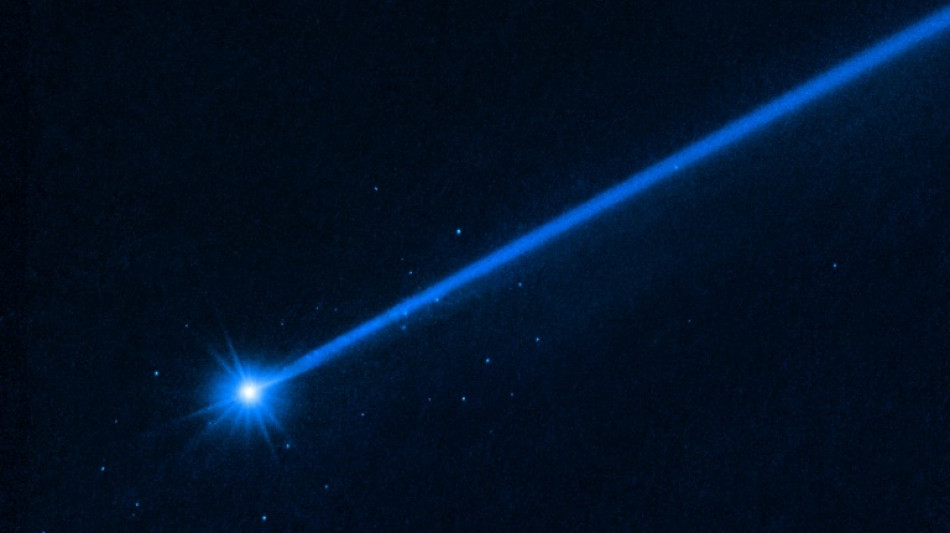
Asteroid-smashing NASA probe sent boulders into space / Photo: © Space Telescope Science Institute/AFP

Asteroid-smashing NASA probe sent boulders into space

When a NASA spacecraft successfully knocked an asteroid off course last year it sent dozens of boulders skittering into space, images from the Hubble telescope showed on Thursday.

Text size:

NASA's fridge-sized DART probe smashed into the pyramid-sized, rugby ball-shaped asteroid Dimorphos roughly 11 million kilometres (6.8 million miles) from Earth in September last year.

The spacecraft knocked the asteroid significantly off course in the first-ever such test of Earth's planetary defences.

New images taken by the Hubble Space Telescope show that the collision also sent 37 boulders -- ranging from one metre (three feet) to seven metres (22 feet) across -- floating into the cosmos.

They represent around two percent of the boulders that were already scattered across the surface of the loosely-held-together asteroid, scientists estimated in a new study.

The finding suggests that possible future missions to divert life-threatening asteroids heading towards Earth could also spray off boulders in our direction.

But these particular rocks do not pose any threat to Earth -- indeed they have barely gone anywhere.

They are drifting away from Dimorphos at around a kilometre (half a mile) per hour -- roughly the speed a giant tortoise walks, Hubble said in a statement.

The boulders are moving so slowly that the European Space Agency's Hera mission -- which is due to arrive at the asteroid in late 2026 to inspect the damage -- will even be able to take a look at them.

"The boulder cloud will still be dispersing when Hera arrives," said David Jewitt, a planetary scientist at the University of California at Los Angeles and lead author of the new study.

"It's like a very slowly expanding swarm of bees," he said.

The "spectacular observation" by Hubble "tells us for the first time what happens when you hit an asteroid and see material coming out," he added.

"The boulders are some of the faintest things ever imaged inside our solar system."

The dispersal of the boulders indicates that DART left a crater roughly 50 metres (160 feet) wide on Dimorphos, according to Jewitt. The whole asteroid is 170 metres across.

The scientists plan to continue following the boulders to work out their trajectory and determine how exactly they launched off the surface.

The study was published in the Astrophysical Journal Letters.

C.M.Harper--TFWP