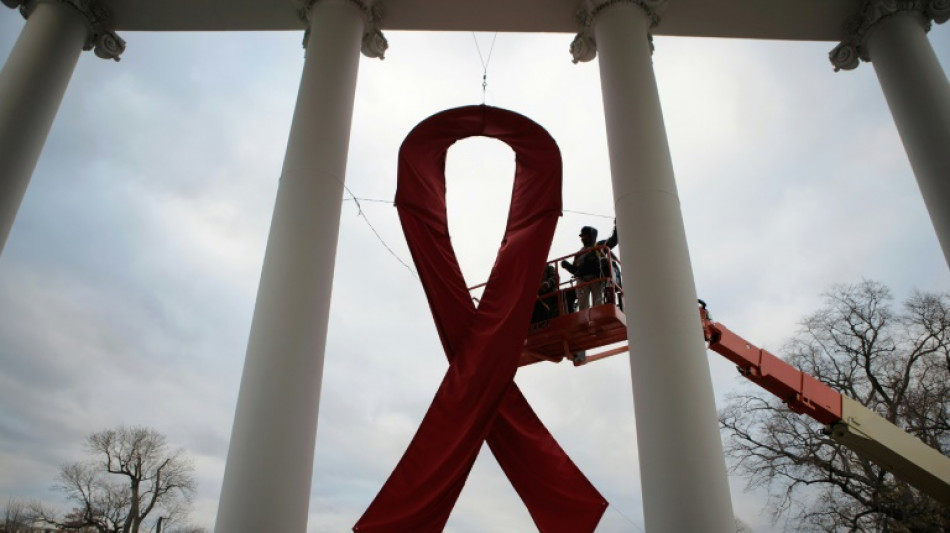
'Geneva patient' the latest in long-term remission from HIV / Photo: © GETTY IMAGES NORTH AMERICA/AFP/File

A man dubbed the "Geneva patient" is the latest person with HIV to be declared in long-term remission -- however he did not receive a transplant with a virus-blocking gene mutation like previous cases, researchers said Thursday.
Five people have previously been considered "cured" of HIV: the Berlin, London, Duesseldorf, New York and City of Hope, California patients.
All had bone marrow transplants to treat serious cases of cancer, receiving stem cells from a donor with a mutation of the CCR5 gene. This mutation is known to block HIV from entering the body's cells.
In 2018, the Geneva patient similarly received a stem cell transplant to treat a particularly aggressive form of leukaemia.
But this time the transplant came from a donor who did not carry the CCR5 mutation, French and Swiss researchers told a press conference in the Australian city of Brisbane as part of an AIDS conference that begins at the weekend.
This means that the virus is still able to enter the patient's cells.
However, 20 months after the man stopped taking antiretroviral treatment -- which reduces the amount of HIV in the blood -- doctors at Geneva University Hospitals have not found a trace of the virus in his system, the researchers said.
While they cannot rule out that the man's HIV will return, the researchers said they consider him to be in long-term remission.
"What is happening to me is magnificent, magical," the Geneva patient said in a statement.
The patient, a white man who chose not to be named, was diagnosed with HIV in 1990.
He had been on antiretrovirals until November 2021, when his doctors advised him to stop taking the treatment after the bone marrow transplant.
- 'Promising' -
Two previous cases, known as the Boston patients, had also received normal or "wild type" stem cells during their transplants. But in both cases, HIV returned a few months after they stopped taking antiretrovirals.
Asier Saez-Cirion, a scientist at France's Pasteur Institute who presented the Geneva patient case in Brisbane, told AFP that if there was still no sign of the virus after 12 months "the probability that it will be undetectable in the future increases significantly".
There were a couple of possible explanations for why the Geneva patient remains HIV free, Saez-Cirion said.
"In this specific case, perhaps the transplant eliminated all the infected cells without the need for the famous mutation," he said.
"Or maybe his immunosuppressive treatment, which was required after the transplant, played a role."
Sharon Lewin, the president of the International AIDS Society holding the HIV science conference in Brisbane, said the case was "promising".
"But we learned from the Boston patients that even a single" particle of the virus can lead to HIV rebounding, she cautioned.
"This particular individual will need to be watched closely over the next months and years."
While these cases of long-term remission raise hopes that one day HIV can truly be cured, the brutal and risky bone marrow transplant procedure is not an option for the millions of people living with the virus around the world.
It is instead a last-ditch attempt to treat life-threatening cancer in people who also have HIV.
However, there are hopes that the remission cases could point towards new avenues of research, such as the potential role played by immunosuppressive treatments.
Saez-Cirion said the case had also encouraged the researchers to continue studying innate immune cells, which act as the first line of defence against various pathogens, and could help control the virus.
For his part, the Geneva patient said he was now "looking to the future".
M.T.Smith--TFWP