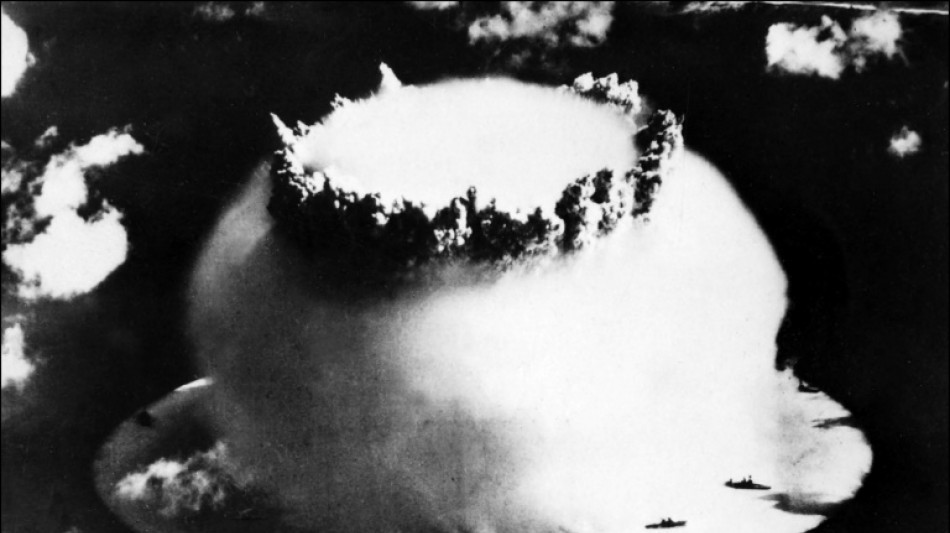
Signs of the human era, from nuclear fallout to microplastics / Photo: © US Defense Nuclear Agency/AFP/File

As scientists make the case that humans have fundamentally transformed the planet enough to warrant our own geological epoch, another question arises: is there anything left untouched by humanity's presence?
Soaring greenhouse gases, ubiquitous microplastics, pervasive "forever chemicals", the global upheaval of animals, even old mobile phones and chicken bones -- all have been put forward as evidence that the world entered the Anthropocene, or era of humans, in the mid-20th century.
Jan Zalasiewicz, a British geologist who chaired the Anthropocene Working Group for over a decade, paused for a moment when asked if there was anywhere on Earth that lacked signs of human influence.
"It's hard to think of a more remote place" than the Pine Island glacier in Antarctica, Zalasiewicz told AFP.
Yet when scientists drilled deep below the glacier's ice a few years ago, they found traces of plutonium.
It was lingering fallout from nuclear weapon tests that began in 1945, leaving behind a radioactive presence unlike anything before.
Zalasiewicz said these radionuclides represented perhaps "the sharpest signal" to mark the start of the Anthropocene epoch 70 years ago.
But "there's an awful lot to choose from," he added.
On Tuesday, the Anthropocene Working Group is expected to announce its choice for the epoch's "golden spike" location, selecting the site that most clearly represents the many ways humans have changed the world.
However the announcement will not make the Anthropocene an official geological time unit just yet, as the world's geologists continue to sift through the evidence.
- The weight of humanity -
Another major calling card of the Anthropocene will likely come as little surprise: the rapid surge in carbon dioxide and other greenhouse gases that are heating the world.
Many things changed "once humans developed the technology to pull fossilised sunshine -- in the form of oil, coal and gas -- out of the ground," Zalasiewicz said.
Humans have consumed more energy since 1950 than was used in the previous 11,700 years of the Holocene epoch, the Anthropocene scientists have shown.
This new power was used to dominate the world in a way not previously possible. Both land and animals were deployed to feed the exploding human population.
Humans and their livestock make up 96 percent of the biomass of all land mammals on the planet, with wild mammals representing just four percent, researchers estimated in 2018.
Supermarket chickens, bred by humans to grow far larger than natural, account for two thirds of the biomass of all birds, Zalasiewicz said.
Humans also reshuffled species across the globe, introducing invasive species such as rats to even the most remote Pacific islands.
- Technofossils, forever chemicals -
In 2020, researchers estimated that the mass of all objects made by humans has now exceeded the weight of all living things on the planet.
The Anthropocene researchers called these objects "technofossils".
Successive generations of mobile phones, which so quickly become obsolete, were just one example of a technofossil that will "be part of the Anthropocene record," Zalasiewicz said.
Smaller pieces of plastic called microplastics have been detected on the planet's highest peaks and at the bottom of the deepest oceans.
Substances called PFAS or "forever chemicals," created for products such as non-stick cookware, are also being increasingly identified across the world.
Pesticides, fertilisers, increasing levels of nitrogen of phosphorus, even the buried skeletons of humans -- the list of potential Anthropocene markers goes on.
The scientists say that hundreds of thousands of years into the future, all of these markers will be clearly preserved to give our future ancestors -- or any other beings who care to look -- insight into this human era.
But what will this future geologist see happen next?
"One of the signals that you would want to see from the Anthropocene is humanity responding in a positive way," said Mark Williams, a British palaeontologist and member of the Anthropocene Working Group.
The fossil record does not yet show a mass extinction, but one "is now very much on the cards," he told AFP.
"We go two ways from here," he added.
So is there somewhere left on Earth that does not bear a human fingerprint?
The scientists agreed that the only such place was likely somewhere under the ice in Antarctica.
But if nothing changes, these ice sheets will be steadily melted by global warming, Zalasiewicz warned.
J.Barnes--TFWP