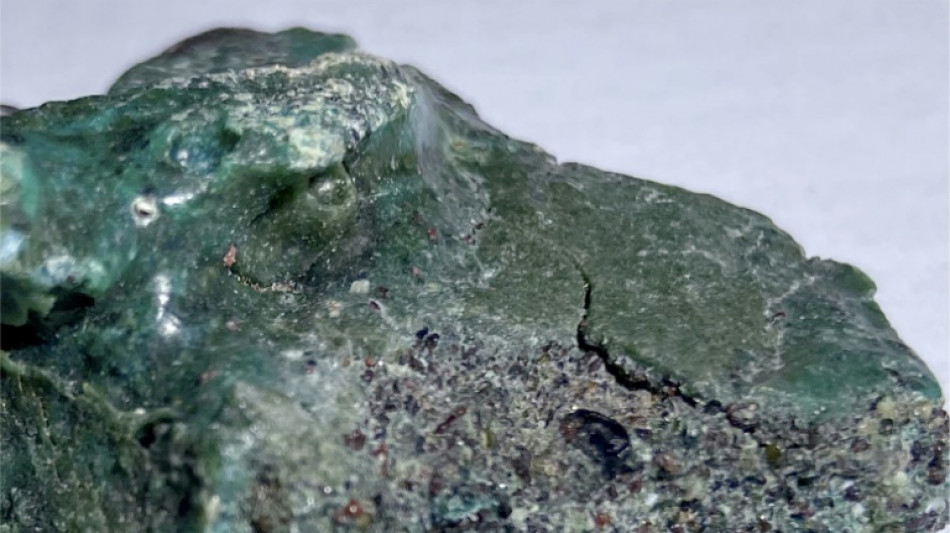
Scientists make 'disturbing' find on remote island: plastic rocks / Photo: © Parana Federal University/AFP

There are few places on Earth as isolated as Trindade island, a volcanic outcrop a three- to four-day boat trip off the coast of Brazil.
So geologist Fernanda Avelar Santos was startled to find an unsettling sign of human impact on the otherwise untouched landscape: rocks formed from the glut of plastic pollution floating in the ocean.
Santos first found the plastic rocks in 2019, when she traveled to the island to research her doctoral thesis on a completely different topic -- landslides, erosion and other "geological risks."
She was working near a protected nature reserve known as Turtle Beach, the world's largest breeding ground for the endangered green turtle, when she came across a large outcrop of the peculiar-looking blue-green rocks.
Intrigued, she took some back to her lab after her two-month expedition.
Analyzing them, she and her team identified the specimens as a new kind of geological formation, merging the materials and processes the Earth has used to form rocks for billions of years with a new ingredient: plastic trash.
"We concluded that human beings are now acting as a geological agent, influencing processes that were previously completely natural, like rock formation," she told AFP.
"It fits in with the idea of the Anthropocene, which scientists are talking about a lot these days: the geological era of human beings influencing the planet's natural processes. This type of rock-like plastic will be preserved in the geological record and mark the Anthropocene."
- Island paradise -
The finding left her "disturbed" and "upset," said Santos, a professor at the Federal University of Parana, in southern Brazil.
She describes Trindade as "like paradise": a beautiful tropical island whose remoteness has made it a refuge for all sorts of species -- sea birds, fish found only there, nearly extinct crabs, the green turtle.
The only human presence on the South Atlantic island is a small Brazilian military base and a scientific research center.
"It's marvelous," she said.
"So it was all the more horrifying to find something like this -- and on one of the most ecologically important beaches."
She returned to the island late last year to collect more specimens and dig deeper into the phenomenon.
Continuing her research, she found similar rock-like plastic formations had previously been reported in places including Hawaii, Britain, Italy and Japan since 2014.
But Trindade island is the remotest place on the planet they have been found so far, she said.
She fears that as the rocks erode, they will leach microplastics into the environment and further contaminate the island's food chain.
- 'Paradigm shift' -
She and her team's study, published in September in the journal Marine Pollution Bulletin, classified the new kind of "rocks" found worldwide into several types: "plastiglomerates," similar to sedimentary rocks; "pyroplastics," similar to clastic rocks; and a previously unidentified type, "plastistones," similar to igneous rocks formed by lava flow.
"Marine pollution is provoking a paradigm shift for concepts of rock and sedimentary deposit formations," her team wrote.
"Human interventions are now so pervasive that one has to question what is truly natural."
The main ingredient in the rocks Santos discovered was remnants of fishing nets, they found.
But ocean currents have also swept an abundance of bottles, household waste and other plastic trash from around the world to the island, she said.
Santos said she plans to make the topic her main research focus.
Trindade "is the most pristine place I've ever seen," she said.
"Seeing how vulnerable it is to the trash contaminating our oceans shows how pervasive the problem is worldwide."
W.Lane--TFWP