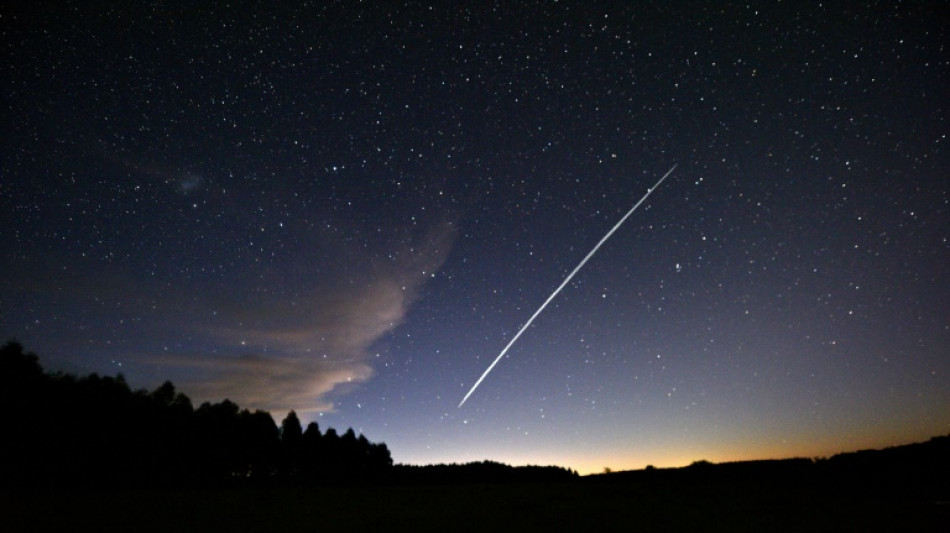
Astronomers sound alarm about light pollution from satellites / Photo: © AFP/File

Astronomers on Monday warned that the light pollution created by the soaring number of satellites orbiting Earth poses an "unprecedented global threat to nature."
The number of satellites in low Earth orbit have more than doubled since 2019, when US company SpaceX launched the first "mega-constellation," which comprise thousands of satellites.
An armada of new internet constellations are planned to launch soon, adding thousands more satellites to the already congested area fewer than 2,000 kilometres (1,250 miles) above Earth.
Each new satellite increases the risk that it will smash into another object orbiting Earth, creating yet more debris.
This can create a chain reaction in which cascading collisions create ever smaller fragments of debris, further adding to the cloud of "space junk" reflecting light back to Earth.
In a series of papers published in the journal Nature Astronomy, astronomers warned that this increasing light pollution threatens the future of their profession.
In one paper, researchers said that for the first time they had measured how much a brighter night sky would financially and scientifically affect the work of a major observatory.
Modelling suggested that for the Vera Rubin Observatory, a giant telescope currently under construction in Chile, the darkest part of the night sky will become 7.5 percent brighter over the next decade.
That would reduce the number of stars the observatory is able to see by around 7.5 percent, study co-author John Barentine told AFP.
That would add nearly a year to the observatory's survey, costing around $21.8 million, said Barentine of Dark Sky Consulting, a firm based in the US state of Arizona.
He added that there is another cost of a brighter sky that impossible to calculate: the celestial events that humanity will never get to observe.
And the increase in light pollution could be even worse than thought.
Another Nature study used extensive modelling to suggest that current measurements of light pollution are significantly underestimating the phenomenon.
- 'Stop this attack' -
The brightening of the night sky will not just affect professional astronomers and major observatories, the researchers warned.
Aparna Venkatesan, an astronomer at the University of San Francisco, said it also threatened "our ancient relationship with the night sky".
"Space is our shared heritage and ancestor -- connecting us through science, storytelling, art, origin stories and cultural traditions -- and it is now at risk," she said in a Nature comment piece.
A group of astronomers from Spain, Portugal and Italy called for scientists to "stop this attack" on the natural night.
"The loss of the natural aspect of a pristine night sky for all the world, even on the summit of K2 or on the shore of Lake Titicaca or on Easter Island is an unprecedented global threat to nature and cultural heritage," the astronomers said in a Nature comment piece.
"If not stopped, this craziness will become worse and worse."
The astronomers called for drastically limiting mega-constellations, adding that "we must not reject the possibility of banning them.""
They said that it was "naive to hope that the skyrocketing space economy will limit itself, if not forced to do so," given the economic interests at stake.
X.Silva--TFWP